Protesters call for end to French rioting

POLICE tightened security in central Paris yesterday with riot forces and bomb squads placed along the Champs-Elysees.

Meanwhile, the angry residents of riot-torn suburbs staged a sit-in near the Eiffel Tower, calling for an end to more than two weeks of arson and vandalism across France.

The moves came as the wave of violence that spread outward from Paris’s impoverished outlying neighbourhoods appeared to be calming in other French cities but remained persistent in the capital.

“Stop the Violence,” read one banner draped on the Wall of Peace near the Eiffel Tower. Some of the 200 demonstrators - a small turnout in protest-friendly France - waved white flags.

The dozens of civic groups timed their demonstrations to coincide with official military commemorations for Armistice Day, marking the end of World War One.

Hours before the sit-in, bomb squad police with dogs and metal-detecting wands screened spectators as a military parade processed down the famed Paris avenue.

“Today, we don’t want an armistice - we want peace,” national police chief Michel Gaudin said.

Police blocked off large swaths of central Paris, with trucks of riot police also deployed near the presidential palace. Some 715 officers brought in from other districts raised the full deployment to 2,220.

Paris police announced a ban from this morning to Sunday morning on public gatherings that “could provoke or encourage disorder”.

The police statement cited concerns about a string of mobile phone or internet messages - methods neighbourhood youths have used to organise themselves during the riots - calling for gatherings and urging “violent actions” in the French capital.

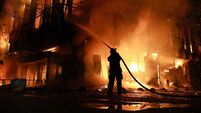
Thursday, a 15th consecutive night of violence, saw fewer skirmishes and fewer cars burned - 463, down from 482 the previous night, police said.

Among the few buildings hit was a village banquet hall vandalised and burned in the south-eastern Drome region, officials said.

France’s foreign minister, speaking in Ukraine after meeting his counterpart, also said yesterday that order had been restored in “most cities”.

“The situation is being stabilised,” Philippe Douste-Blazy said in Kiev.

The mayhem sweeping neglected and impoverished neighbourhoods with large African and Arab communities has forced France to confront anger building for decades among residents who complain of discrimination and unemployment. Although many of the French-born children of Arab and black African immigrants are Muslim, police say the violence is not being driven by Islamic groups.

President Jacques Chirac acknowledged on Thursday that France must confront the social inequalities and prejudice that has fuelled the violence - France’s worst since the 1968 student-worker uprising.

“Whatever our origins, we are all the children of the Republic, and we can all expect the same rights.”

The first night of violence on October 27 was touched off by youths angered by the accidental deaths of two teenagers who believed they were being chased by police. The teenagers hid in a power substation and were electrocuted.

Rioting swiftly spread from the north-eastern suburban Paris town of Clichy-sous-Bois and grew into a nationwide wave of arson and nightly clashes between youths armed with firebombs and police retaliating with tear gas.

The Justice Ministry said yesterday that 398 people have been jailed since the violence began.

Bursts of similar violence have erupted in places like neighbouring Germany and Belgium, in what authorities believe may be copycat attacks.

In Athens, Greece, about 70 youths carrying clubs laid siege yesterday to the entrance of the French Institute to express support for the youths in France.

Police on Thursday suspended eight officers, two of them who allegedly beat a man who was detained, causing “superficial lesions” on the forehead and the right foot, the Interior Ministry said.

More in this section

Cookie Policy Privacy Policy Brand Safety FAQ Help Contact Us Terms and Conditions

© Examiner Echo Group Limited