Militant signals raise hopes of Mideast ceasefire
Cabinet secretary Hassan Abu Libdeh said he is confident Israel and the Palestinians can halt three years of fighting very soon.
Whether a ceasefire can hold, he warned, will depend largely on Israel. Prime Minister Ahmed Qureia, hopes to reach a ceasefire as a first step of resuming talks on the US-backed "road map" peace plan, which envisions full Palestinian independence by 2005. The plan has stalled amid violence and Palestinian political wrangling.
"The Palestinian factions are giving us very positive indications," Mr Abu Libdeh said. "I think that if Israel does not play around with us they are willing to go as far as possible but it is all in Israel's hands."
Mr Qureia said yesterday that the truce talks with the militants would begin soon after the arrival tomorrow of Egyptian intelligence chief Omar Suleiman. The Egyptian, who has helped mediate past ceasefires, is coming to assist Mr Qureia in talks with Hamas and Islamic Jihad.
It was unclear whether the two groups, responsible for dozens of suicide bombings over the past three years, would participate.
Hamas West Bank spokesman Adnan Asfour said his group would weigh a truce, but only if Israel agreed to stop its attacks. If so, he said, "we will consider it seriously". He said Mr Suleiman had contacted Hamas leaders abroad.
Mr Qureia hopes to persuade Islamic militant groups to end attacks against Israel as a first step toward securing an Israeli-Palestinian ceasefire. A ceasefire also could strengthen Mr Qureia, whose government was sworn into office last week. An earlier truce collapsed over the summer in a fresh wave of bloodshed.
The earlier ceasefire was declared unilaterally by the militant groups. Yesterday, Hamas's political leader, Khaled Mashaal, said his group would only consider ending the violence if Israel reciprocates.
"If you can stop [Israel's] aggression and get an initiative from it and from America, then come to the Palestinian resistance and we will study it," Mr Mashaal said in Beirut, Lebanon.
But Israel has not said whether it would agree to halt its military operations. Israeli officials have said they must continue acting against what they term "ticking bombs" although critics say the term has been defined so broadly as to justify some actions seen by the Palestinians as provocations.
Mr Qureia and Israeli Prime Minister Ariel Sharon have been preparing for a possible summit in the coming days to discuss the road map.
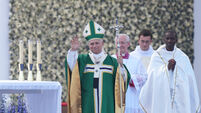
Meanwhile, Nobel peace laureate Elie Wiesel criticised Pope John Paul II for condemning Israel's building of a West Bank security barrier in an interview with an Italian newspaper which coincided with the start of a visit by Mr Sharon.
"I really expected something different from the spiritual leader of one of the biggest religions in the world," the daily Corriere della Sera quoted the Jewish writer as saying yesterday.
Wiesel accused the Pope of meddling in politics, saying it would have been better it he had issued "a declaration which condemns terror and the murder of innocents, without mixing political considerations, and above all without comparing them with a work of self-defence".
"Politicising terrorism like that is mistaken. The authors of the carnage in Istanbul did not murder because of the wall, but because they hate Jews. The pope should have understood this and condemned it," said Auschwitz death camp survivor Wiesel.
The writer backed the building of the barrier, over which Israel has come in for massive international criticism.
"What distinguishes it from terrorism is that separation does not cause the death of someone and what's more, it has saved many lives.
"In recent years, the Pope has worked ceaselessly to fight anti-Semitism in all its forms. But precisely because of this, a man in his position, knowing the weight of his words, should have been more careful and specifically condemned terrorism," the writer said.
During his traditional Angelus address on Sunday, the leader of the Roman Catholic Church criticised the barrier.
CONNECT WITH US TODAY



Be the first to know the latest news and updates