Suicide bomber kills 39 in market blast

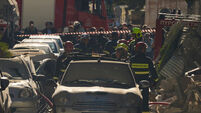
A SUICIDE bomber and a car bomb ripped apart a market yesterday in a Shi’ite slum in Baghdad, killing at least 39 people and wounding more than 100.

The carnage came shortly after Iraqi politicians decided to convene parliament three days earlier than planned, suggesting some progress in efforts to form a unity government.

The death toll in Sadr City was sure to rise as residents, many firing Kalashnikov rifles into the air, raced to and fro to collect charred corpses from among burning vehicles and shops. Angry residents kicked the head of the suicide bomber, apparently an African, as it lay in the street of the al-Hay market in the East Baghdad neighbourhood.

It was the second major attack targeting members of the Shi’ite majority in less than three weeks. On February 22, the bombing of a revered Shi’ite shrine in the mostly Sunni city of Samarra, triggered a wave of reprisal attacks against Sunnis that pushed Iraq to the brink of civil war.

Before the deadly blast in Sadr City bomb blasts, rocket and gunfire killed at least 12 people (10 in Baghdad) and wounded 27 yesterday.

On March 4, General John Abizaid, chief of the US Central Command predicted just such an attack by terrorists trying to spark an all-out civil war.

“I expect we’ll see another attack in the near future on another symbol. They’ll find some other place that’s undefended, they’ll strike it and they’ll hope for more sectarian violence,” the general said after a two-day visit to Baghdad.

He was speaking after the February 22 bombing of a Shi’ite shrine in Samarra that set in motion more than a week of sectarian violence in which hundreds of people were killed in revenge attacks. Dozens of Sunni mosques were damaged or destroyed.

“The shrine bombing exposed a lot of sectarian fissures that have been apparent for a while, but it was the first time I’ve seen it move in a direction that was unhelpful to the political process,” Abizaid said at the time. “It shows that we need a government of national unity to emerge in Iraq. Too many delays in the formation of a national unity government will negatively affect the security situation.”

US Ambassador Zalmay Khalilzad met with leaders of Iraq’s main ethnic and religious blocs in a bid to broker the end of a stalemate over the formation of a unity government Washington hopes can stabilise the country so its troops can begin going home in the summer.

President Jalal Talabani, a Kurd, stood by Shi’ite leader Adbul-Aziz al-Hakim and other Kurdish, Sunni Arab and secular leaders to make the announcement about the parliament, telling reporters that meetings would continue daily until there is accord on key government positions and other issues.

More in this section

Cookie Policy Privacy Policy Brand Safety FAQ Help Contact Us Terms and Conditions

© Examiner Echo Group Limited