May Day protests held across the world amid rising energy costs due to Iran war
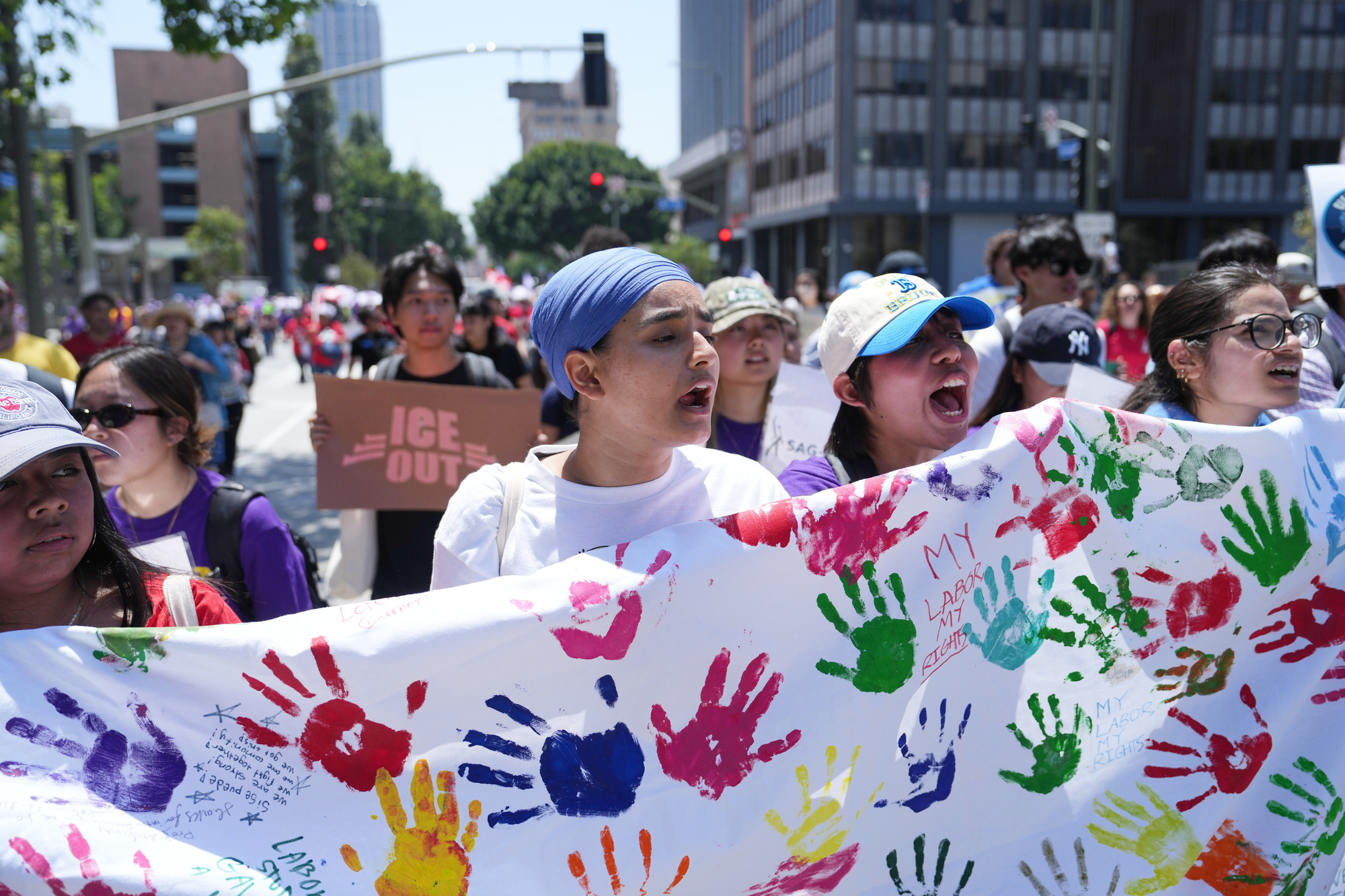
Activists worldwide have held May Day rallies and street protests, calling for peace, higher wages and better working conditions.
The protests were held as many workers grapple with rising energy costs and shrinking purchasing power tied to the Iran war.
May 1 is a public holiday in many countries to mark International Workers’ Day, or Labour Day, when unions traditionally rally around wages, pensions, inequality and broader political issues.

Demonstrations were held from Seoul, Sydney and Jakarta to many European capitals. In the US, activists opposing President Donald Trump’s policies also held marches and boycotts.
“Working people refuse to pay the price for Donald Trump’s war in the Middle East,” said the European Trade Union Confederation, which represents 93 trade union organisations in 41 European countries. “Today’s rallies show working people will not stand by and see their jobs and living standards destroyed.”
Rising living costs linked to the conflict in the Middle East emerged as a key theme in Friday’s rallies.

In the Philippine capital, Manila, large crowds denounced the US role in the Iran war. Protesters clashed with police blocking the way near the US embassy.
On a main avenue in Casablanca, Morocco’s largest city, taxi drivers honked their horns and bus drivers parked their vehicles to protest against rising fuel costs.
“All my expenses have gone up, but my wages haven’t budged,” said Akherraz Lhachimi, of the Moroccan Labour Union.
Turkish authorities in Istanbul detained hundreds of demonstrators for attempting to march in areas declared off-limits on security grounds, most notably the central Taksim Square, the epicentre of 2013 protests. May Day rallies in Turkey are frequently marred by clashes with authorities.

Tens of thousands of people crowded into a public square across from the US embassy in Havana, celebrating Cuba’s workers and decrying US sanctions. Many held banners that read, “Down with Imperialism” and “US hands off Cuba”. President Miguel Diaz-Canel and former president Raul Castro attended.
A demonstration in Santiago, Chile, ended with vandalism and clashes between protesters and police, who used water cannons and tear gas to disperse the crowd.
Other demonstrations in the South American nation were peaceful as thousands of workers took to the streets to demand better working conditions.
Several thousand people gathered across Portugal as unions rallied together to protest against proposed changes to labour laws that would make worker dismissals easier, limit how long breastfeeding women can claim a flexible work schedule and reduce miscarriage bereavement leave, among other things.

Several rallies were staged in South Africa, where the head of the Congress of South African Trade Unions, Zingiswa Losi, said workers were “suffocating” under rising costs of food, electricity, transportation and healthcare.
May Day carries special meaning this year in France, after a heated debate about whether employees should be allowed to work on the country’s most protected public holiday — the only day when most employees have a mandatory paid day off.
Tens of thousands of people joined marches across the country, including in Paris, where brief scuffles with police broke out.
Almost all businesses and shops are closed, and only essential sectors such as hospitals, transport and hotels are exempt.
A recent parliamentary proposal to expand work on the day prompted a major outcry from unions and left-wing politicians.
Faced with the dispute, the government this week introduced a bill that would allow bakeries and florists to open. It is customary in France to give lily of the valley flowers on May Day as a symbol of good luck.

In the United States, where May Day is not a federal holiday, May Day Strong, a coalition of activist groups and labour unions, urged people to protest under the banner of “workers over billionaires” and called for an economic blackout through “no school, no work, no shopping”.
Protesters voiced opposition to Mr Trump’s policies, including his immigration crackdown.
“We’re seeing tons and tons of attacks on working people and on oppressed communities from the Trump administration, both at home and abroad,” said Kathryn Stender, an activist with the Party for Socialism and Liberation who was among thousands at a rally in a Chicago park.
While labour and immigrant rights are historically intertwined, the focus of May Day rallies in the US shifted to immigration in 2006. That is when roughly one million people, including nearly half a million in Chicago alone, took to the streets to protest against federal legislation that would have made living in the US without legal permission a felony.

May Day, or International Workers’ Day, traces back more than a century to a pivotal period in US labour history.
In the 1880s, unions pushed for an eight-hour workday. A Chicago rally in May 1886 turned deadly when a bomb exploded and police responded with gunfire. Several labour activists — most of them immigrants — were convicted of conspiracy and other charges; four were executed.
Unions later designated May 1 to honour workers. A monument in Chicago’s Haymarket Square commemorates them with the inscription: “Dedicated to all workers of the world.”
CONNECT WITH US TODAY



Be the first to know the latest news and updates