The illusion of professionalism - when football system designed to serve children starts serving itself
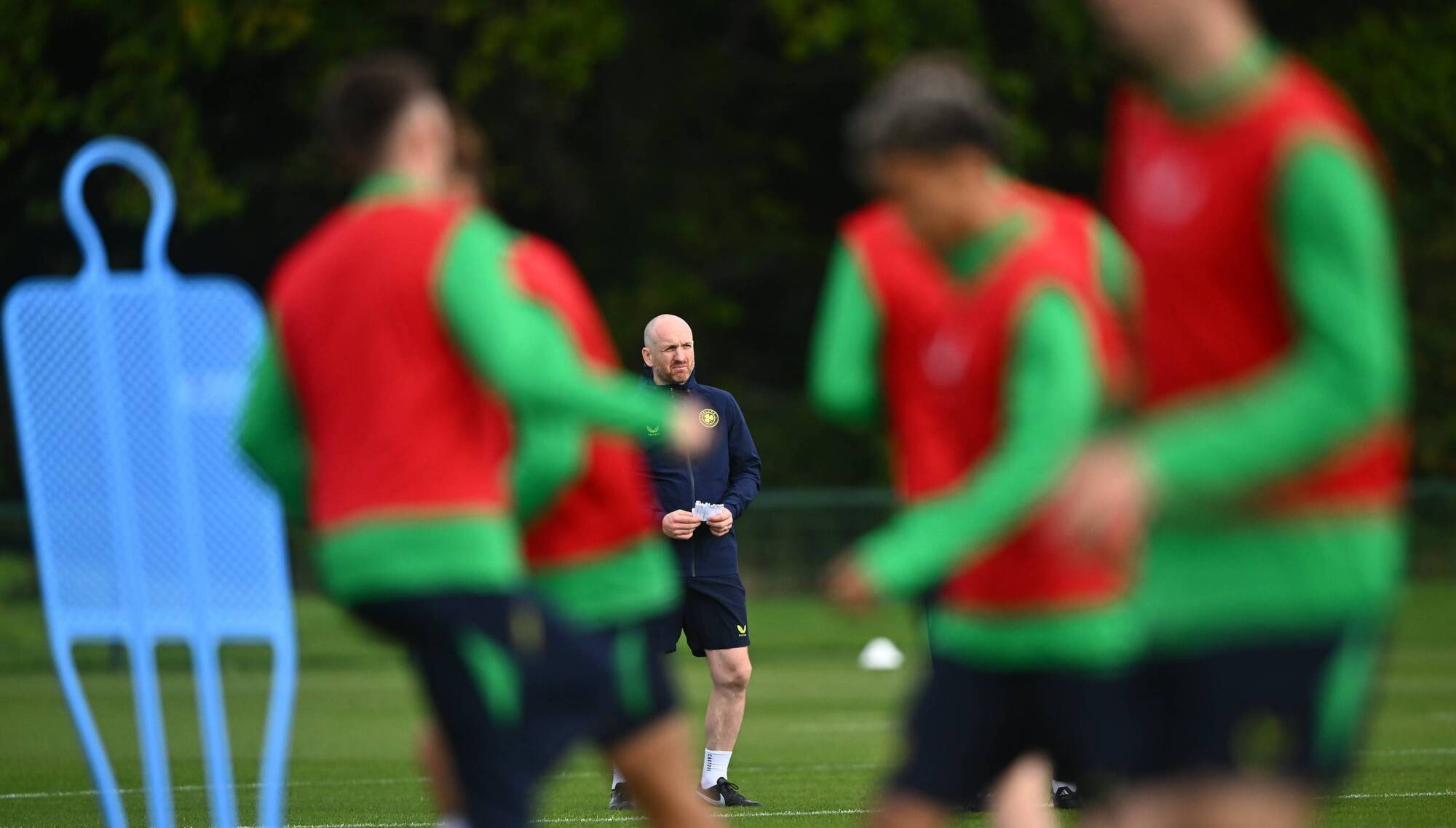
COACHING MATTERS: Assistant coach Stephen O'Donnell during a Republic of Ireland U21 training session at the FAI National Training Centre in Abbotstown. Pic: Piaras Ó Mídheach/Sportsfile
In my previous article, I argued that we need to look beyond the production logic that increasingly shapes the debate around Irish youth football.
Children are too often viewed through an economic lens based on their potential to become elite performers, while the wider cultural, social and developmental value of sport is pushed to the margins.
The response might reasonably be: if the system is not “producing” enough players, surely we need to make it more professional?
There is some truth in this.
Irish football has genuine deficiencies. Facilities are inadequate in many parts of the country, academy and grassroots environments lack resources, and young players have fewer opportunities for structured training than their counterparts in some other football nations.
Even informal opportunities- self-directed play and informal "street sports"- have diminished.
These problems should not be ignored.
But there is a danger in assuming that the answer is simply more professionalisation.
The distinction matters. Professionalism concerns individual conduct: competence, integrity, responsibility and a commitment to ethical practice.
Professionalisation, by contrast, refers to the development of systems, standards and structures intended to ensure that those working in children-youth sport have the knowledge, skills and values required to support the needs of young people.
There is nothing inherently wrong with professionalisation. Indeed, children's sport needs knowledgeable coaches, appropriate safeguarding, good facilities and effective organisations.
The problem begins when professionalisation becomes detached from its purpose.
A youth football system can become increasingly sophisticated administratively while becoming increasingly disconnected from the experience of the child. Academy structures, strategy documents, generic pathways, external consultants, certification systems, databases, performance analysis, talent identification processes and quality-assurance frameworks can all create the appearance of a highly professional system.
But more structure does not automatically mean better development.
This is what I mean by the illusion of professionalism.
We can professionalise the administration of children's football without necessarily professionalising the practice of developing children.
This is particularly relevant to the current Irish debate.
The discussion around our deficiencies increasingly centres on a familiar question: how do we catch up?
Other countries have more academy “contact” hours. They have more full-time coaches. They have better facilities. They identify players earlier. They bring their best players together earlier and more frequently.
Therefore, the logic goes, Ireland needs more of the same.
There are obvious reasons for wanting some of these things. Facilities matter. Coaching matters. Opportunities matter – well, meaningful opportunities matter.
But once the discussion becomes dominated by international benchmarking or so called mythical best practice, something else happens. Development starts to resemble a market in which countries and clubs compete for advantage.
As a side note the concept of "best practice" originated at Xerox in the late 1970s, when Robert C. Camp shifted focus from reverse engineering products to benchmarking company processes. Xerox of course pioneered the photo-copying machine – yes, copy-paste!
If another country trains more, we need to train more.
If another academy identifies talent earlier, we need to identify talent earlier.
If another system has more full-time staff, we need more full-time staff.
The process becomes one of permanent catching up. But catch up to what?
This is where the administrative apparatus can begin to shape the purpose of the system.
Structures that were created to support children can gradually become the things that determine what children's football is understood to be.
Coaches are required to satisfy frameworks. Organisations need to demonstrate compliance. Players are profiled and benchmarked. Development is divided into sequential stages. Progress is about measuring what we can measure. Contact hours become a key indicator of quality.
The administrative tail begins to wag the dog.
The child is no longer simply participating in football. The child becomes part of a pathway. And the pathway acquires its own logic.
More contact time becomes an unquestioned good. Earlier selection becomes evidence of ambition. Bringing the "best with the best" as early as possible becomes synonymous with better development.
But contact time is an opportunity, not an outcome.
Two hours spent in an environment does not have the same developmental meaning as two hours spent in another. What children perceive, experience, explore, decide and learn during those hours matters. So do relationships, motivation, autonomy, family circumstances, school, maturation, other sports, informal play and the wider culture in which football takes place.
Increasing the quantity of organised football is therefore not the same as increasing the quality of development.
There is also a broader issue here.
Youth football increasingly operates within a competitive environment in which clubs, academies and countries compare themselves and search for developmental advantages. This introduces a market or production logic based on investment, efficiency, optimisation and competitive advantage.
Children can consequently begin to be treated as a form of future human capital.
The question becomes: How can we develop better players, faster?
Rather than: What environments allow children to develop through football?
These questions are not necessarily contradictory. But they are not the same.
The first treats the player as an output of the system. The second recognises the player as a developing person within a complex social and sporting environment.
This distinction matters because the emergence of an elite footballer is through a highly uncertain process. Biological maturation, opportunity, motivation, family circumstances, coaching, culture, relationships, injuries, chance and countless other factors interact over time.
No academy structure owns all of those variables.
Yet when a successful player emerges, the system can retrospectively claim responsibility (through marketing) for the outcome.
This takes us back to the problem of survivorship bias.
We see the player who made it and ask what the system did correctly. We rarely examine the thousands of children who passed through the same system and did not become professional footballers.
None of this is an argument against investment.
Ireland needs better facilities. It needs more meaningful opportunities for children to play. It needs knowledgeable coaches and better environments. It needs organisations capable of supporting those who work with children.
This even begs the question: should volunteers have to pay to gain their coach education qualifications ? Indeed, should coach education be free for everyone?
Maybe the question is not whether Irish youth football needs to become more professional. Perhaps we should ask what kind of professionalism we actually need.
Professionalism should mean having the knowledge and judgement to recognise that children develop differently – it is highly complex, unpredictable and nonlinear.
It should mean recognising that more training is not automatically better training.
It should mean valuing informal play and the Irish context with its unique potential for meaningful multi-sport participation and of course community. It should mean being able to adapt practice to the child and the context rather than forcing the child to adapt to the system.
And it should mean having the courage to question our own assumptions and beliefs rather than simply doing some copy-paste or cherry picking from the structures of countries we perceive to be more successful.
This is where Ireland has an opportunity.
We do not need to choose between having no system and building an ever-more elaborate academy system. We can invest in facilities, coaching and participation while questioning the assumption that development must become increasingly intensive, selective and administrative.
We should professionalise the practice without professionalising childhood.
In general, child-youth football development has a patience problem.We tell young players that development takes time, yet seek to build a system that signals the opposite. We identify earlier, specialise earlier, train more, increase contact hours, and move children between clubs in search of better opportunities. We tell children not to rush while creating a culture in which everyone around them is in a hurry.
Perhaps the real challenge for Irish football is not simply giving children more opportunities, but creating a culture confident enough to let development unfold.
Patience is not the absence of ambition; it is the recognition that development cannot be hurried simply because the system is impatient.
A football pitch does not become valuable simply because it exists. Its value lies in what it makes possible: play, exploration, relationships, challenge, participation and meaningful experiences.
An academy does not become professional simply because it has more staff, more analysis, more data, more qualifications and more procedures.
Football clubs are cultural institutions. They create relationships, identity, belonging and connections between generations. They can provide children with something that cannot easily be measured in contact hours or academy rankings.
This is why the debate needs to move beyond "How can we catch up?"
Perhaps the better question is: What should we refuse to lose in the process of catching up?
The core idea of this quote from Sweden’s first post-war prime minister is still relevant today. The "dance floor" represents the societal framework - such as schools, healthcare, sports and leisure facilities, infrastructure, and equal rights. The “dancing” represents the lives, dreams and choices of individual citizens.
Irish football, in particluar youth football undoubtedly needs investment. A huge opportunity continues to be ignored – the development of multi sport municipal facilities all across the country. Done correctly, this would resonate with Irelans unique sporting culture.
As Alan Byrne from Lourdes Celtic in Dublin said to me recently – “There is a defecit in 'free to play' facilities in Ireland that could offer opportunities for children to play and develop away from standard and organised "training" run by clubs But investment should serve children, not the other way around.
Systems don’t rise to the level of their goals, they fall to the level of their design.
CONNECT WITH US TODAY



Be the first to know the latest news and updates