Conditions ripe for an Arsenal dynasty
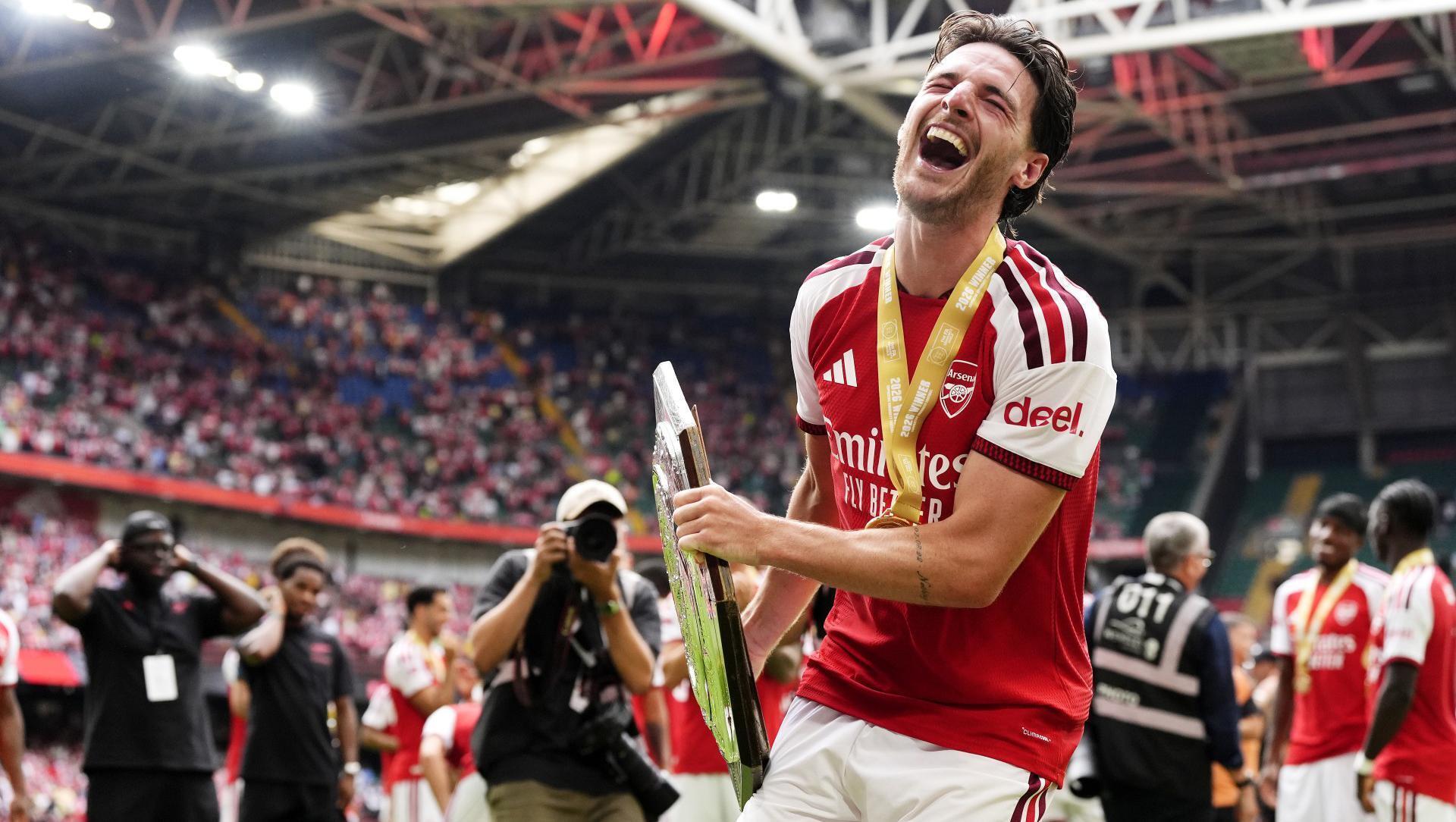
Arsenal's Declan Rice celebrates with the FA Community Shield. Pic: Nick Potts/PA Wire.
There is a different feeling around Arsenal now. For years, the club's supporters were encouraged to believe that something was coming: the young team would mature, the painful lessons would eventually count, the near misses would become a platform for something greater. Then, last season, it happened. Arsenal became champions of England for the first time in 22 years.
What has been striking since is that winning the Premier League has not diminished the appetite around the club. If anything, it has intensified it. The season-ticket waiting list has grown to extraordinary levels (125,000 and counting at the time of writing), while Arsenal say more than 1.8 million tickets were purchased across their men's competitive home fixtures last season, with every available seat allocated. Ticketing income reached £154 million.
The demand has spread beyond the Emirates. Following the title triumph, JD Sports recorded a 1,749% increase in searches for “Arsenal top”, an indication of how rapidly the club's commercial and cultural appeal has expanded. The champions have become more desirable, not less, and that creates an intriguing backdrop to a season in which the expectation is no longer simply to compete.
Arsenal switch from the hunters to the hunted. That change in status owes an enormous amount to Mikel Arteta, whose own transformation is inseparable from that of the club. When he was appointed in December 2019, this was his first managerial job. He had never managed a professional team, let alone one of the biggest clubs in England. Nearly seven years later he is the longest-serving manager currently in the Premier League, having taken Arsenal from a club searching for direction to one that has just won the title and reached a Champions League final. Only three previous Premier League managers have defended a championship. Arsenal have not done it since the thirties.
"We start from scratch and we’re going to have to prove we have the level to go back to that position again," Arteta said on Thursday. "But I think that happened in the last three seasons – at some point we were first, at some point we were chasing it, and you never know what’s better. You give me the choice, I want to be first, I want to be hunted, and I want to be in control of our future, rather than depending on somebody else.”
The remarkable part is not simply the length of his tenure but the extent to which Arsenal continued to believe in him through the difficult stages of it. There were doubts when the ‘process’ seemingly slowed, when Arsenal missed out on the title, and when the investment in players brought an increasing expectation of results. Yet the club persisted with the manager they had appointed without any previous experience of the job.
That faith has now been repaid. Never before has the club witnessed such scenes of celebration, both locally and worldwide, after the title was won last season. Having covered all of Arsenal’s five previous title successes, dating back to 1989, I can attest that Arsenal have never been ‘bigger ’, and a lot of that is down to the backing of the Kroenke family owners and their support of Arteta.
The Spanish coach is entering the final year of his existing contract, but there is little sense of Arsenal preparing for a succession. He has said publicly that he wants to stay and that there is no reason for supporters to worry about his future. The smart money would predict the announcement of a new deal next month, after the transfer window business has been concluded. The club and manager are aligned on extending a relationship that has already transformed Arsenal.
Continuity has become increasingly rare in the Premier League. Nine clubs changed managers during the summer (ten if you add Roberto de Zerbi’s late arrival at local neighbours Tottenham at the end of last season), leaving Arteta as an increasingly unusual figure: the established coach, now defending the title while many of his rivals begin again.
Arteta promised on Friday that homegrown star Myles Lewis-Skelly will not be leaving in this transfer window, despite links to Chelsea and Manchester United. But the club has not treated becoming champions as a reason to stand still. Bruno Guimaraes has arrived from Newcastle in a £75 million move, while winger Christos Tzolis has added another attacking option. Their immediate impact was evident in the Community Shield, where Arsenal beat Manchester City 3-0 in Cardiff, but the significance lies less in the trophy than in the sense that Arteta is still refining the team rather than simply protecting what he has built.
Captain Martin Odegaard's assessment of Guimaraes was revealing. He praised the Brazilian's ability to win the ball and fight for his team, but also his composure and quality in possession. That combination points towards the next stage of Arsenal's development: not merely remaining difficult to beat but finding more ways to control and win football matches.
Odegaard, too, represents a part of Arteta's achievement. The Norwegian has developed from an enormously talented but relatively inexperienced signing into Arsenal's captain and one of the defining players of the Arteta era. After an injury-disrupted campaign, he returned against City with a goal and the kind of freedom that suggested there may be another level to come from him.
“Of course, last year we won the league,” Odegaard said. “But this year we want more.” It is a simple sentence but perhaps the most useful way of understanding Arsenal now. The club spent years trying to become champions. Arteta spent years trying to make them behave like one. Now he has to make sure that winning does not become the peak of the project.
The financial growth, the extraordinary ticket demand, the explosion in merchandise interest and the increasing global profile are all consequences of what Arsenal achieved on the pitch. But they also increase the stakes. Supporters will expect more, opponents will be more determined to beat them and the Champions League will remain the competition against which Arteta's Arsenal are ultimately judged.
Arteta also wants more, however. He stated it publicly in the wake of their penalty shoot-out Champions League defeat by Paris Saint-Germain in May and it is debatable whether or not they start the season vastly better off. The pursuit of Real Madrid’s Vinicius Jnr proved their ambition, albeit the player stayed put. The squad is so strong and deep that there are few players available of genuine quality who would obviously represent an immediate upgrade on his current roster.
There is no longer any need to explain what Arsenal might become. They have become champions.
The challenge for Arteta, and for the club that trusted a first-time manager nearly seven years ago, is considerably harder now: to make that success feel less like an arrival than the start of an era.


CONNECT WITH US TODAY



Be the first to know the latest news and updates