Premier League’s warped economics make €74m fee for Semenyo a snip
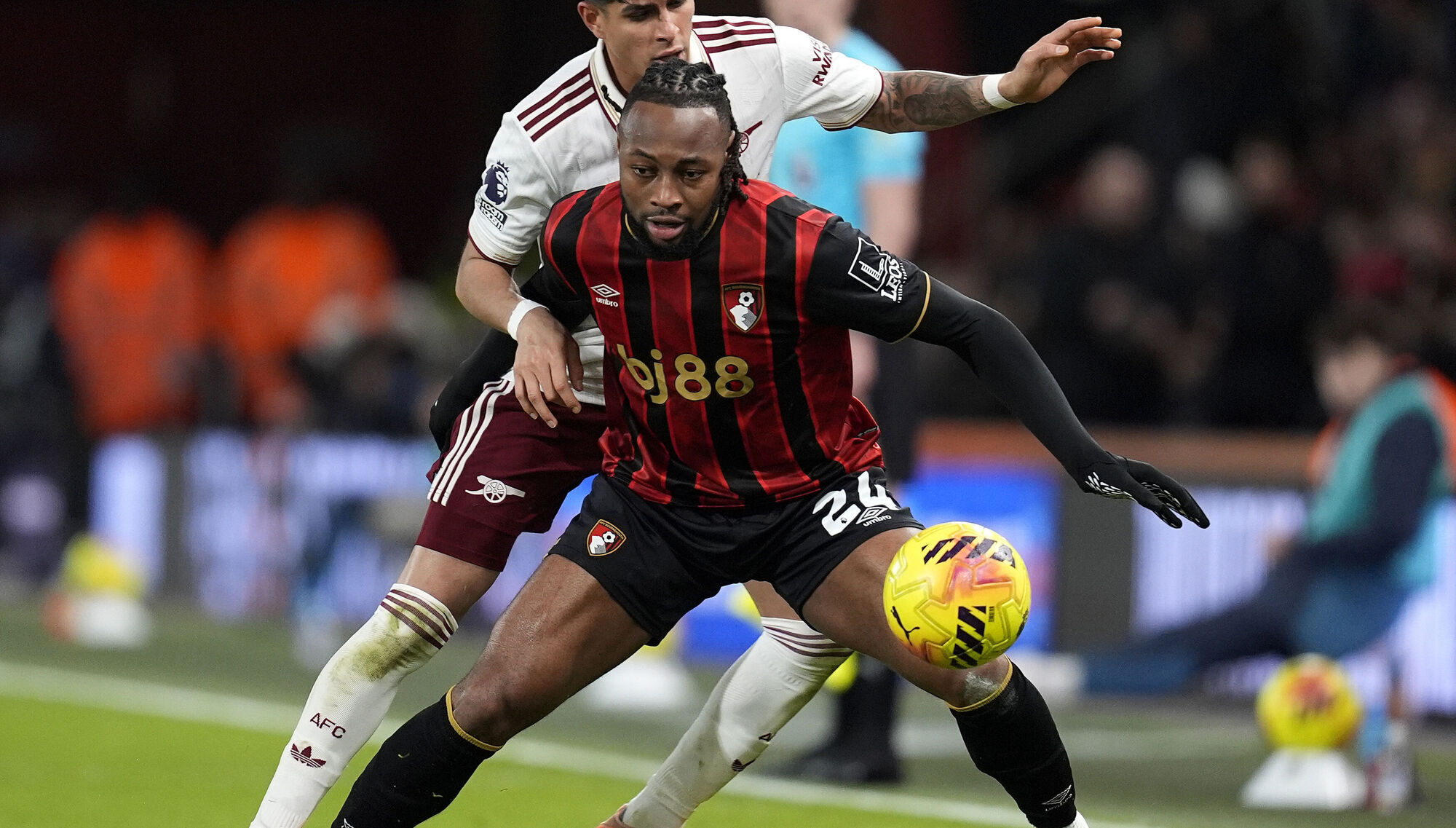
MARKET FORCES: Bournemouth's Antoine Semenyo holds off Arsenal's Piero Hincapie at the Vitality Stadium on Saturday. The defeat to the Gunners could well be the Ghana forward's final game with the Cherries. Pic: Andrew Matthews/PA Wire
Antoine Semenyo, it seems likely, will soon join Manchester City from Bournemouth for a fee of £65m (€74m). Given how well Rayan Cherki and Phil Foden have played from the right this season, it is not immediately obvious why City need him, but the modern game is the modern game, the rammed calendar makes large and flexible squads essential and Pep Guardiola may have some esoteric plan for the Ghanaian anyway. But perhaps what is most striking about the deal is the fee – or, more precisely, how little attention it has drawn.
English football has become inured to big transfers. The fee feels about right. Semenyo is 25. He has four and a half years left on his contract. He is quick, skilful, intelligent and works hard. He is disciplined, but has the capacity to do the unexpected. Of course a player of his ability costs that much. Yet £65m (€74m) would make him the third-most expensive player in Bundesliga history. He would be the seventh-most expensive in Serie A history, the 14th-most expensive in La Liga history. Only nine non-English clubs have paid a fee higher than that. Even in Premier League terms, Semenyo sneaks into the top 25.
Perhaps that’s fine. As anybody who has raised any qualms about World Cup ticket prices recently has found out from online Americans passionately committed to being ripped off because that’s what capitalism demands, the market is what it is. Value is what people are prepared to pay. If one club say they will pay £65m for Semenyo, his price is £65m. City can afford it.
A pedant might wonder whether Semenyo really is worth nearly seven times as much as, say, Nordi Mukiele, who was two years older when he joined Sunderland from Paris Saint-Germain in the summer (albeit with two years left on his contract). Sometimes a particular player or type of player becomes fashionable and if there is demand, then the price goes up. That is just supply and demand. Semenyo had seemingly drawn interest from Chelsea and Liverpool, whereas a desultory loan spell at Bayer Leverkusen meant everybody had pretty much forgotten about Mukiele.
The effect those crazes can have is seen by the player Semenyo will slot one place below on the list of most expensive Premier League arrivals: Benjamin Sesko. The Slovenian – nine league starts this season, two goals – is a jarring reminder of the trend of the summer: the big No 9. We are not quite in the territory of tulips in the Netherlands of 1636 or non-fungible tokens in 2021, but classic strikers are beginning to look like one of those crazes everybody almost immediately regrets joining in. Just why did you call your daughter Khaleesi?
There were not many centre-forwards out there, we were told. After the fracturing of the guardiolista consensus, coaches were going back to basics. Who knows how football will look in two or three years, what the next tactical orthodoxy will be. But goals will always be valuable, so get yourself a striker. Video assistant referee offside calls, the abolition in effect of “level” in decisions meaning a pixel of infraction will be penalised, has militated against the sniffer, the poacher, the hanger-on-the-shoulder, wiped out the Filippo Inzaghi-style forward, so best to make your No 9 a big one.
Of the players signed in the great striker bubble of 2025, the most effective has probably been the one least like an orthodox No 9. Aside from his bullet header of an own goal in the Wear-Tyne derby, Nick Woltemade has been a success for Newcastle, not just for his seven goals and an assist in the Premier League, but for his link-up play, angular disruptiveness and general charisma; the beanpole Rudi Völler is hugely popular on Tyneside.
Hugo Ekitiké, who cost Liverpool £82.5m, can also look back on his first six months in the Premier League with a reasonable degree of satisfaction, having managed eight goals and two assists and given the impression of being able to interact with his teammates in a way that has eluded many of the arrivals at Anfield in the summer. Had it not been for Arne Slot’s efforts to get Alexander Isak up and running, he might have achieved even more.
But by and large, the other big centre-forwards of the summer have – and with the caveat that half a season is no time to write somebody off – flopped. Isak is the most expensive signing in English history at £125m (€143m), and he is due sympathy after fracturing his leg against Tottenham last month, but even before that he was already being talked of as potentially one of the worst signings in history. Probably because of his disrupted summer and the toxic nature of his departure from Newcastle, he arrived undercooked at Liverpool and had managed two goals and an assist from some desultory performances before suffering that injury.
He is not the only one, though. Viktor Gyökeres and Liam Delap have had their fitness issues, but equally they have underwhelmed, as has Sesko.
At the same time, the player who perhaps persuaded everybody that old-school No 9s might still have a role to play in the modern game, Erling Haaland, has somehow found another level: 19 goals in 19 league games is absurd, particularly when other parts of his game have developed as well. But just because one player resembling an old-school No 9 is thriving, it does not necessarily mean that old-school No 9s are back more generally. Hope and a large fee do not make a functioning centre-forward.
There’s no reason to think Semenyo will not be an excellent player for City. Guardiola will have a plan and his plans tend to be better than those of most coaches (although as the case of Kalvin Phillips shows, even City get it wrong occasionally). Will he be worth £65m? That’s much harder to say. Value in the market is very much in the eye of the beholder and fees in the Premier League feel entirely divorced from any kind of objective reality.
CONNECT WITH US TODAY



Be the first to know the latest news and updates