We must look beyond the brute numbers to really appreciate Haaland’s legend
Perhaps the data-soaked discourse of modern football actually does this Premier League centurion something of a disservice.
We must look beyond the brute numbers to really appreciate Haaland’s legend

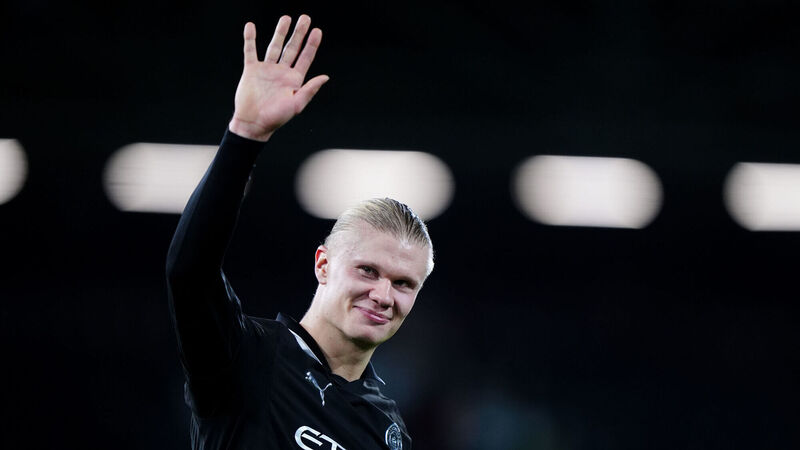
Manchester City's Erling Haaland. Pic: Bradley Collyer/PA Wire.

Stack them up. Pile them high. Sort them and arrange them, parse them and categorise them, order them to your table like items in a Chinese restaurant. Personal favourites? Give me the No 33 against Arsenal, the one with the flowing hair. 

I’ll also take a No 81 against Chelsea, when he spots a hapless Robert Sánchez out of goal, and lobs him deliciously from the edge of the area.


Give me a No 98 against Bournemouth, in which he deliberately slants his run around the keeper, slots it in from a tight angle, tries to clamber atop the advertising hoardings in triumph, loses his balance, collapses in peals of giggles. 

And maybe chuck in a No 53 against Brentford, in which Kristoffer Ajer somehow manages to fall over without being touched, spooked into incoherence by his very presence.

And perhaps numbers – the basic currency of football – are the most instinctive way of interpreting Erling Haaland’s 100 Premier League goals for Manchester City, a career built on accumulation, the pursuit of hard round certainties. Seventy-one with his left foot. Seventeen with his head. Eleven with his right foot. 

And one with his bum, No 49 against Chelsea, in which the ball rolls up his back as he slides over the line, perhaps the first Premier League goal that also doubles up as a massage.

You can have plenty of fun with this stuff. Kevin De Bruyne (13) has been by some distance his most prolific assister. Wolves (10 goals) and West Ham (nine) have been his most frequent victims. 

Indeed since his arrival in the Premier League, only four West Ham players have scored more goals at the London Stadium than Haaland. Some weeks, I swear, he manages to score against West Ham when he’s not even playing them.

Is there any more to the Haaland story than brute numbers? For a while, I wasn’t sure. Three years ago, in the early stages of his first golden season in English football, I wondered aloud whether there might come a point when the Haaland supremacy slipped into monotony. 

“How long,” I asked, “are we meant to carry on gawping and gasping at this thing? What will be the appropriate level of whooping reverence when Haaland is still doing this in, say, 2025?” 

Well, here we are: still gawping and gasping, still reverentially whooping at the sight of a man slide‑tackling the ball into the goal again and again. 

All the same, I think I was wrong about Haaland in one significant aspect: time and tide have enriched rather than dulled the Haaland legend, added tones and shades to this champion footballer. Whisper it, but: I think I’m actually warming to the guy.

Part of the reason is that City are simply a more interesting team than they were three years ago: more flawed and brittle, more prone to self-doubt and thus more recognisably human as a result. 

These days it is Arsenal who are the frictionless winning machine, Haaland the man who – for all the recent excellence of Phil Foden and Jérémy Doku – is still desperately grabbing at their tails, hurling coal into the furnace, trying to whip this imperfect assemblage into some kind of cogent shape.

But Haaland, too, has changed. Go back through those 100 goals and something seems to shift around No 50. Throughout his City career, the Haaland back catalogue has been built above all on three types of goal. The barrelling run in between the two centre‑halves, holding them both off before side‑footing in. The back-post raid, butting the ball in from two yards with whatever body part feels most convenient. 

The cross from the left, Haaland stealing in from out of shot, the ball bulging the net almost before anyone knows what’s happening.

Those three goals remain the raw steak and potatoes of Haaland’s output (see, by way of example, No 100 against Fulham on Tuesday night). But latter-day Haaland has a few more tricks up his sleeve. He has learned how to feint a defender and then take the shot on his right foot. 

He dinks the ball more. Occasionally he will open up his body for the classic side-foot, manipulating the keeper before putting the ball to his left. There is more of a lightness and a playfulness to him, a striker even now adding tools to his repertoire.

Off the pitch, too, there is a sense of maturity and growth, fun and self‑awareness, a man finally beginning to allow the world in, confident enough in his own personality to toy with it. 

He films YouTube videos in which he shares his daily nutrition regime (yak milk, ice pellets, liquid barium, that kind of thing) and says things like: “My glutes are strong now. They are really activated.” 

In the meantime, we still have the numbers. And perhaps the data‑soaked discourse of modern football actually does Haaland something of a disservice: reducing this generational phenomenon to a snackable meme, to the point where it is easy to overlook just how outlandish these figures actually are.

A case in point: the two men directly above Haaland on the all-time Premier League goals list are Didier Drogba and Cristiano Ronaldo, strong shouts for an all-time post-1992 XI. 

Both played more than twice as many games as Haaland. In terms of goals per game, your Jimmy Greaves’s and Steve Bloomers don’t get close. By the time he finally exhausts that nine-year contract, who knows what records will still be standing?

And yes, there are mitigations here. We can talk about City’s financial dominance, we can talk about state ownership and economic stratification, the greater protection strikers get from referees in the modern game, the way Haaland – like Lionel Messi and Cristiano Ronaldo before him – essentially benefits from an entire system oriented to his needs.

We can talk about all of that. But only, I think, to a certain point. And frankly to see Haaland purely as the product of his circumstances is to undersell his uniqueness as a footballer, the sort of footballer we want to tell our grandchildren we saw in the flesh. 

Perhaps it is possible even to see in Haaland’s ingenuity a kind of antidote to the stultifying, pre-programmed AI-style set-piece slop that passes for a lot of attacking football in the Premier League these days.

And ultimately, this all comes down to what we want from our star footballers. We want them to struggle a little, hurt a little. We want them occasionally to make a fool of themselves. We want them to be recognisable as people, not simply as avatars or assets on a ledger. 

But above all we want to be moved and astonished, to see things that have never been done before. Will we ever get tired of the sight of Erling Haaland scoring goals? Maybe come back and ask in another three years.

Guardian

x

More in this section

Sport

Newsletter

Latest news from the world of sport, along with the best in opinion from our outstanding team of sports writers. and reporters

Cookie Policy Privacy Policy Brand Safety FAQ Help Contact Us Terms and Conditions

© Examiner Echo Group Limited