FAI's Pathways still clogged with uncertainty and growing angst
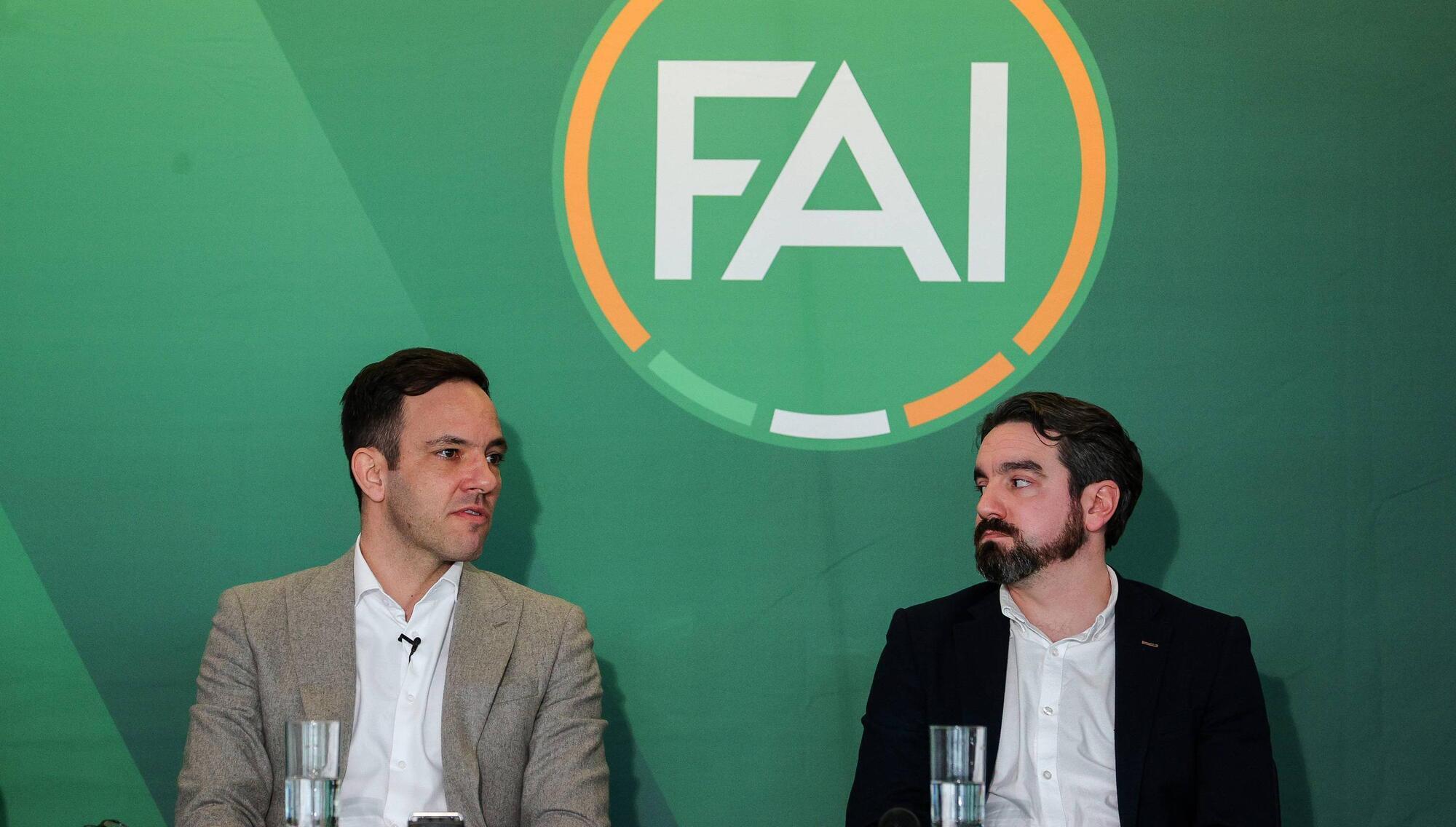
DISSENT GROWING? FAI Director of Football Marc Canham and FAI Grassroots Director Ger McDermott unveiling the FAI Football Pathways Plan which has yet to convince many. Photo: INPHO.
The FAI have admitted that funding to affiliates will be contingent on alignment with their strategies and policies – including summer soccer.
Friction over the refusal so far of the schoolboys/girls sector to endorse the switch has put the €160,000 grant used to meet the costs of the annual Kennedy and Gaynor Cups in jeopardy.
The standoff has forced the SFAI, which caters for 200,000 players, to reroute the shortfall on to the 50 teams participating in the June tournaments at the University of Limerick. Each has been hit with an entry bill increase of €3,000.
It was opportune for the FAI to have scheduled update briefing Wednesday on the implementation of their Football Pathways Plan (FPP), the centrepiece of which is synchronising all grassroots seasons to the League of Ireland February-October format starting between 2026-2028. Yet there was very little update.
Talks are ongoing with leagues nationwide about implementation but Ger McDermott, the association's head of grassroots, was unable to provide information on what proportion of 72 leagues are committed to their directive.
A group of dissenters unhappy with their freedom of choice being removed have formed their own group, with 23 leagues of 550 clubs across 18 counties reportedly steadfastly objecting.
They claim the FAI General Assembly ballot of December 5, carried by a slim 57% majority, was flawed as cohorts of voters such as educational bodies are unable to change from the academic season. It has also been noted that underage and amateur clubs had no say in the decision of the League of Ireland to adopt a similar summer season in 2023.
Regardless, the issue has created a seismic chasm across Irish football. McDermott did his best to contend the funding freeze wasn’t a done deal but, given the impasse and the SFAI making alternative arrangements for funding their tournaments, there’s no sign of resolution.
“Naturally, as the governing body, we want our affiliate members, leagues and clubs to embrace policies,” said McDermott, who insisted the grant was from the FAI, not ringfenced by state agency Sport Ireland.
“We have a budget and grant process annually and the SFAI have made their application. We are going through the normal process where we review it, score it based on the criteria set out for any grant paid.
“I met the SFAI to discuss FPP implementation because when any affiliate grant is made to us, part of the scoring criteria is around alignment with FAI strategy.
“Funding has always been contingent on alignment with FAI strategy so nothing has changed there. Our strategy has changed but why and how we pay out money hasn’t changed.”
This hard-nosed, clinical approach doesn’t necessarily chime with the FAI’s stated aim for inclusivity, as extra costs may now cascade onto parents proud to have their 1,000 kids representing local leagues in national competition.
“We haven’t refused anything,” added McDermott about the grant status. “There is nothing surprising in that the General Assembly voted on this in early December. The leagues having an extra cost will absolutely be in our thinking.”
Nothing visible will alter either in September when seasons around the country kick off. A tiered approach starting with the 8–12-year-olds in January is due to commence but won’t drift into a new season in January 2026 unless leagues are onside.
It is known that five of the largest underage entities, Dublin District, North Dublin, Cork, Limerick and Waterford have yet to be convinced of the proposal.
“The process of meeting each individual league and going through their concerns and letting them design their calendar is more important than me saying x leagues of y grouping have said A, B or C,” reasoned McDermott.
If those concerns, such as the impact of clashing with GAA in the summer, remain insurmountable, rebellion will rule.
The next meeting of the General Assembly, an online gathering, is scheduled for May 8, after which the accurate appetite of dissension will be calculable. As it stands, clubs will be debarred from fielding teams from January 2026 unless they’ve received the FAI’s Club Mark, another stick to ensure adherence to FAI “strategy”.
“It is not our intention to lose clubs,” noted McDermott about talks of breakaways in response to the edict. “There’s an acceptance that in this phase, from some of the strong feedback we’re hearing. there’s a normality because it's a significant change. We didn’t expect people to roll with it easily. There’s an awful lot of change and we’re asking people to come with us.
“There is an acceptance that people will choose to play other sports but we won’t forgo our obligation which is providing football opportunities to those who want to play across the year.”

CONNECT WITH US TODAY



Be the first to know the latest news and updates