Munster's interim head coach Ian Costello welcomes IRFU decision to tweak funding model
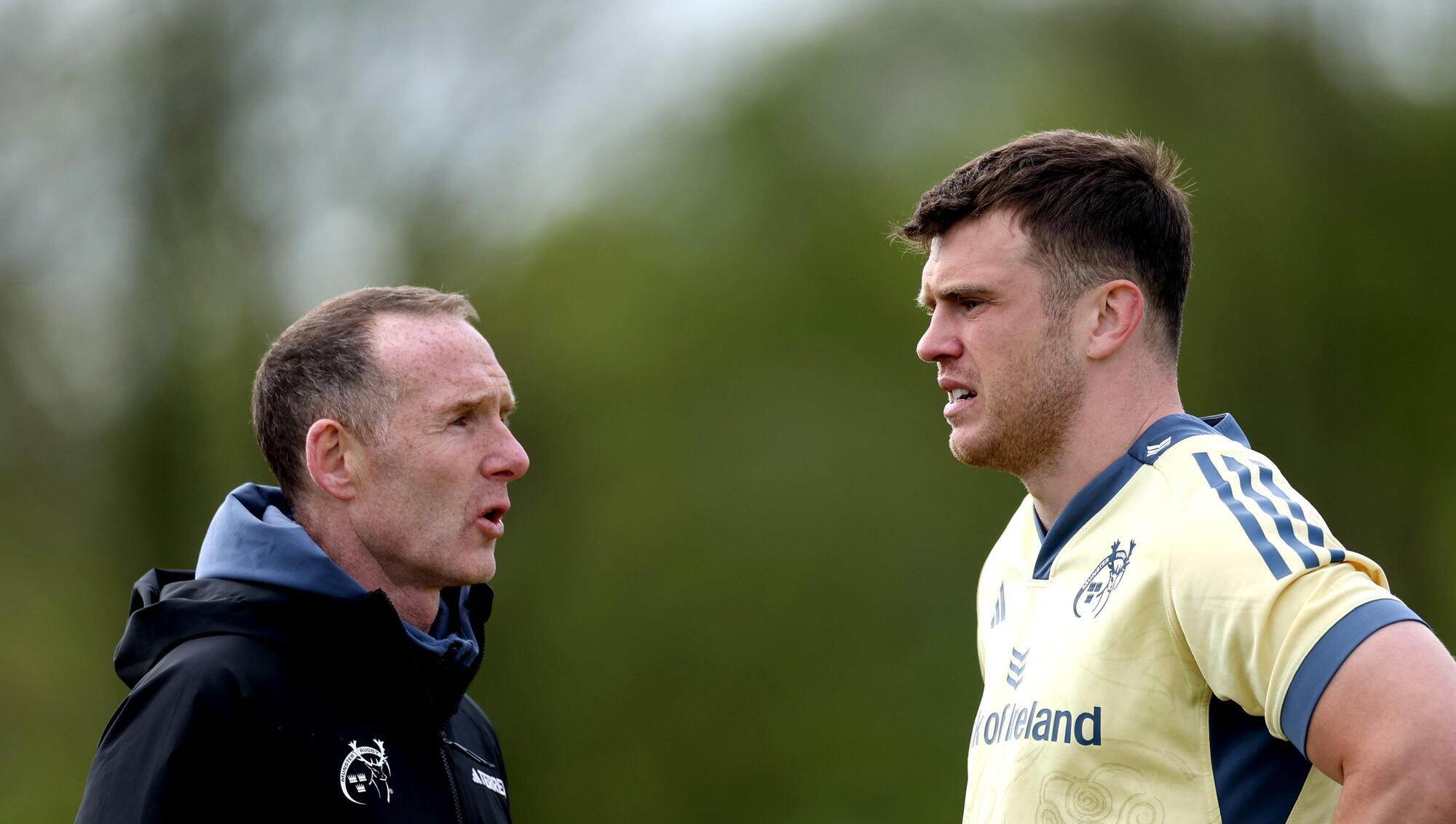
FUNDING TWEAK: Head of Rugby Operations and Interim Head Coach Ian Costello and Tom Farrell in training on Tuesday. Pic: ©INPHO/James Crombie.
Ian Costello has welcomed the IRFU’s decision to channel increased provincial contributions to its central men’s contracts into funding player pathway initiatives in Connacht, Munster, and Ulster.
Munster’s interim head coach and current Head of Rugby Operations was reacting to Tuesday’s announcement from the IRFU that effective from August 1, 2026, the provinces will be responsible for 40 per cent of the cost of National Player Contracts, an increase of 10 per cent from the previous level of contribution.
Leinster will be the hardest hit by the increase given 11 of their players will be centrally contracted next season, compared to two from Connacht, none from Ulster and only Tadhg Beirne from Munster.
The decision to tweak the funding model comes following a review the IRFU said “considered both the evolving financial landscape of Irish Rugby and the need to maintain the competitiveness of the national and provincial teams”.
Costello, whose role oversees all of Munster’s high-performance programmes from Under-18 level up, said: “I think anything that decentralises or creates opportunities to develop pathways is a positive thing.
“I would say that we, for probably four years now, feel that is going to underpin any future success of the club, and we have a lot of external funding and external projects that we raise to run athletic development programmes, we have an extra pathway coach and it has made a really big difference in our pathway.
“We probably look to raise between €250,000-300,000 a year to invest in external projects, and they are central to what we do at the moment. So, anything that supports that means we can even improve the ones that we have or add new projects to it.”
Read More
Yet Costello downplayed the financial windfall set to come to each of the three provinces earmarked to benefit and insisted it was still in Munster’s best interests to get as many of its players onto central contracts as was possible.
“If you look at it, there is still 60 per cent of the contract (paid by the IRFU), so you pick any player in our squad at the moment and instead of a third of the extra 10 per cent that we are getting back into our pathways, 60 per cent of their contract is being paid for.
“Yesterday would have been 70 per cent, so the more we get in central contracts, it makes a massive difference.
"You guys can do some hypothetical sums that if we had five guys on central contracts, so if we had four more, guess what you think they might be being paid, and then you work out 60 per cent of that, and that’s all coming back into our budget. So, It’s massive.
“This helps but a huge aim for us would be to get more players into the national squad, getting more people on central contracts. That would really benefit our financial model.”
As to the extent of additional aid set come in from the start of the 2026-27 campaign, Costello said: “I suppose if you put that across, depending on the number of (central) contracts you have, I suppose it makes a difference.
“And my understanding is that it’s being divided up between the pathways of the other three provinces.
“I don’t think it will be massive. When you look at it, it’s an extra 10 per cent and then divide that by three, but everything helps. Everything helps.
“It could be a critical role, it could be a project that you run, it could be €100,000, it could be €150,000 all in by the time (it is divided), I don’t know what it will be per province, but I know how hard it is to generate investment or resources to run a pathway because I was heavily involved in that for the last four years.
“Everything is under pressure at the moment – everything because of the rate that the pathways are growing. When I came in, we had 24 players in the elite pathway, it’s always about 45 now.
“Gar Prendergast (Munster head of academy and pathways) has a team of 18 full-time (staff) and there are another four to six contractors. We started off with barely 10.
“It’s growing at a rate that is hard to manage, so anything that supports that is a positive thing. And I still think that’s the thing that drives sustainable success. It’s critical here anyway. I don’t want to speak about other provinces.”
Explaining the IRFU’s decision-making process, the governing body’s performance director David Humphreys said: “Since last year, we have worked tirelessly with the provinces, players, and our various stakeholders to design a funding model that balances the demands of national and provincial success.
"With a changing landscape, it is critical that we remain flexible in our approach, which is why the provinces will contribute 40 per cent of National Player Contracts. This adjustment follows our initial commitment in May 2024 to review the funding percentage, ensuring the model remains equitable and financially sustainable for all parties involved.
“As we move forward, it is imperative to maintain a unified approach to grow Irish Rugby at every level, from grassroots to elite players. The increase in provincial contributions aligns with our ongoing mission to ensure that Irish Rugby remains competitive, both domestically and on the international stage. This money will be ringfenced into funding pathway initiatives in Connacht, Munster, and Ulster.
"By making this adjustment, we ensure that our model is fair and flexible enough to support the changing needs of both the national and provincial teams."
CONNECT WITH US TODAY



Be the first to know the latest news and updates