Marc Canham calm amid the backlash, still hoping government delivers for football
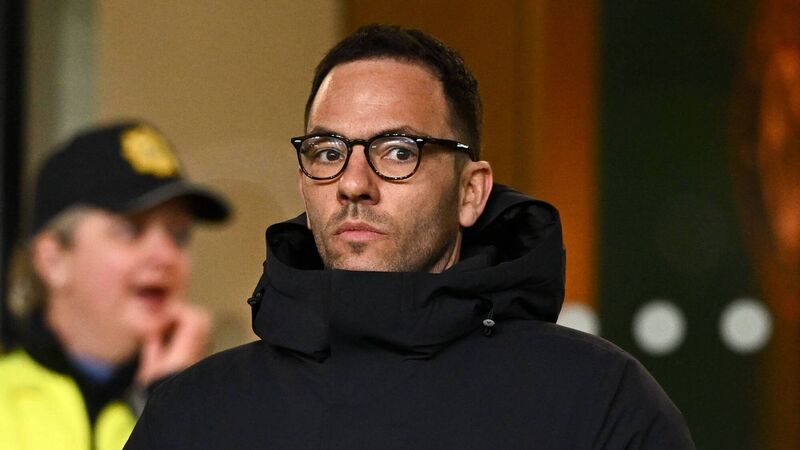
FAI director of football Marc Canham before the UEFA Nations League B/C Play-off 2nd Leg match between Republic of Ireland and Bulgaria at the Aviva Stadium in Dublin. Photo by Ben McShane/Sportsfile
Marc Canham attempted to explain the FAI’s controversies as reactions to normal events but the chief football officer is operating in abnormal times.
League clubs rebelling against a national programme by refusing to release their players for centralised coaching certainly isn’t a routine occurrence.
Nor is the national women’s team manager returning to a different job within the organisation after being sacked.
Certainly, last year’s protracted eight-month search for the men’s team equivalent couldn’t be classified as normal.
Yet Canham portrays a sense of being unperturbed by the welter of backlash around his methods.
He opened his quarterly briefing with media on Monday at FAI HQ by joking about his Powerpoint presentation – a subtle reference to the barb which Shamrock Rovers manager Stephen Bradley ventilated towards the brains trust in authority.
Canham takes pride in some of his initiatives but unless the Government funding materialises to subsidise facilities and staff which national league clubs require to develop an academy system, he’s in the firing line.
The delay in state aid being granted, he contends, revolves around the change of cabinet, not necessarily a change of governing parties.
Timing is everything. There was much stock placed by Canham in his interactions with the Taoiseach and new sports minister Charlie McConalogue when the pair attended Ireland’s win over Bulgaria the previous evening.
This is the same Micheál Martin who advocated funding four years ago. McConalogue’s predecessor in the sports portfolio, Thomas Byrne, spent last year indicating money towards sculpting the next generation was on its way.
Frustration and impatience among clubs came to the boil recently in their flat rejection of a scheme for their best players to assemble in Dublin over 45 days of school holidays for coaching.
Canham insists this curriculum – National Pathway Programme for 250 boys and girls between 14 and 17 – isn’t an alternative, rather a necessary step while the wait for funding prolongs.
That will drag on, at least for another few months, as a costing audit of the clubs across the country is undertaken.
“We hope that comes this year but I would stress that it’s not a magic wand that will work,” he emphasises.
“We submitted a proposal to the Government which is circa €8m per annum, which we think will deal with what we think is the deficit of what we need to fund academies to the level we feel it should be.
“It’s known from other countries that we believe it should be tiered, or categorised, into one, two and three – with funding appropriate to those levels. And depending on the category that you apply for, you have to have a certain number of staff and contact time. That level of detail in a proposal.
“We believe every club should have their own academy, that every child should have the opportunity depending on where they live to go into an academy and progress if they want to.
“We are meeting the Government in the next week on a range of topics but the biggest agenda item is around academies.”
Refusing to call their NPP as a stopgap, he admits the pushback has put the Easter start date in doubt.
However, he did dispute the tenor of club complaints about a lack of consultation, suggesting internal gaps may have contributed.
He added: “Our aim is to have a club-led player development programme. In the next two or three years, we need to do something different, and this is a good thing for players, a good thing for Irish football.
“We have said we won't launch the NPP until clubs are comfortable with it.
“We are now working more intimately with the national league committee to help them work through the issues they have. We will tweak and change a few things, but it is our objective to deliver this programme to support players and clubs.
“We spent the end of January, all the way through February up to March speaking directly to clubs.
“Every single academy manager was spoken to as part of that process. They are the people who day-in day-out look after players, deal with players' parents, coaches, all the stuff. They are the people who know this area the most, we spoke directly to every single one of them.”
There was also a reality check tabled about the panacea that the state aid is being described as.
“Even if the funding came tomorrow or yesterday, it would take time for academies to get set up properly.
“They will have to hire people, get the right facilities, upskill their staff, write coaching curriculums and games programme, develop sports science and nutrition plans and develop strength plans. None of this happens overnight.
“The funding is urgent and critical. We hope it will come soon but is the alternative just to do nothing?
“We in the FAI must take some action over the next couple of years so the young players, aged 13, 14, 15, have the level of contact time they need.
“Players would have gone to the UK before Brexit would have had that level of contact time and quality of programmes.”
CONNECT WITH US TODAY



Be the first to know the latest news and updates