Hannah Dingley: 'There are limited resources let’s plough it into the right areas, to strengthen the foundations'
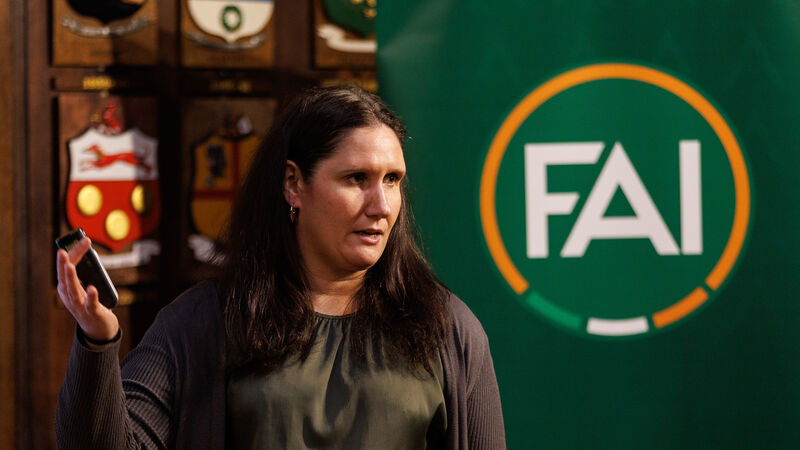
FUTURE PLANNING: FAI Head of Women & Girls' Football Hannah Dingley set out the Women's Action Plan. Pic: ©INPHO/Ben Brady
Understandably cautious from previous missed targets – and the FAI’s stark financial state – Hannah Dingley is favouring substance or statistics in her action plan for the women’s game.
Tuesday’s unveiling at the Mansion House in Dublin was the first time since she joined the FAI from Forest Green Rovers almost a year ago that the head of women’s and girls’ football offered her views publicly.
Bar the unresolved saga over where her predecessor Eileen Gleeson fits into the organisation after being relieved of the senior team job, Dingley was fortright in her opinions.
However noble her framework is, for instance ensuring females have access to the basic right of toilet facilities at clubs, the vast majority of her two-year blueprint was bluesky aspirations.
This was the latest wish-list produced, the type state agencies and Uefa cherish, in succession to the FAI strategy 2022-2025 and Marc Canham’s football pathways plan.
FAI habitually miss the targets they aim for, leading Dingley to adopt a broader mindset.
“We have set internal Key Performance Indicators and it’s not that I’m shy of sharing them, but they become the focus,” reasoned the woman who made history by being the first female to manage in the English Football League.
“The focus is have you delivered 50 programmes when actually I think, does it matter if they were 50 rubbish programmes?
“Has there been an impact? Have the women who will be taking part in those programmes felt supported, felt they have improved, felt it’s helped them get into senior positions? That’s the measure.
“We talked a lot about it, whether we should start to measure girls’ confidence from the recreational football sessions for example.
“Do you come out more confident than when you came in? Because it’s not the number of sessions that’s important, it’s the impact it has on those women and girls that we’re trying to impact.”
To do so, the FAI are relying on their preachings cascading at club level.
Smothered by €40m of debt restricts their investment levels across all dimensions, including the re-establishment of home-based training sessions for potential Ireland call-ups.
These were appreciated by the national league pool during the reign of Vera Pauw and Colin Bell but vanished during the Gleeson era. Her warped excuses for their absence only succeeded in magnifying the folly of ditching them. Still, money's too tight to mention.
“There are limited resources but if there are limited resources let’s plough it into the right areas, to strengthen the foundations, the things that are going to make the most bang for your euro,” said Dingley.
“We want to review them - and people say we do a lot of reviews - but we really need to understand what was good and wasn’t good about those sessions.
“We have the development squad in during Carla Ward’s last window and there will be some activity in the next window in April.
“We call it a development programme strategically because we don’t want to come out and say it's U21 or U23 yet.
“But it is a stepping stone. If UEFA introduces a U21 competition, we want to be part of that.
“We want a varied menu, and players and need opportunities to bridge that gap, but it can’t be training all the time.”
Then there’s the thorny topic of Gleeson being at a loose end on a six-figure salary. While her contract wasn’t renewed following the Euro playoff defeat to Wales in December, she had an inbuilt clause entitling her continuity of employment within the organisation.
Coalescing with her successor Dingley to implement the mechanics of this manuscript seems sensible within an association where commonsense is frequently lacking.
“Eileen was a great help to me when I started - an excellent knowledgeable coach – but that’s an ongoing situation that I don’t know anything about,” she said.
“I’ve no comment to make on that.”


CONNECT WITH US TODAY



Be the first to know the latest news and updates