Rudi Vata: How Liam Brady and learning Italian changed my life
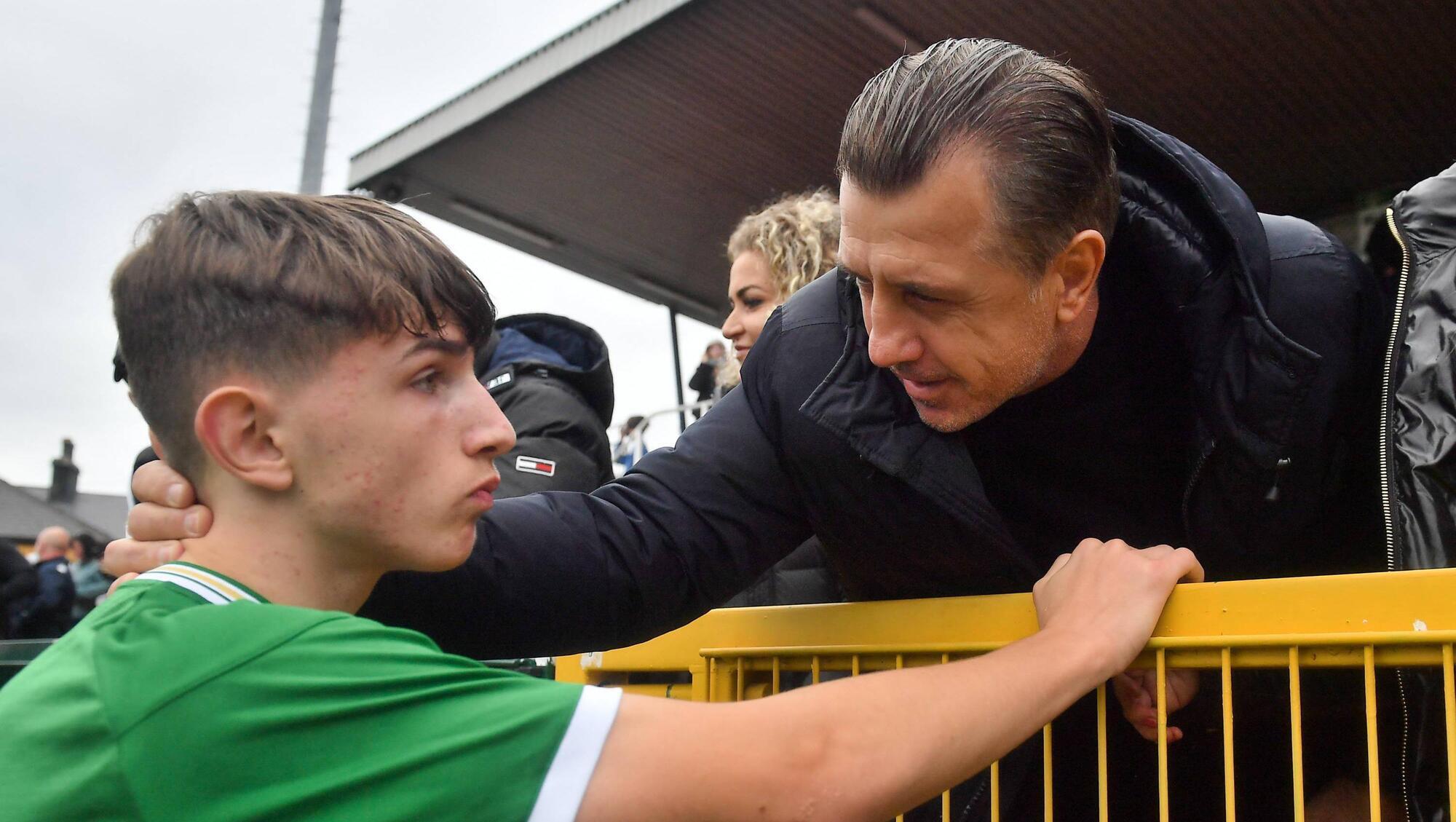
Rocco Vata of Republic of Ireland with his father, former Celtic and Albanian footballer Rudi, after the UEFA U17 Championship Qualifying Round Group 5 match between Republic of Ireland and Poland at Turner's Cross in Cork in 2021. Photo by Eóin Noonan/Sportsfile
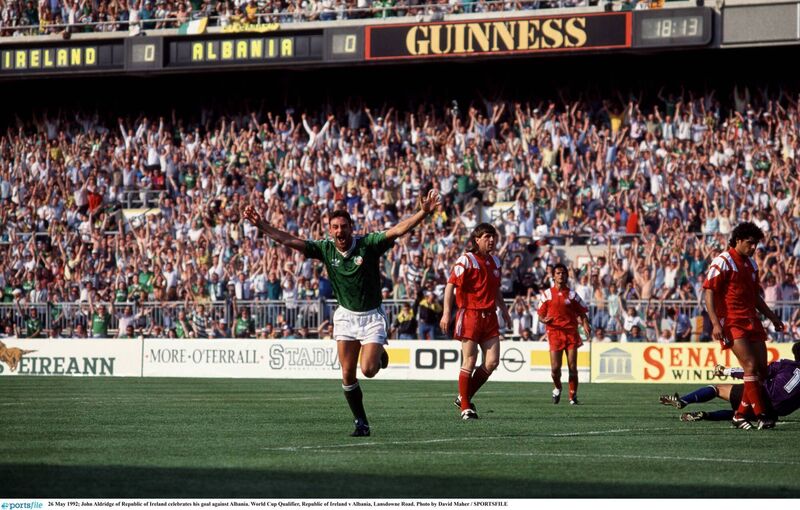
A 2-0 home win over Albania got Ireland's campaign to reach the 1994 World Cup off to a solid start at Lansdowne Road in May 1992. Paid for by the Cork Examiner, the adidas factory in Cork knocked up a set of red jerseys for the visitors, who had travelled without gear or balls. And for the guy who wore number 5 in that bespoke away kit, life changed.
A year before that game in Dublin, Rudi Vata marked Eric Cantona in the Parc des Princes as Albania went down 5-0 to France in a Euro '92 qualifier. After the match, Vata slipped away from the team hotel with just his boots and Cantona's jersey and sought asylum, leaving his life in communist Albania behind.
By summer 1992, the regime had fallen, Albania's first parliamentary elections had been held and Vata was able to return to Tirana and his national team.
And a mix of fate and determination brought Liam Brady into his story.
"When I was a young boy of 10 years old my family brought an old Italian ex-priest to teach us Italian which was illegal at the time. They hoped that investment would serve us in the future.
"Liam was the manager of Celtic in 1990 and was in the main stand in Dublin when Albania played Ireland. He thought I had the qualities that could do well for Celtic. He expressed his feelings to the Albanian FA after."
Vata hadn't a single word of English but Brady was a fluent Italian speaker from his days in Serie A.
"At 10 I learned Italian and 12 years after the same language helped me communicate with Liam.
"I found out about the interest so when I went back to France I called Celtic Park, spoke to the secretary and connected to Liam. He asked me if I was ready to come to Celtic.
"My life perspective changed. I was thinking about France and my career and then Celtic appeared because of Liam. I got an Irish visa and took a plane to Dublin where Celtic were in pre-season at the time and took part in a few games against Cork City, Manchester City. That's where it started."
Brady would soon be gone from Celtic, but left behind a defender who won the affection of the fans and the Scottish Cup in 1995.
"It didn't last very long, the journey with Liam, but it was because of him."
What was the life he had run from like?
"Very sad. The communist (sic) had fallen apart and we were a very poor country. We had nothing, more or less. There was nothing to buy in the shops. Even bread, there was a shortage. It was a sad, sad country. A beautiful country, located in the most beautiful part of Europe but the system had collapsed based on their strategy and we had nothing.
"We wished to have the smallest things like bread on the table, that would have been a privilege at the time but there was no future, especially for a young generation and players with a special gift. That's why there were so many leaving the country at the time for a better future in another country. For me as a young footballer, I could see it was a matter of time before everything collapsed. It was the right time and God had chosen that moment.
"The France game was a blessing as well. It has been a long journey and when I think today, how did you do and manage to get through this situation, I'd say nine out of 10 people would fail. But I never looked at it in this way and just looked at the best situation."
Football had always been his driving force, early personal training regimes involving runs up five-storey apartment buildings in his home city Shkodër.
"As a child I had that plan to become a national team player one day and I always woke up with that in my imagination and worked every day towards that goal. That was my main dream.
"Eventually I got to a football school which was very professional at the time and I had to improve there again, competing with the best talent in the country.
"Maybe I was not the most talented boy in the school, but I was the hardest working. I ended up playing for all the group ages of the national team and being the captain of the country.
"I never dreamed I could play abroad, outside of Albanian territory because I lived under a dictatorship regime and you could not even imagine having an experience in a foreign country.
"Until that moment in 1991, when the whole communist bloc started falling apart. I had to make a plan about my future in a different way. But football was purpose, freedom, everything, to achieve your next goal.
"Without freedom you could not have this opportunity and I decided in 1991 after the match against France in Parc de Princes, I decided to stay there and ask for political asylum and from there build up a professional football career in that country."
It was the biggest risk of his life, one taken without any safety net.
"When you are brought up in a country like Albania, your knowledge is not at that level that can guarantee you success, as knowledge is important information. The language is very important. It was a matter of make it or break it. I had to make a strong decision and on the night of the game, I had already made the plan and I had very good picture in my head of what I was going to do, but I didn't know what to expect.
"The biggest shock was realising what it means to become a refugee, to ask for political asylum. You are in a position to play against top players like Papin, Deschamps, Laurent Blanc, Franck Sauzée, then 48 hours after you wake up in a completely different environment with many different nationalities from some of the poorest countries.
"You had to follow the procedure that any refugee would go, interviews and waiting for appointments. You go through so many things that a refugee would, so you need enough time. But as a professional footballer, if you lose one week of proper training then you lose your fitness and fitness is everything in football. I had to build up a special programme to keep that fitness level so I would be ready for any trial.
"I planned what to do and all I did was get up early in the morning and go for long runs, 10-15km, and come back and go through the routine and do ball work in the afternoon and any extra work.
"You had to become a self motivator, you have to become a psychologist."
Vata’s life has come full circle. Son Rocco, born to a Scottish mother with Dublin roots, currently plays for Ireland's U21s and Watford, a promising football career in front of him.
"Very proud. From the moment Ireland knocked on the door Rocco wasn’t even 15. He asked me what I thought and I said ‘go for it young man, it's a beautiful opportunity’.
"The Irish know how to treat you and welcome you, you can develop and grow in their system. He’s done very well. He has earned his spot on the team. He’s worked very hard.
"It’s very tough to be a father, I know he has lots of potential and is blessed with a lot of talent. Most of the time I like to be his main critic. I don’t like him to enjoy it too much because he has so much potential, and it’s a long journey right to the top. He has to be consistent and build up his mentality to fulfil his potential. But so far we’re very happy. He’s doing very well with Watford so far, they are taking care of him and have a proper plan to get him minutes.
"If he continues to develop and stay grounded and work hard I think he has a great future in the game."
Contrary to constant speculation that the younger Vata is ready to defect back to the country of his father's birth, Rudi says there has been no approach.
"So far Ireland has been the only FA who have been serious. Apart from that, there has been no official approach from Scotland, Montenegro or Albania. Officially, nobody has approached.
"I had approached three people but not in a professional way and people who approached me were not serious enough and I didn't give them attention. The question is how happy is Rocco in that environment, it is down to him.
"Rocco is born with freedom of choice and it is his life. As long as he’s happy and works towards the goal of the (senior) team, that’s a big success. He has a lot of work to do first. To get to that level is a big mountain to climb.
"When it comes to that situation, the only person who will make the decision is Rocco."
CONNECT WITH US TODAY



Be the first to know the latest news and updates