How Kieran McKenna pushed Sam Morsy to achieve Premier League dream
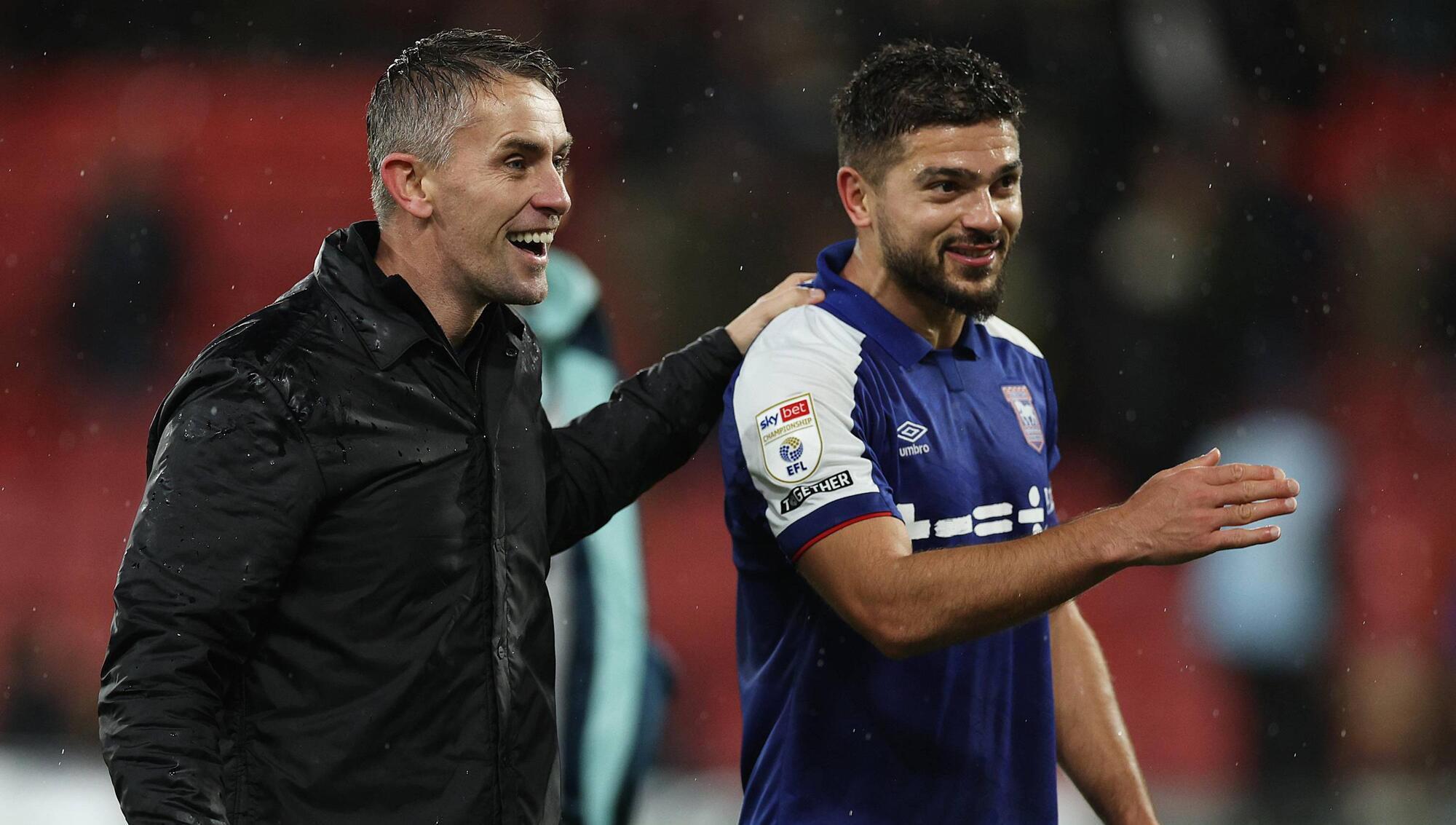
Ipswich manager Kieran McKenna and Sam Morsy celebrate after the team's Championship victory
Sam Morsy is thinking back to his first match for Port Vale Under-18s and sees no need to pull punches. He had just been released by Wolves, the shock tempered by knowing deep down that his attitude was simply not right, and a career would hinge on taking this second chance.
âA disaster,â he says. âI came off after 60 minutes, worst player on the pitch, just a complete culture shock. I had the mentality of âIâve just come from Wolves, Iâll be the best player hereâ. My last game had been against Manchester United, now we were playing Morecambe. It was a rude awakening: this is what football looks like. And I thought: âWhoa, OK, I need to sort myself out now if Iâm going to be a footballer.â
The lessons taken in 2008 will crystallise when, on Saturday lunchtime, he leads Ipswich out to face Liverpool as a Premier League captain. Morsyâs 15th season as a professional will be his first in the top flight; he turns 33 next month and admits that there was a time in the recent past when he reconciled himself with the idea a taste of the elite would elude him. But he has given the lie to any notion that players have to slow up with age, summoning phenomenal levels of performance during Ipswichâs double promotion and appearing sharper with each passing year.
There is no sleeping on success for Morsy, who could not quite lose himself in the moment after Ipswich overcame Huddersfield to confirm their ascent in May. âWhen youâre that close itâs more relief to be honest,â he says. âI donât think you ever go âthatâs it, Iâve done itâ, because if you climb one mountain you look up and see another thatâs even bigger. We want to do well this season, we want to show ambition. We donât want to say: âWe got here, back-to-back promotions, itâs brilliant and whatever happens, happensâ.â

What drives a midfielder who could have looked back on a respectable life spent mainly between the second and third tiers, with a World Cup appearance for Egypt thrown in, to discover such thrilling new levels? âThe battle is always with yourself,â he says, scanning through his days in the lower tiers and noting the number of âreally talented people who are scared to see how good they areâ he has encountered. But there is more to the story and so much of it stems from seeing how his parents, Mekawy and Karen, made successes of work and family life after difficult beginnings.
Mekawy was 21 when he arrived in Manchester from Egypt. âHe used to help people with their bags in hotels and just work any job he could,â Morsy says. âHe started to work in a pizza shop and save bits of money.â It was while preparing those pizzas that he met Karen. She would continue working there while heavily pregnant; they were eventually able to buy a modest flat and, three decades on, Mekawy runs a thriving property business in Wolverhampton.
âThey just continued to build an empire,â he says. âTheyâve both worked really hard. In my dadâs case nothing is ever enough and I think Iâve inherited that, which is a gift and a curse. Itâs partly why people talk to me about our achievement here and Iâm thinking âgreat, well, now the next oneâ. But the whole family is like that: pushing, being able to work hard and keep going.â
Jostling with three older siblings, a brother and two stepbrothers, also helped develop an edge. âYouâre last in line for anything so you always have to fight and scrap,â he smiles. âThatâs probably where the competitiveness comes from.â His brother Nader, based in Turkey, is imbued similarly and has devoted himself to the faith that is a cornerstone of Morsyâs life too. Nader studied Islamic science and classical Arabic; he now teaches Arabic to English speakers and vice versa. âWhat heâs learned in the religion and the Qurâan, to speak Arabic the way he can, my family canât believe how heâs done it because we werenât born speaking it, they say itâs impossible. But thatâs his personality: if youâre studying something, to study 15 or 16 hours a day.â It sounds familiar. The young Morsy would play football all day if he could â âIn the street, on fields, jumping over school gates after hours, two-touch, headers and volleysâ â and joined Wolvesâ academy aged seven. Nader, three years older, already played there and he entered the fold after accompanying him to training. He had been on course to succeed there until a wobble that dealt those hard truths.
âMy focus had gone,â he says of being let go at 16. âI was too busy going out with my friends, took no interest, football was at the back of my mind really. Iâd get home after a day at school, be on the sofa, training would be in the evening and I couldnât really be bothered. That reflected in my performances. Wolves did their best, kept giving me warning signs, telling me they needed more. And I could do it, but Iâd been in an establishment for so many years and just wanted to enjoy myself.â Eventually Port Vale straightened him out and offered a professional deal. In his second full season there would be a contretemps with Micky Adams, a renowned taskmaster, who was furious with Morsy for a reckless red card against Rochdale. He would soon depart for Chesterfield; the pair have made up since but his next manager, Paul Cook, would sow the seeds for what has followed.
âThe perfect manager for me at the time,â Morsy says of Cook. âHe was massive for me, showed a lot of faith, put his arm around me and treated me amazingly well.â Later they would work together at Wigan, winning promotion from League One and reaching the FA Cup quarter-finals. By August 2021 Morsy was a consistent Championship player with Middlesbrough and Cook, tasked with dragging a newly-monied Ipswich from the third tier, called again. He was surprised to be let go: things had been going well under Neil Warnock at Boro and there had been talk of a new deal. The move to Suffolk came on deadline day; while happy to become Cookâs new captain he sensed it spelt the end of any top-level ambitions.
âWhen I went to Ipswich I probably thought the Premier League dream was over, really,â he says. âThe goal was to get back into the Championship and whether I could have a good few years there. But in football itâs never that simple, is it?â
A transfer that looked to have extinguished the flame has, instead, set a fire raging. But its foundations were exposed early on. Ipswich struggled for cohesion and three months later Cook was dismissed. Did Morsy worry this was not what he had signed up for? âYeah, definitely, because the only reason I came was him. I wasnât playing well so I felt guilty, because he brought me in with the expectation of the player he had at Wigan. It was tough, the emotions were more like sadness because I wished Iâd done better. And youâre thinking: âWhat happens here?â.â

What happened was that Ipswich brought in Fermanagh man Kieran McKenna and, for Morsy, it just felt right. âI think I knew instantly,â he says. âHe said he wanted us to be a big club, the training and individual coaching were very good, so in week one youâre thinking: âOK, this is going to be good.â I was 30 and you want to be enjoying your football, it canât be a chore. We had a conversation, he told me what he thought, I said I feel good and Iâm always looking to improve. Heâs pushed me ever since.â McKenna has drawn previously hidden layers from Morsy, who signed a new contract last month. He was always combative, a hard runner and snappy ball winner to the point of being deemed a walking yellow card. That side of him has never died. The bookings have racked up and his debut for Ipswich was delayed by suspension, although he has never been dismissed for them. But there is more now: a shift of the upper body and five-yard bursts that lose opponents; a varied range of passes; nuances in movement that mean he is rarely unavailable to take the ball on.
âIf youâve got somebody you really trust saying âWhat about that? You could try that,â then sometimes youâll just do it without thinking,â he says. âYou start building new things in your brain. In football, like in life, people want to put you in a box of what you can or canât do. Then you get coaches like Kieran who go âyou can do thisâ, and you keep developing.â
The book had barely been closed on last seasonâs success when McKenna was targeted by Brighton, Chelsea and Manchester United, coming close to leaving before opting to continue with Ipswich. The uncertainty was not confined to those outside. âIt came fast and strong,â Morsy says. âIt was always a worry because it was top clubs coming, teams well ahead in the food chain. But deep down I always thought he would stay. Heâs done so much for the club and it sums up what sort of man he is.â Now they can prepare for Liverpool and, for Morsy, a reunion with Mohamed Salah. They spoke a few weeks ago, he says; Salah helped him settle into the Egypt squad in which they both featured at Russia 2018 and they remain friendly. Watching in the Portman Road stands will be his parents, his brothers, his wife Chanel and their six-year-old daughter Sienna, who is beginning to show the same football aptitude as her dad.
âWe want to write our own history,â he says. âItâs about embracing and enjoying it, but being really competitive and finding that will to win.â Since that rocky afternoon for Valeâs youngsters, Morsy has never lost it.