'There were cries of ‘no’ from the Polish when they thought it was them out in our group'
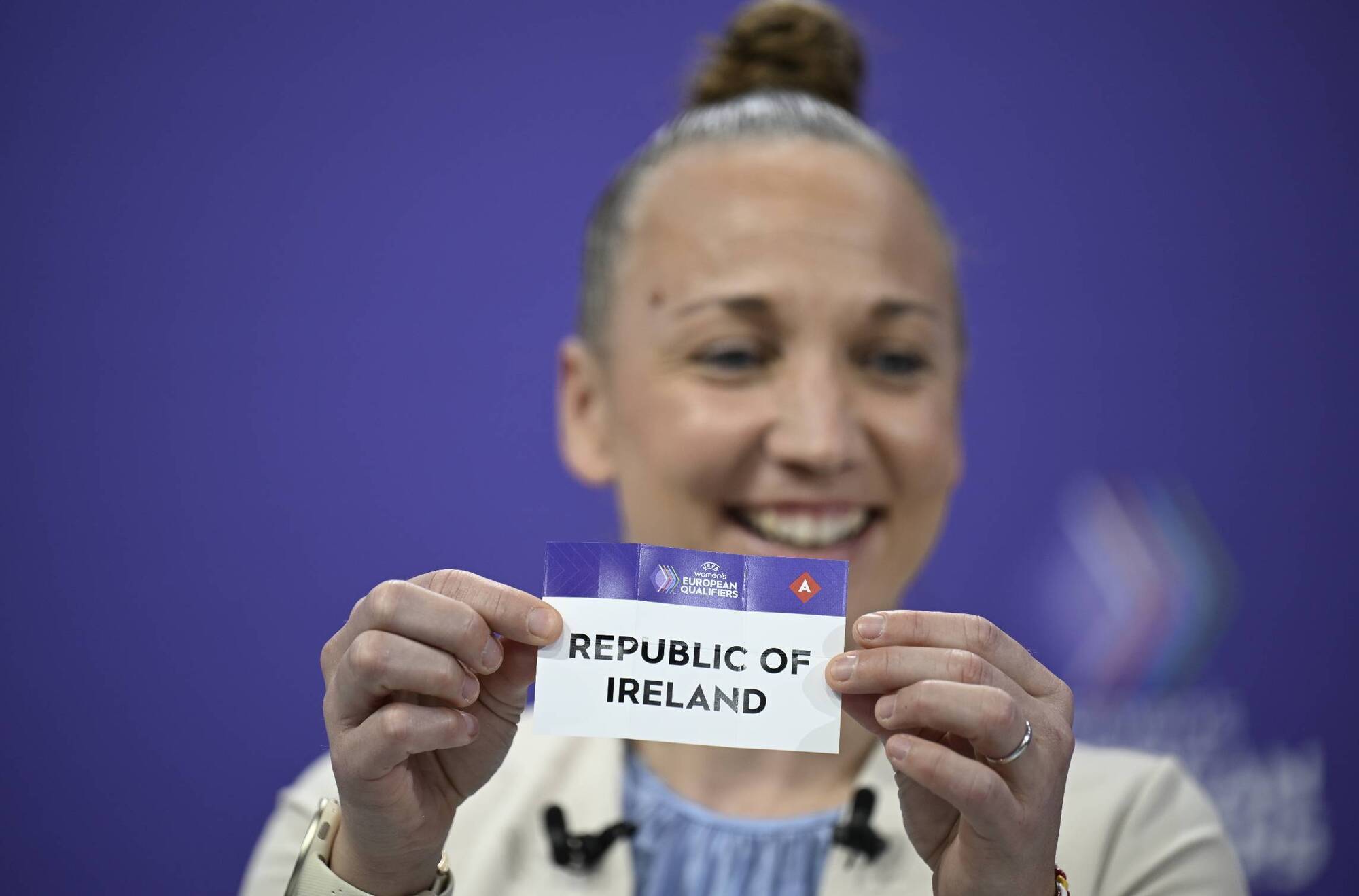
DAUNTING TASK: Swiss international player Gaelle Thalmann draws out the Republic of Ireland during the Uefa Women's Euro 2025 qualifying draw in Nyon.
It fell to Denise O’Sullivan for the rallying cry to convey transatlantic following Ireland’s most daunting of tests.
Not even their World Cup finals field competes with this for a European Championship qualifying group – France, England and Sweden.
That’s the third, fourth and fifth-ranked teams on the planet, only bettered by World champions Spain and their predecessors USA.
Avoiding Spain was the sole solace from the draw in Nyon.
That the alternative top seed they were pitted, France, are backboned by a Lyon side who reached six of the last eight Champions League finals signifies their strength too.
Only an underwhelming Nations League campaign demoted England, Euro holders and runners-up to the Spanish in last year’s World Cup final, into the second rung while Sweden are considered as forceful, if not superior, to the team that missed out on Olympic gold three years ago on penalties.
Read More
“We wanted to be here, now we are,” Cork native and Ireland playmaker Denise O’Sullivan said on as dawn broke in her adopted home of North Carolina.
“Let’s have it.”
They got there by storming through last Autumn’s Nations League B with a peerless record of six wins, clinching promotion with the added bonus of a playoff route to the 2025 finals through the backdoor.
Eileen Gleeson, speaking shortly after the draw on site, offered an unexpected declaration of intent to reach Switzerland directly – as one of the top two finishers – but her side, trailing behind in 24th spot of the rankings, have an uphill task to usurp one, never mind, two of the heavyweights for that feat.
If they are funnelled into the playoff route, two-legged ties against a team from League C and then League B will be obscuring their path.
“In terms of the play-off, there is nothing guaranteed there,” said the manager, whose caretaker role was made permanent in December.
“It’s not like we’ll have a cavalier approach to this group stage and then we have the play-off in our back pocket.
“It’s not to underestimate any other team in any other league, there is excellent quality in League B, which would be the second round of the playoffs.
“For now, we have an opportunity to qualify out of the group, potentially, within the top-two, and that’s what we’ll be trying to do in this phase.”
Now is reality because there’s scant planning time for the matches.
The Aviva Stadium, where the FAI finally allowed them grace last September, will be opened up again for these glamour fixtures on Friday and Tuesday nights between April and July but restrictions apply.
Firstly, Leinster’s Champions Cup clash against Leinster is scheduled for the day after their opening fixture, Friday April 5, so they’ll either be away or must remain within the 10,000-capacity Tallaght Stadium.
That also clashes with League of Ireland fixtures, including two in Dublin between St Patrick’s Athletic and Shamrock Rovers, as well as Bohemians against Waterford.
For the next window, one of the two dates is the same as Ireland’s men’s team welcoming Hungary on June 4.
That obstacle formed part of the criteria each national association submitted to Uefa ahead of the fixture list being finalised.
The last window involves games on Friday, July 12 and Tuesday, July 16, the latter in the same week Tallaght residents Shamrock Rovers play their home Champions League first round tie. The Aviva appears probable for that one, potentially for the final match of the series.
“Ideally you would have a longer turnaround in terms of knowing who your opposition is in terms of a preparation and organisation perspective,” said Gleeson, noting the congested schedule is a byproduct of the Olympics, which France host, kicking off on July 24.
“There’s no getting away from it and it is probably the hardest group any Irish side has been placed in before. And that’s the general feeling around the auditorium as well. I got plenty of looks from other associations.
“I mean there were cries of ‘no’ from the Polish when they thought it was them out in our group.
“There is no escaping it, it is the toughest group we could possibly have got. Did we want to be in it? Maybe not. But we are here now.”
Wembley could stage the fixture against England, with both derby meetings expected to sell-out.
Gleeson futilely tried her best to downplay the history and rivalry – they last met in 1987 – but English coach Sarina Wiegman wasn’t.
“The two countries are obviously close to each other so hopefully lots of fans will have the opportunity to go to watch those games,” said the Dutchwoman.
“Like with Sweden, the players know each other so well because a lot of them play in the Super League and some play alongside our players. So I think they are another two games which will be competitive and have some special elements to it too.”

CONNECT WITH US TODAY



Be the first to know the latest news and updates