Gambia team forced to make emergency landing on way to Africa Cup of Nations
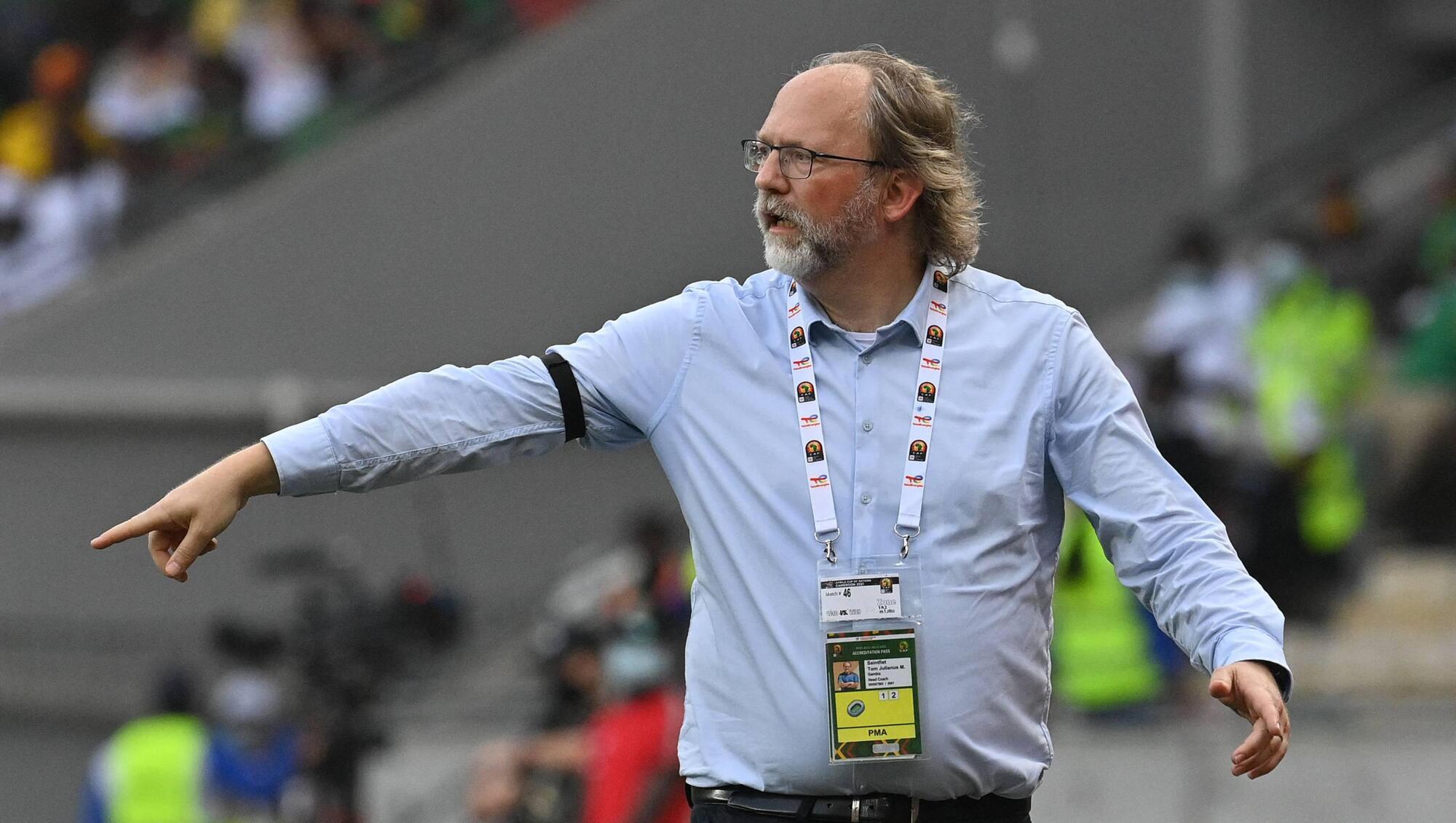
Gambia's Belgian coach Tom Saintfiet
GAMBIAN coach Tom Saintfiet said he and his players feared for their lives after the plane taking them to the Africa Cup of Nations made an emergency landing, delaying their arrival at the tournament in the Ivory Coast.
Gambia’s squad set off from Banjul on Wednesday for the short trip to Yamoussoukro, where they will play their opening two group games, but minutes after take-off they turned around because of a lack of oxygen inside the plane, he said, adding: “Luckily for us, the pilot recognised the problem and after nine minutes in the air turned around to land again. We all fell asleep.”

The Gambia full-back Saidy Janko, formerly at Manchester United and now with the Swiss champions Young Boys, posted a detailed description on social media. “As soon as we entered the small plane that was hired to fly us, we noticed the immense heat that left us dripping in sweat. It was assured to us by the crew that the air condition would start once we are in the sky,” he wrote on Instagram. “The inhumane heat mixed with the occurring lack of oxygen left many people with strong headaches and extreme dizziness. Furthermore, people started falling deeply asleep minutes after take-off.
“Whilst in the air, the situation got worse, leaving the pilot with no other option, than initiating an emergency landing back in Banjul airport nine minutes after take-off, which happened successfully. If it wasn’t for this, the consequences could have been a lot worse.”
A statement from the Gambia Football Federation said preliminary investigations indicated that there was a loss of cabin pressure and oxygen. “However, the technical team of the operating company of the flight, Air Côte d’Ivoire, is further assessing the situation to establish what caused the lack of oxygen and cabin pressure,” it read.
Saintfiet said his players were still struggling with nausea and headaches on Thursday, but that they were due to depart at 4pm local time. Gambia play their opening Group C game in Yamoussoukro on Monday against the defending champions Senegal.
Gambia, whose population of some 2.64-million pales in comparison to most countries at this month’s tournament in the Ivory Coast, are competing at the finals for a second time but in their debut appearance two years ago were giantkillers and progressed to the quarter-finals.
"I'm aware that it will be tough to repeat what we did two years ago. Cameroon, Guinea and Senegal are all top contenders and it is a group of death but I don't think any of them is pleased about the prospect of going up against us," Saintfiet said in a pre-flight conference.
Gambia have progressed rapidly since the arrival of the nomadic Belgian, who had nine different national team coaching jobs before moving to west Africa.
"When I arrived, Gambia were 172 in the world, and they had not won a competitive match for five years. My first salary was the least I'd ever earned but I had made an analysis of the team and I felt there was potential," he said.
"I told the federation president I’d qualify them for the Cup of Nations but he laughed and said ‘first win a match’. But they gave me the freedom to do my job and we slowly built a successful process."
Gambia qualified top of their group to make the 24-team field for the 2021 tournament and continued the upsets at the finals in Cameroon, beating Tunisia and Guinea before succumbing to the hosts in the quarter-finals.
The recipe two years ago was a determination to stay involved in the tournament as long as possible.
"Our attitude was we are not just happy to be here; rather we'll only be happy if we stay as long as possible here. I think that determination was the strength of the team. They were heartbroken when we finally went home," Saintfiet said.
Behind his desk at home in Belgium, Saintfiet has a display of 10 football shirts – all of the different national teams he has coached. His first was Namibia in 2008, and since he has worked in Zimbabwe, Ethiopia, Yemen, Malawi, Togo, Bangladesh, Trinidad & Tobago and Malta before Gambia.
Some of the assignments lasted only months but the 50-year-old says he drew from each experience.
"When I look back, each job helped me to be a better coach, giving me unique insights and helping me learn from mistakes," he added.
His stewardship of Gambia is without a doubt his most successful mission to date and there is every determination to upset the odds all over again.
"We are underdogs but we like it that way," Saintfiet said.