Kenny's Ireland fall to Dutch defeat in drab Amsterdam affair
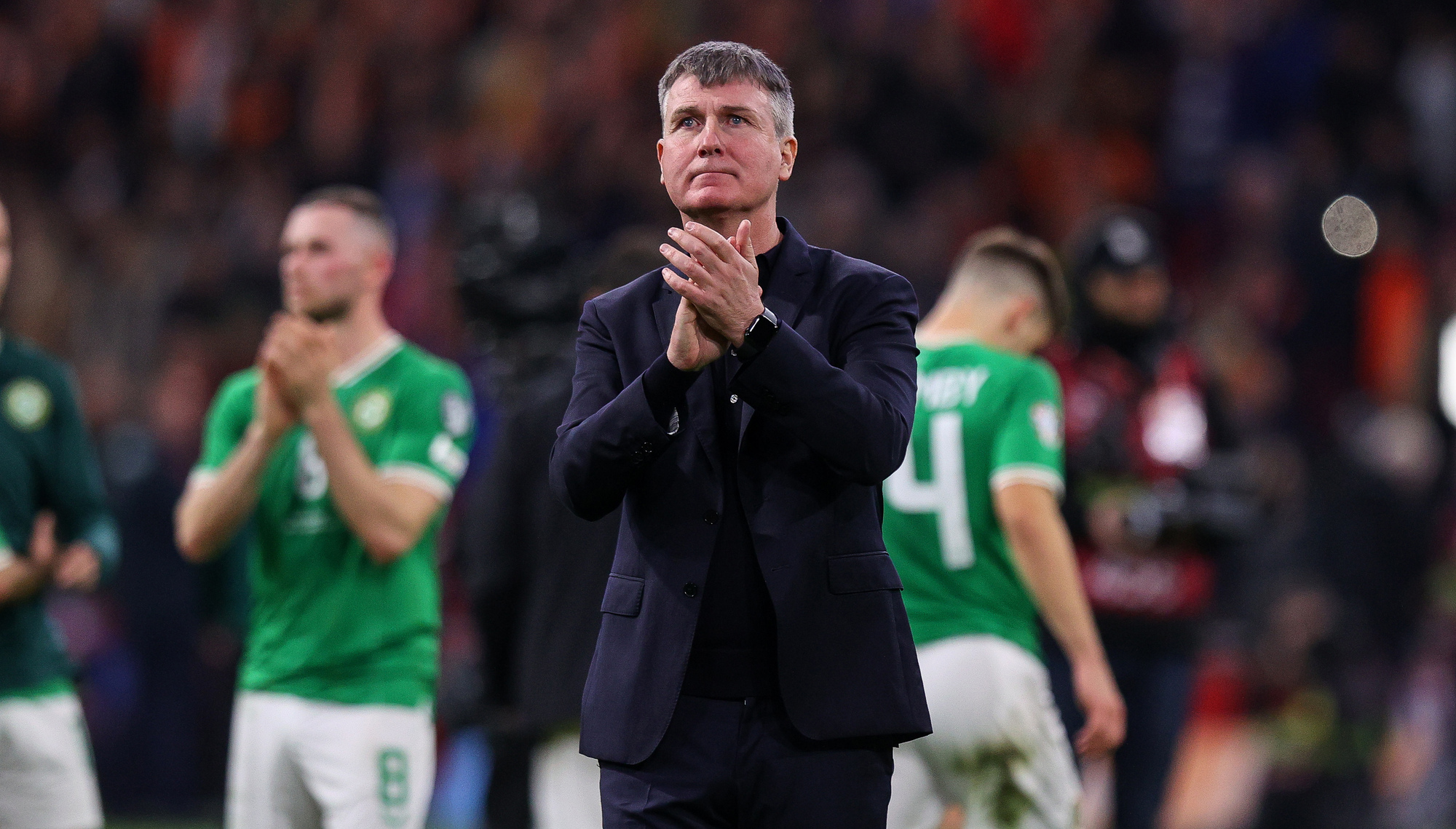
END IS NIGH: Ireland manager Stephen Kenny after the game. Pic: ©INPHO/Ryan Byrne
A solitary goal was needed for the Netherlands to clinch Euro qualification but the presence of the celebratory props confirmed their confidence of completing the double over Ireland.
Similar to the first game, Wout Weghorst was the matchwinner, belying his reputation as a gangly target man to barge clear and tuck a sumptuous shot into the top corner after 11 minutes.
A slender winning margin but no doubt which of the teams deserve to be in Germany next year.
This defeat ends Stephen Kenny’s era with a record of six losses from their eight qualifiers – the only points coming against a Gibraltar side dismantled 14-0 by France.
That he didn’t even use this dead rubber to introduce Andy Moran – snared from the Under-21s for their defeat in Norway on Friday – adds to the rap sheet of the outgoing manager.
He did his best to bow out resolute until the end.
September’s home defeat, which effectively killed off any hope of recovery from a ropey start, was characterised by Ireland’s lively opening fading into familiar failings.
Something similar unfolded here, only it wasn’t franked with a goal.
Adam Idah grabbed that breakthrough in Dublin and his fellow Corkman Alan Browne was presented with the chance to silence the home crowd on six minutes.
Slack passing out from the back allowed Callum Robinson to activate the press by retrieving possession and freeing Browne through the inside channel.
He opted to shoot early but could only do so with the outside of the boot and Bart Verbruggen was unnerved, standing tall to easily save.
Stephen Kenny had cited Josh Cullen as pivotal to Ireland’s plan of taking control of the proceedings and that was a possibility given the absence of Frenkie de Jong.
A Dutch midfield of Jerdy Schouten and Tijjani Reijnders had between the pair a mere five caps but they were the duo who seemed experienced by dominating.
Ireland couldn’t gain a foothold, constantly being dispossessed and unable to find their way into space. Daley Blind nicking the ball off Browne to tee up Xavi Simons for a dribble he concluded by firing wide sounded the alarm for the pattern that was to ensue.
Stefan de Vrij was only starting due to an injury crisis ravaging their defence but the 31-year-old strode out from the back once the gap appeared in front of him.
His rolled pass towards the halfway line could have picked out either Denzel Dumfries or Weghorst but the latter cutely tugged on the shirt of Nathan Collins to both floor him and create a clear lane to dart into.
Known for his aerial power, the former Manchester United forward displayed his footwork by travelling to the edge of the box and rifling his rising shot inside the near post.
That the lead, scored precisely on 11 minutes, wasn’t added to by the break was a mystery, for the breakthrough was the forerunner of superiority that bordered on showboating.
Weghorst’s back-heel was too heavy for Cody Gakpo to reach but the Liverpool attacker tormented a new Irish defence that struggled for cohesion.
Reijnders twice went close, firstly firing a left-footer wide following a dribble from right to left and approaching the break Bazunu had to turn over another drive when Gakpo teed him up.
Aside from Ireland’s corner that Browne tried unsuccessfully to pick out Ryan Manning with on the edge of the box with, they were seldom not in defensive mode.
The lack of fans didn’t help. As occurred in Greece in June, significant delays in accessing the stadium led to rows being vacant for the first half. Tickets were scarce for the sold-out fixture.
Gapko had ghosted behind Ireland’s defence unmarked in first-half stoppage time but chose to set up Weghost, whose shot was deflected out for a corner.
He was again culpable within two minutes after the restart by inadvertently blocking a close-range shot from Simon after he’d swapped passes with Dumfries on the counterattack.
Pressure continued to mount.
After denying Weghorst from point-blank range, Bazunu bundled a shot from Reijnders, this time from his right foot, onto the post.
Ireland’s great hope Evan Ferguson came into the match carrying an injury and it showed as he was sluggish, replicating what he’s been forced to do against France in March – retreat into his own half to gain any semblance of service.
He made way early in the second half, applying ice to his hamstring, another worrying sign for the teen.
Idah was more effective off the bench for the second half, breaking the one-way traffic just past the hour by latching onto Manning’s lofted pass and drilling a shot at Verbruggen.
Perhaps it was down to being underworked but the Brighton ‘keeper made a hames of the save, allowing the ball through his legs and trickle over the line. His embarrassment was saved by the assistant’s flag for Idah straying marginally offside.
He again couldn’t keep the right side two minutes later when releasing Cullen but at least there was some hope of a leveller amid the trend of what had preceded.
Still, Dumfries and Reijnders might have added a second. The midfielder’s miscontrol in the box enabled Collins to dash across to clear when a goal seemed certain.
Hope existed while the narrowest of margins existed but it was immaterial when it came to the serious business of trying to get Ireland back to tournaments. That decay had set in five months ago in Athens.
A sea of orange engulfed the pitch at full-time as the DJ’s tunes abounded to a crowd with something big to embrace next year.
Ireland will again be mere onlookers.
Bart Verbruggen; Stefan de Vrij, Virgil van Dijk, Daley Blind; Denzel Dumfries, Jerdy Schouten (Marten de Roon 88), Tijjani Reijnders (Teun Koopmeiners 90), Quilindschy Hartman; Xavi Simons (Donyell Malen 80), Cody Gakpo (Joey Veerman 70); Wout Weghorst.
Gavin Bazunu; Dara O’Shea (Troy Parrott 90), Nathan Collins, Liam Scales; Matt Doherty (Mikey Johnston 77), Josh Cullen, Alan Browne, Ryan Manning; Callum Robinson (Adam Idah 46), Jason Knight (Jayson Molumby 77); Evan Ferguson (Jamie McGrath 55).
Marco Di Bello (ITA)
CONNECT WITH US TODAY



Be the first to know the latest news and updates