Samuel Eto’o investigated by Cameroon police over match-fixing allegations
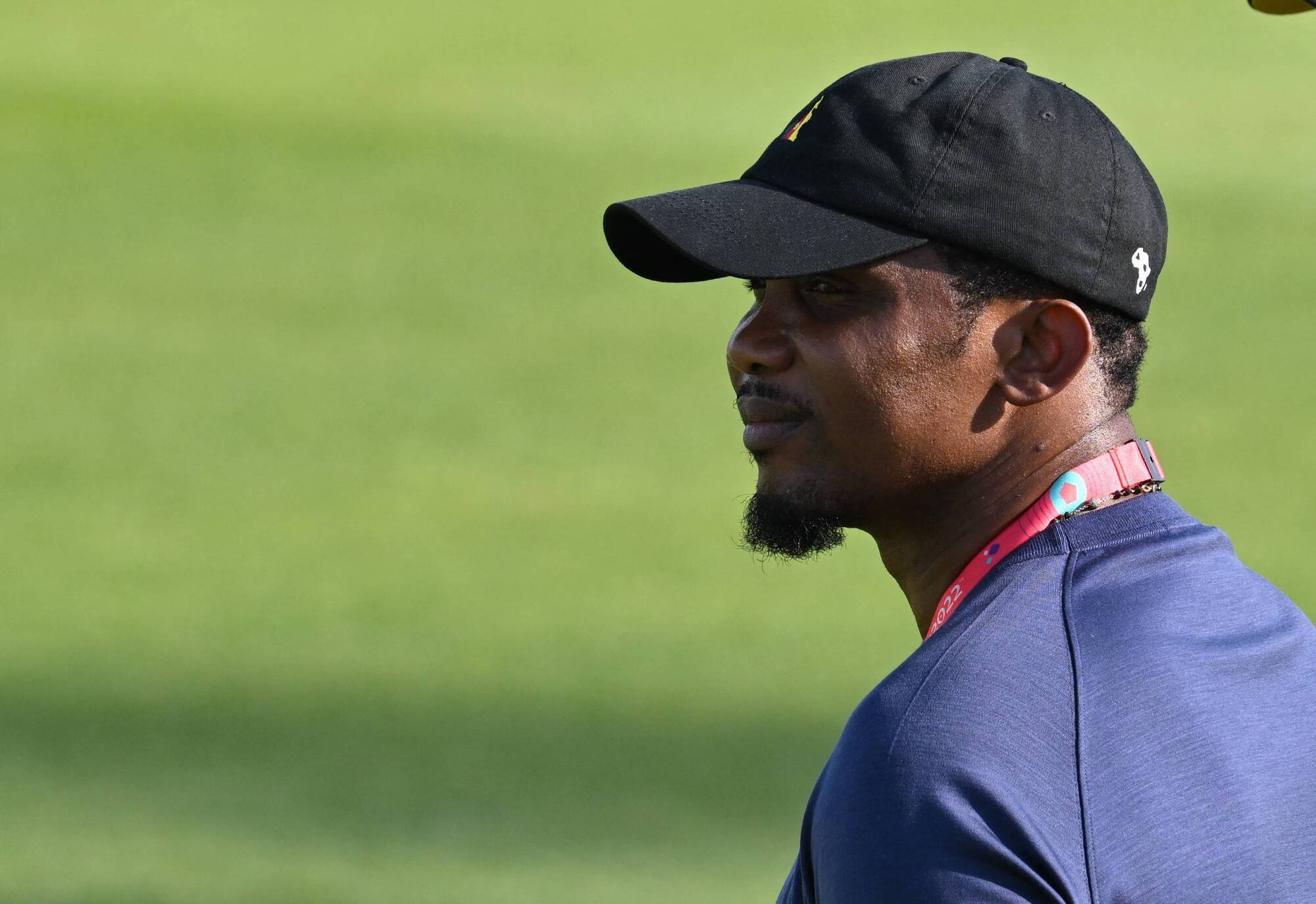
Cameroon's Football Federation president and former player Samuel Eto'O fils attends a training session on November 27, 2022 at the Al Sailiya SC in Doha on the eve of a Qatar 2022 World Cup football match between Cameroon and Serbia. (Photo by ISSOUF SANOGO / AFP) (Photo by ISSOUF SANOGO/AFP via Getty Images)
Police in Cameroon have opened an investigation into claims that Samuel Eto’o was part of a match-fixing scandal.
The former Barcelona striker, who has been president of the Cameroon Football Federation (Fecafoot) since December 2021, was accused of helping to fix matches in Cameroon’s second tier in July after a recording of him speaking to someone alleged to be Valentine Nkwain, the president of Victoria United and known as ‘Bobdidy’, was made public. According to Camfoot, Eto’o allegedly promised to promote the club from the second division by manipulating matches – a claim denied by the former striker and by Nkwain, who has said it was not his voice on the recording.
Police have confirmed in a letter, seen by the Guardian, that they have opened an investigation into alleged “abuse of authority and corruption”. They are understood to have interviewed several key witnesses involved in the case. The investigation will also look into wider accusations of corruption at Fecafoot during Eto’o’s tenure, which it is believed could involve up to 40 people.
On the recording, Eto’o is alleged to have informed Nkwain that “there are things we can do” regarding a game in which Victoria were beaten 1-0 in December last year “but you have to be very discreet, brother”. “Don’t worry, we’ll give you your three points and we will suspend the referee,” he is alleged to have said. “Opopo [Victoria’s nickname] must go up to the first division. This is our goal. This is our federation. Victoria United will go up.”
Victoria went on to be promoted in April.
Eto’o told the Italian newspaper Gazzetta dello Sport in June that he had been “talking to a friend, someone who invests in football and wants to make his club one of the best in Cameroon”. He said: “I just reassured him by saying that I would have done everything possible to avoid any refereeing errors against him.”
The news comes after a group of Cameroon’s football officials called on Fifa to take action against Eto’o after a series of public incidents, including a “violent altercation” with an Algerian journalist at the World Cup in Qatar last year. The group – which includes Pierre Semengue, president of the Professional Football League of Cameroon – have written a letter jointly addressing Fifa’s president, Gianni Infantino, and the Confederation of African Football (CAF) president, Patrice Motsepe, questioning how the former striker has been allowed to continue “to illegally impose himself on the Fecafoot presidency”.
A investigation into “certain alleged improper conduct” of Eto’o was opened by CAF in early August but no action has been taken.
“Not a word has been heard from Fifa,” the letter reads, “despite numerous complaints and reminders from Cameroonian football actors. How can Fifa continue to remain silent in the face of so many scandals that compromise public confidence in sporting ethics and the sincerity of matches?”
The letter was also critical of Infantino after he and Eto’o were pictured together earlier this month in France to discuss “football development”.
Meanwhile, one of Eto'o's former clubs, Barcelona, are under formal investigation for suspected bribery in an investigation spanning two decades of activities at the country’s refereeing committee, according to a court document seen by Reuters.
The investigating judge, Joaquín Aguirre López, said this month that Barcelona may have benefited from “possible systemic corruption”. In a statement in February, Barcelona denied any wrongdoing.
In March prosecutors filed a complaint over alleged payments of more than €7.3m over 17 years to firms owned by José María Enríquez Negreira, who was vice-president of the football federation’s refereeing committee (CTA) from 1993 to 2018.
Reuters has been unable to reach Negreira. RFEF and Barcelona were not immediately available for comment.
Barcelona said in February they had paid an external consultant who supplied them with “technical reports related to professional refereeing”, which the club said was a common practice among professional football clubs.
According to judge Aguirre, Negreira was responsible for ranking and evaluating the referees. However, no evidence has been found of Negreira paying referees to influence match results, Aguirre said in early September.
Guardian


CONNECT WITH US TODAY



Be the first to know the latest news and updates