It's 1981 all over again — but Ireland find themselves a world away now
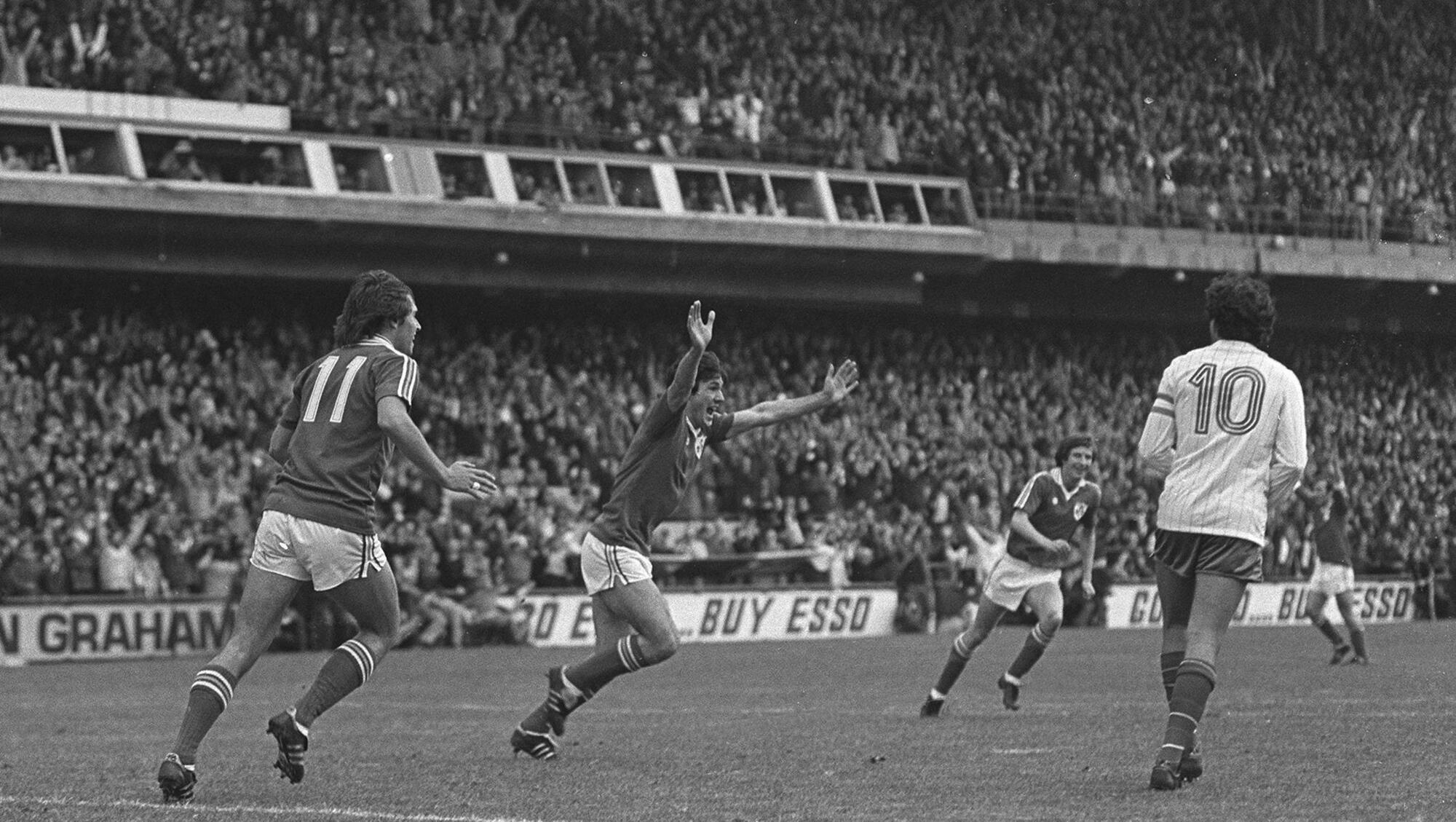
MOMENT IN TIME: Republic of Ireland's Frank Stapleton celebrates scoring his side's second goal with team-mates Michael Robinson, 11, and Ronnie Whelan as France's Michel Platini, 10, looks on during the World Cup 1982 Qualifier at Lansdowne Road. Pic: Ray McManus / SPORTSFILE
We’ve been here before. Only here isn’t the same place as before.
As daunting as it seems having to play both France and the Netherlands back-to-back in qualification games for a major tournament, it is a scenario which Ireland has previously not just survived but thrived in.
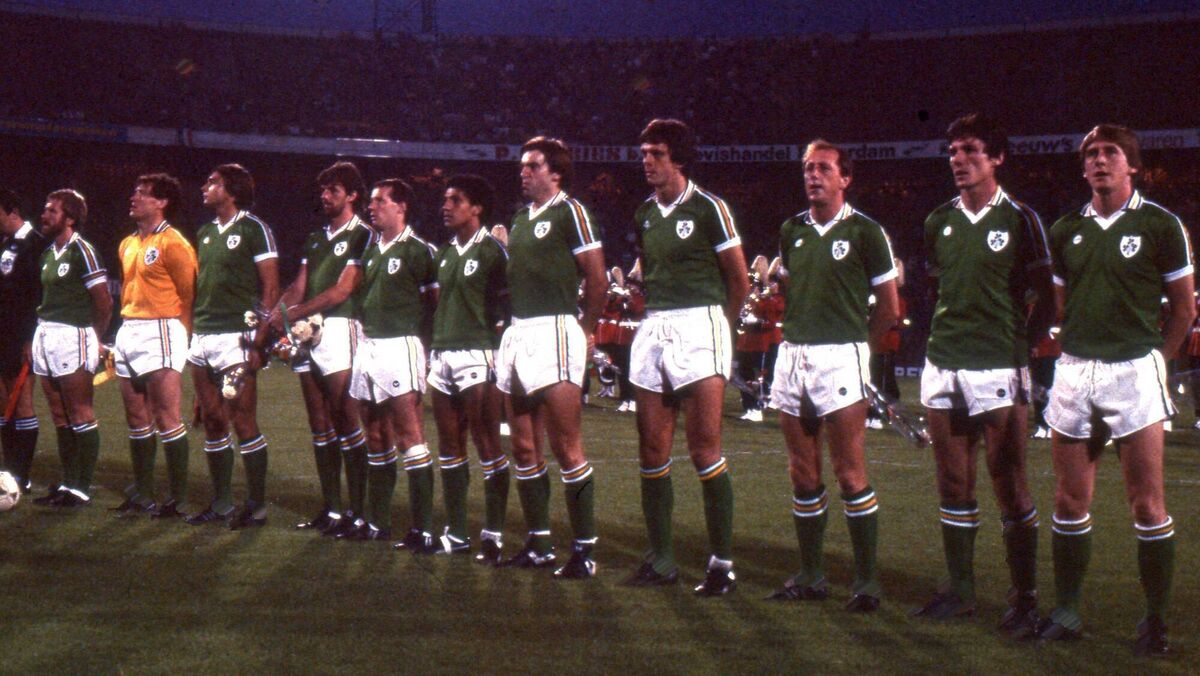
When Stephen Kenny’s team line out against the Dutch on September 10, it will be exactly 42 years and a day on from when the same two countries played out a 2-2 draw in the Stadion Feijenoord, Rotterdam.
Ireland’s subsequent game in that 1982 World Cup qualifying campaign saw Eoin Hand’s team beat France 3-2 in front of 53,000 back in Dublin the following month. It was, as Hand noted in his autobiography, the biggest crowd to that point that had ever watched the national team at home. “It felt,” he’d write, “like all of Ireland had been crammed into Lansdowne to inspire us to victory.” France and the Dutch were at the time much like they are now: formidable, laden with big-name players with big-game experience.
That French team went on to reach the semi-finals of the following World Cup and win the following Euros, just as the core of Didier Deschamps’ squad reached last year’s World Cup final and contains players that have won a World Cup and contested the final of the (2016) Euros. For Mbappe now, they had Platini then.
As for the Dutch, they were coming off a last-eight appearance in a major championship, just as they are now.
Their lineup featured household names that had played in at least one of the two previous World Cup finals: Krol, van de Kerkhof, Rep; just rolling them off the tongue, they still sound magnificent. They even had a couple of players playing with one of the top teams in England: their two goalscorers on the night, Frans Thijssen and Arnold Muhren, had only months earlier won a UEFA Cup with Ipswich Town, just as Gapko and van Dijk have linked up at Liverpool.
It’s Ireland though that has changed drastically — our team and the world we live in.
It may be hard for at least one generation to fathom but when Hand’s team stunned the French with three goals before half-time, kickoff was at 3pm on a Wednesday; as Lansdowne hadn’t any floodlights, most of the crowd had to skip or leave work and school early so the game could be completed ahead of the October twilight. For the game in Rotterdam, this writer and his father were hardly alone in watching it on the second television in the house and that second television being black and white.
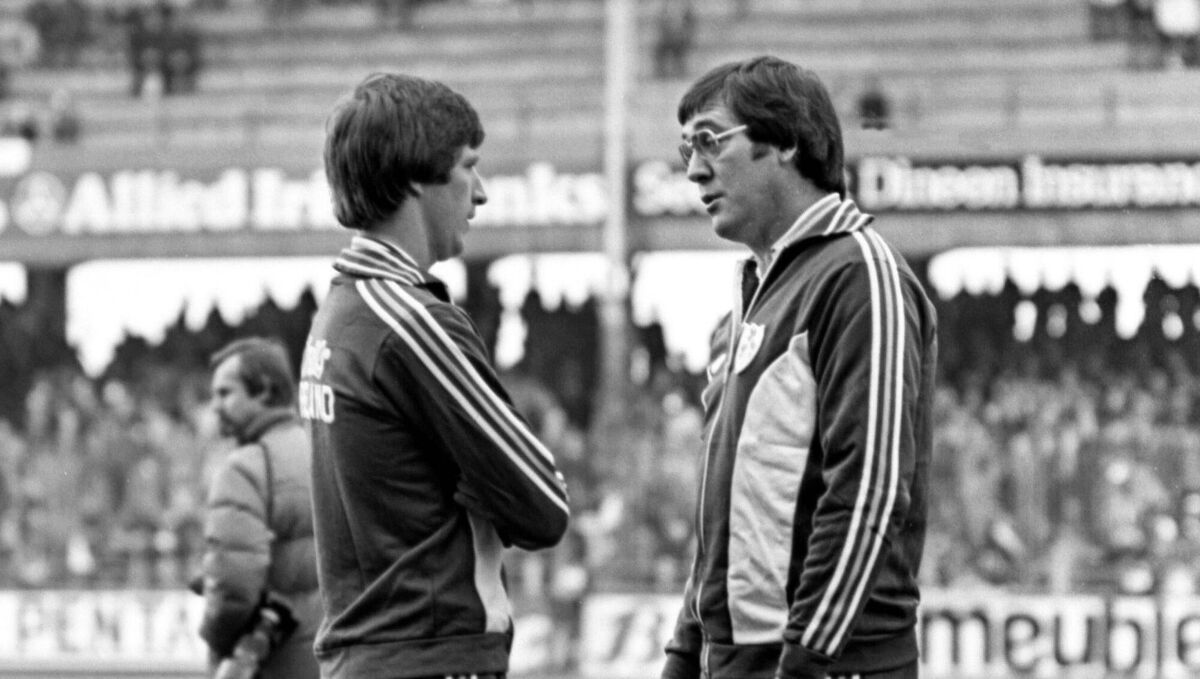
The profile and makeup of the national team is also from another age. Ten of the 14 players that started for Hand over those games against France and Holland in the autumn of 1981 had or would play in Europe for four of the biggest clubs in the UK.
O’Leary, Brady, Stapleton had all started for Arsenal in the Cup Winners Cup final the previous year while John Devine was on the bench that night in Heysel (yes, there were other nights in Heysel before 1985). Lawrenson, Robinson, Heighway and Whelan all won European Cups with Liverpool. In 1984 Chris Hughton would win a Cup Winners Cup with Spurs (by which time he had been joined by Tony Galvin). That same season in that same competition Kevin Moran and Manchester United knocked out at the quarter-final stage a Barcelona team featuring Maradona.
Of the 25-man squad Stephen Kenny has announced for next week’s back-to-back games, not one of them is playing with an English team that are competing in Europe this season (in contrast, 18 of Deschamps’ 25-man French panel, as the writer Aidan Fitzmaurice has noted, will feature in the Champions League).
Only three of Kenny’s squad are ‘declarees’. Will Smallbone’s mother is from Kilkenny. Will Keane’s father is from Sligo. The sole player to avail of the granny rule is Josh Cullen, as that particular relative of his hailed from Leitrim.
Hand, in contrast, was able to make full use of that mechanism. Four of the 14 players who featured in that autumn campaign of ’81 — Lawrenson, Hughton, Robinson, and Seamus McDonagh — were born and reared in England. A fifth, Steve Heighway, though born in Dublin, moved to England as a young child.
So what has changed? England, that’s what. Back then they were sleeping at the wheel. Now they are very much awake at it, underlined by the appointment last month of former Nottingham Forest academy chief Gary Brazil as the FA’s head of recruitment and retention for their national teams.
His beat is to ensure that England do not lose talented players who are eligible to play with both England and another nationality. They’re to get in there before an Ireland identifies them or caps them; in truth, like they have for the past decade at least, casting their net wide and handing out underage caps quite liberally by virtue of the multiple tournaments and friendlies they organise. And even when Ireland has got to them first, they can still change their mind. Be sure that Brazil will be looking for a Tom Cannon to follow a path Jack Grealish and Declan Rice have gone before.
And then, most obviously, there’s been the birth of the behemoth that is the Premier League. In 1992-93 there was only one French player operating in it, a chap by the name of Cantona. There were just four Dutch. The Republic of Ireland, in contrast, had 33, the most number of non-English players in the league, bar Scotland on 43.
By the time we played the Netherlands on a famous September afternoon in 2001, there had been a remarkable demographic shift in the makeup of that league.
There were now 14 Dutch players playing in it; in fact 10 of the players who Louis van Gaal played on the day that Jason McAteer put the ball in the Dutch net would play in the Premier League at some point. And there were 40 French players, more than any other country, bar England, naturally. As to who had the second-most? The Republic of Ireland, on 32.
We’re sixth now. Behind Brazil (33), France (30), Spain and Portugal (22), and the Netherlands (21). With 19, we’re still ahead of ‘home countries’ Scotland and Wales (15 apiece) and the likes of Denmark and Belgium (15 each as well), but the few that are regulars are playing with teams in the lower half of the table. As the title of a Kevin O’Neill book in 2017 put it, Where Have All The Irish Gone?
One answer is the lower divisions (and often their upper echelons); O’Neill calculated that between 2009-2010 and 2014-2015, a total of 51 Irish players featured in the end-of-season divisional play-off finals across the three lower leagues. Eight Irish players featured in the 2015 Championship play-offs.
This season Ireland leads the way in all three lower divisions as the country with the most number of non-English players.
According to the website transfermarkt.co.uk, we’ve 47 in the Championship, 42 in League One, and 52 in League Two, nine more than Wales. In 2004, the same autumn that Brian Kerr sent a team to Paris that outplayed France everywhere but on the scoreboard, Wales had six more than us playing in that league.
In short, we’ve more players than ever — and far more than in the early 1980s — playing professionally in England and across Europe.
They’re just not playing with top teams that qualify for Europe. As O’Neill put it, “They’re playing for unglamorous clubs in unglamorous places. They know Oxford and Oldham, but not Old Trafford.” Yet next Thursday we’ll have a team playing in Paris, led by a man on his last lifeline on Who Wants To Be An Irish International Manager?.
Maybe he’ll somehow come up with all the right answers posed by Deschamps, and then Koeman.
But Irish football still has a lot more questions to ask and solutions to find in this new world.

CONNECT WITH US TODAY



Be the first to know the latest news and updates