Arsenal take on history and Liverpool voodoo with elusive title in sight
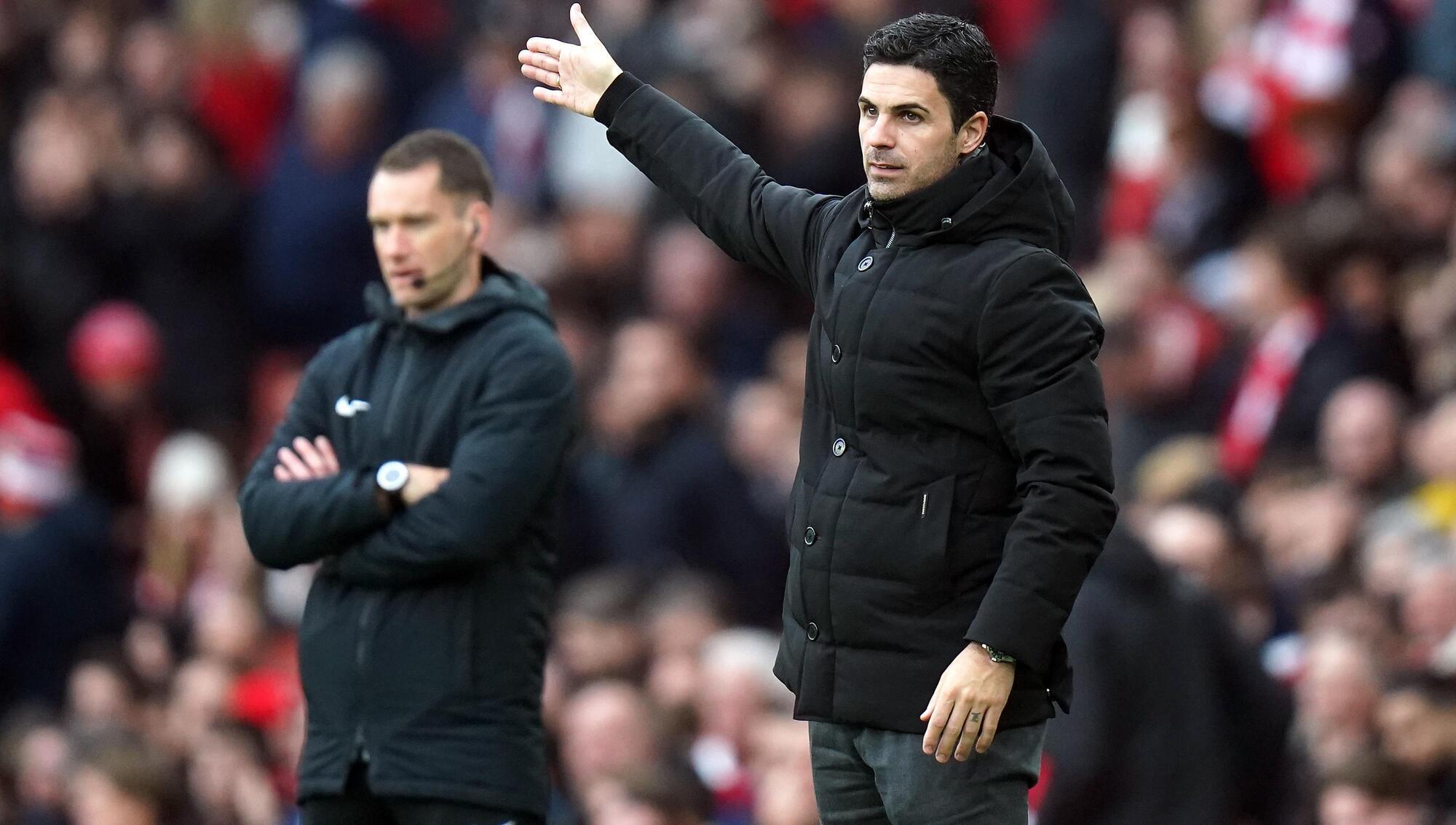
ANFIELD STRUGGLES: Arsenal manager Mikel Arteta. Pic: Adam Davy/PA Wire
These days, for reasons of practicality as much as anything else, you very rarely see a team deciding to switch ends after the pre-match coin toss. But in 2018, in a Champions League quarter-final against Liverpool at Anfield, Pep Guardiola’s Manchester City did. In one of English football’s first recorded instances of a Pep overthink, City decided to switch ends to prevent Liverpool from being able to attack their favoured Kop end during the second half. Genius. Instead, Liverpool banged in three goals in the first 30 minutes, and went on to win 5-1 on aggregate.
Sitting on the City bench that night was assistant coach, Mikel Arteta, who had already endured his own harrowing Anfield experience a few years earlier. In 2014, Arsenal were still chasing that elusive league title when they visited Anfield for a Saturday 12.45pm kick-off. By 1.05pm they were 4-0 down, their gameplan in ruins, a sensory overload of red shirts and white noise having temporarily interrupted the function of their limbs. Arteta was Arsenal’s captain that day and would testify after the 5-1 defeat that he had never seen Arsene Wenger so angry.
A few years later, Arteta would explain the sensation to . “You say: ‘I don’t know what’s going on, stop the game please, because I don’t know where I am,’” he remembered. “At Anfield you can concede five without knowing. There is a word we use in Spain in cycling, pájara, when a cyclist looks amazing, then in one kilometre he goes boom, and looks like he’s struggling again. Suddenly I could only see red shirts flying around. The game is passing over me and I can’t react. I can’t do it emotionally, physically I can’t cope, everything goes too fast. I only had that feeling once in my career, and it was at Anfield.”
Which if you’re an Arsenal fan is a particularly comforting paragraph to read the day before your team travel to Anfield in a game that may well decide the fate of the Premier League title. And of course Guardiola and Arteta are by no means the only ones to have encountered the Anfield ley lines and felt curiously moved by the experience. “The only place you don’t want to go,” Wenger once said of the place. “For 90 minutes, you live in hell,” said Etienne Capoue, whose Villarreal side were well beaten in a Champions League semi-final first leg last year.
And for all the confected mythology of the place, there is something uniquely menacing about the modern Anfield, with its steep stands and enforced intimacy, the first row of seats perched a few feet from the touchline. Like all big stadiums, it occasionally succumbs to indifference and tourist-driven apathy. But on certain days, when the noise walls you in like a prison, it becomes a sporting protagonist in its own right. “You feel small,” as Guardiola puts it. “It’s a bugger of a ground.”
Speaking on Sky Sports last weekend, Gary Neville revealed that Alex Ferguson used to tell his Manchester United players that if they won at Anfield at this time of year, they would win the league. And over the years, that theory has been largely borne out. In the Premier League era Anfield has proven a kind of boss-level challenge for title-chasing teams, a test not just of gameplans but of guts, not just of mentality but mettle, not just of systems but self-control.
Every contender to have conquered Anfield between February and May has gone on to win the league. For Ferguson’s United in 1993 and 1997, for Carlo Ancelotti’s Chelsea in 2010, for Guardiola’s City in 2021, victory at Anfield became a kind of fortifying moment, the point at which they began to convince themselves this thing was won. By the same token, Anfield has been where many title challenges have run aground: Kevin Keegan’s Newcastle in the famous 4-3 of 1996, Manuel Pellegrini’s Manchester City in 2015.
Only three clubs have lost at Anfield in the run-in and gone on to win the Premier League, all of whom could lean on mitigating circumstances. Manchester United were 13 points clear by the time they lost in 2001. Blackburn in 1995 were reprieved on the final day by United’s failure to win against West Ham. And in 2014 Manchester City’s choke at Anfield was ultimately superseded by Liverpool’s subsequent, elite, world-shattering choke against Chelsea and Crystal Palace.
A couple of seasons ago, as shown in the All or Nothing documentary, Arteta tried a novel technique to prepare his players for the Anfield roar. He installed speakers alongside one of the training pitches and forced his players to train to the strains of You’ll Never Walk Alone. Arteta described it as “one of my crazy ideas” and after a 4-0 defeat it is an idea that has probably remained in storage.
And given Liverpool’s form, the incoherence of their press, the porousness of their defence, there is an argument that even to acknowledge the Anfield voodoo is in many ways to self-prophesy it. At what point does all this become counterproductive? Arsenal have played themselves to the top of the Premier League by trusting the process, by treating every opponent with the equal amount of disrespect. Why throw all that out for a trip to the Premier League’s eighth-placed team?
The counterpoint is that when you raise the stakes, you also raise the spoils. For all their travails this season Liverpool have remained tough to beat on home turf: just one defeat, both Manchester clubs conquered, Bournemouth beaten 9-0. Arsenal’s record there is particularly abject; win at Anfield for the first time in more than a decade and they will establish themselves not just as favourites but as presumptive champions. It’s just one game, three points. But for Arsenal — in both the literal and figurative sense — this means more.


CONNECT WITH US TODAY



Be the first to know the latest news and updates