Irish football not getting fair share of funding compared to GAA, argues outgoing FAI chief
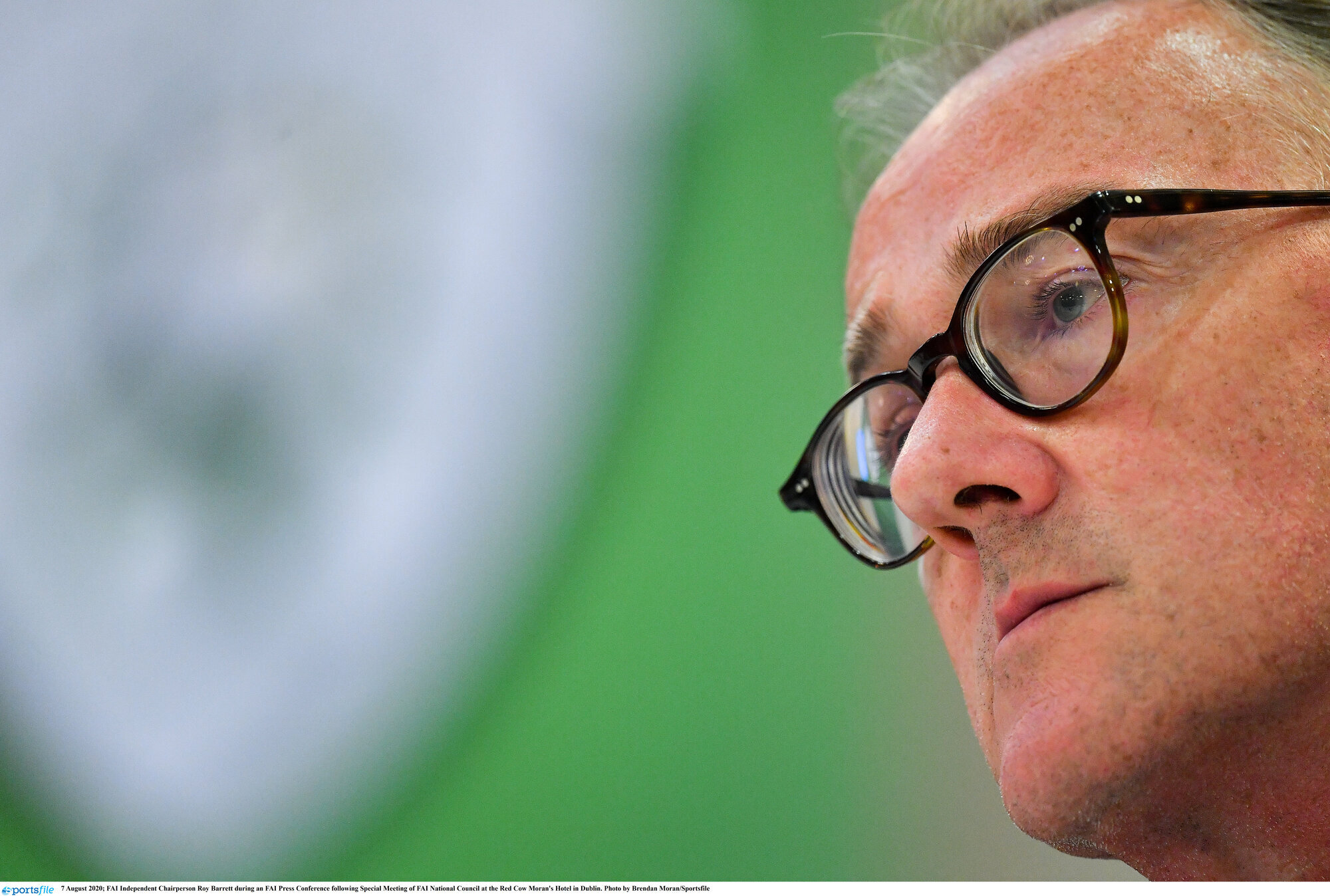
POLITICAL FOOTBLL: Roy Barrett is stepping down to facilitate the FAI’s government-set obligations of meeting their 40% female quota of board members by the end of 2023. Picture: Brendan Moran/Sportsfile
Outgoing FAI Chairman Roy Barrett has hit out at the shortage of Government assistance to football, citing unfairness in the GAA receiving almost quadruple the amount of state aid.
Barrett, appointed as the FAI’s first independent chair amid the fallout of the financial and governance crisis of 2019, will depart this year once his successor is sourced by the FAI nominations.
He, along with fellow independent director Gary Twohig, is stepping down to facilitate the FAI’s government-set obligations of meeting their 40% female quota of board members by the end of 2023.
Before he takes his leave, the ex-Goodbody Stockbrokers MD, who is now chief executive of wealth investment firm CastleGate, pleaded with the Leinster House overlords for the finance to upgrade the country’s antiquated facilities.
League of Ireland venues, in particular, are in dire need of improvements to harness the renewed interest from spectators, while the requirement is equally, or not more, pressing for clubs involved in the underage and amateur sections around the country.
In that regard, the association is in the process of quantifying the cost – using the services of a Welsh specialist company – before presenting their masterplan to leading politicians and Sport Ireland.
A figure of €1bn over a decade has been floated in high-ranking circles – an eye-watering amount but necessary, if Barrett’s view on the disparity of handouts is to be rectified.
“The most obvious area the organisation needs to focus on now is the whole development of infrastructure within the game because the reality is there has been chronic underinvestment in Irish football for the last 20 years or so,” Barrett said, referring to the priorities beyond his tenure.
“People can look at all the reasons as to why that has happened, but the only thing we all agree on is that it is a fact.
“If I put it in context: since 2000, and we can argue whether it is right or wrong, but the fact is that the GAA have got about €430m in government grants, football has got €118m, rugby has got €57m.
“If you look at that per club, GAA has got €208,000 per club, rugby €280,000 per club, and football less than €100,000 per club. We have 1200 different clubs, the facilities are grossly inadequate for where we are and where we are going.
“There’s 220,000-odd registered players, 43,000-odd registered volunteers, and it’s a huge community sport. Football needs a huge amount of significant investment from a governmental and other perspective.
“Where the focus should be is clearly on bridging that gap. That’s just where the state of facilities are. We have five million or so people in the country now, 500,000 more than we thought from the last Census, and by 2040 it is due to grow by a million more.
“That will be the natural birth rate and also people who are immigrants to the country, and by definition there will be a more significant bias among that cohort for the game of football as it’s the only significant international sport we play and is supported.
“Whatever chronic need there is now, there will be a greater need in the future.” Barrett, who turns 60 this year, has been a controversial supremo at times and admitted to some regrets without offering specifics.
“There is no one thing I have regrets about,” he explained. “If I thought about it there are probably lots, but nothing substantive.
“How bad was it? Listen, it was a complete mess from a financial perspective. That was probably the most obvious part of it. What wasn’t as apparent was the damage done to the organisation itself, its reputation.
“Staff confidence levels were really just shot to pieces. That’s within the FAI, outside the FAI all the reputational issues made life for the people in the organisation extremely difficult.
“Going into it I knew that is what it was going to be. I was probably, at a level, surprised that in many ways it was kind of worse but that is what it was. But I had confidence that with time and with effort that could be restored because behind the organisation and all that went on there was a fantastic game. It is the largest participation sport in the country where there is a massive passion for it, for the intentional teams and all aspects of it.
“Societally it’s really important. I may have come not from "in" football but I have always loved football.
“I have always played it and always had a passion for it, so when I was asked to [become chairman] I didn’t really think twice about it because I do think football is important in this country.”

CONNECT WITH US TODAY



Be the first to know the latest news and updates