Chelsea and Gianluca Vialli — that’s amore
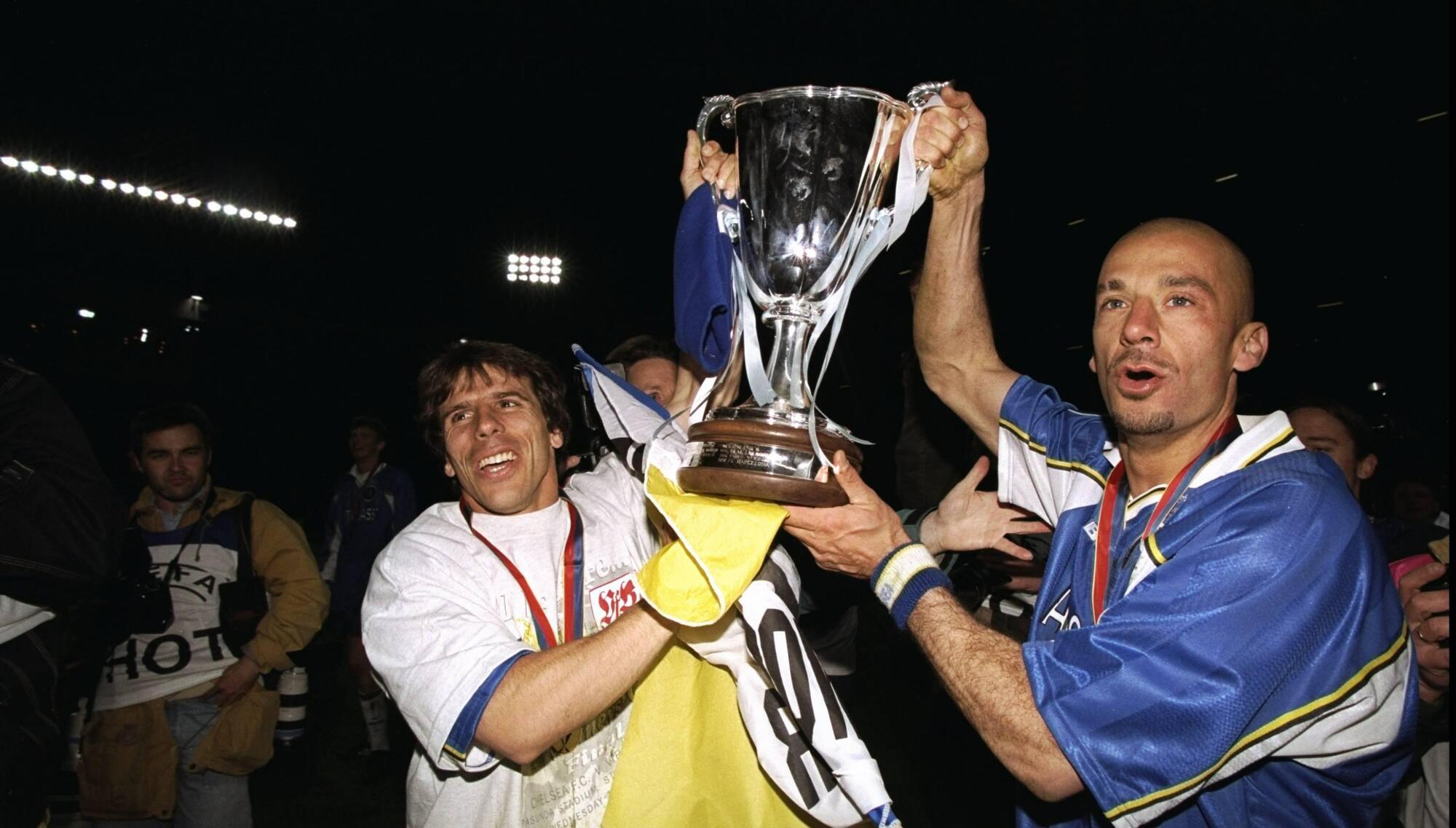
LONDON PRIDE: Chelsea player/manager Gianluca Vialli and Gianfranco Zola show off the European Cup Winners Cup after defeating VfB Stuttgart in the May 1998 final at the Rasunda Stadium, Stockholm. Chelsea won the match 1-0. Pic: Ross Kinnaird/Allsport
There are many images which can be recalled to honour the life of Gianluca Vialli, whose untimely death at the age of 58 to pancreatic cancer is being marked and mourned throughout the world of sport.
Vialli, wearing gloves, barrelling through the icy drifts in Tromso like a runaway snow plough to score two vital goals with an orange ball to keep Chelsea in the European Cup Winners Cup in October 1997, a competition they would win with him as player-manager seven months later.
Another brace against Liverpool at Stamford Bridge to overhaul a 0-2 FA Cup deficit after half-time, a victory which led to their first FA Cup triumph since 1970. An express run down the right wing and inch-perfect cross onto the head of Gianfranco Zola to confound Vicenza in a match which is rated as one of the five greatest European nights in SW6 (AC Milan 1966; Bruges 1971; Barcelona 2000; Napoli 2012).
But for many the enduring memory of his Premier League years came at the start of November 1996 against the Premiership winning Manchester United of Roy Keane and Eric Cantona. Chelsea won 1-2 at Old Trafford and the decisive goal was scored on a breakaway run by Chelsea’s new centre-forward.
Vialli was faced by the daunting barrier of Peter Schmeichel but with Italian gusto he slid the ball through the legs of the onrushing Danish goalkeeper. It inspired the song that was forever associated with him and would be heard at grounds around Europe sung to the tune of the Dean Martin hit Amore: “When the ball hits the back of the Old Trafford net, that’s Vialli. When he nutmegged the Dane and poor Fergie’s in pain, it’s Vialli.”
Vialli, the son of a millionaire and one of five children, was brought up in an expansive castello in Cremona in Lombardy, Northern Italy. But for a child of privilege, he never lost a sense of humility, or the common touch, or his understanding of the link between players and supporters.
He compared Serie A with the Premier League saying: “Italian fans are all about results. English fans are more about effort. They want to see the team and the players try very hard. If you do your best, if you sweat in the shirt at the end of the match, win or lose, they will clap you and support you and tell you that the next game will be a better one.
“You are basically one of the fans. You are an extension of them on the pitch wearing the shirt you are playing for.”
And that is but one of the reasons he was revered by supporters at all four of his clubs. Cremonese in the lower echelons of Italian football; Sampdoria, the main team of Genoa where he made his name in partnership with Roberto Mancini. His last game was a European Cup Final defeat to Barcelona at Wembley before he made a world record (€14m) move to Juventus which brought him a Scudetto, a Coppa Italia, a UEFA Cup, and then in 1996, a Champions League victory on penalties over the defending champions, Ajax, at Rome’s Stadio Olimpico.
His arrival in London marked a significant transition for Chelsea Football Club who had begun to prosper under the player management of Glenn Hoddle. When Hoddle was tempted away by England and replaced by the Dutchman Ruud Gullit the scene was set for a continental drift which carried the Blues and the Premier League forward for more than two decades.
Gullit was committed to delivering fluid and exciting football and the ambitious Vialli and a current Italian international Roberto Di Matteo were the first trophy signings of his 1996/97 campaign, followed in November by Gianfranco Zola. It was a perceptive triumvirate of acquisitions. Chelsea have always been supported by a large Italian contingent, in much the same way that there is a Jewish core in the stands at Tottenham and a large Turkish following for Arsenal. A commentator during the heyday of the Gullit reign rhapsodised: “That’s a goal that sums up Chelsea. Di Matteo to Zola to Vialli. The Italian Job.”
Vialli’s first goal, in his first match, against Coventry was celebrated with an homage to the Sistine Chapel with half the team lying on the ground pointing skywards.
Vialli scored 40 goals in 83 games for Chelsea but he fell out of favour with Gullit and was mainly used from the substitute’s bench. This led to him famously being captured skulking in the tunnel during a match at White Hart Lane smoking a cigarette.
On another occasion, during a victorious FA Cup semi-final, Dennis Wise pulled up his match shirt to reveal a message to his teammate: “Cheer up Luca, we all love you.”
Vialli was given a token five-minute cameo in Chelsea’s Cup Final victory over Middlesbrough which brought the Londoners’ first major trophy for 26 years and there were suggestions that he would move on. Instead it was Gullit who departed at a critical stage the following season with Chelsea second in the league and in the quarter-finals of two cup competitions after falling out with the combustible chairman Ken Bates. Bates said it was over Gullit’s demand for a new contract which was €3m “netto” (free of tax) although this is denied by the Dutchman.
It was Vialli who took over, despite saying that he could never become a manager because he would find it impossible to drop players. Success accelerated. In his first game in charge, a pre-match glass of champagne with the team inspired Chelsea to knock Arsenal out of the League Cup and go on to win the trophy. Outstanding matches in Europe delivered the Cup Winners' Cup with victory over Stuttgart and this was then followed by defeating Real Madrid in the Super Cup. Of all Chelsea managers only José Mourinho has won more silverware than Luca Vialli.
Vialli’s 1998/99 season saw his team finish third, just four points off Manchester United and many believe crucial injuries to Gus Poyet and Tore Andre Flo and the loss of a two-goal lead at home to Leicester cost them the title. To this day you can hear veteran supporters mutter “Steve f***ing Guppy” about the Foxes winger who scored the equaliser at Stamford Bridge.
Vialli took Chelsea into the Champions League for the first time in 1999/2000 and there were outstanding performances including a 5-0 dismantling of the, then feared, Galatasaray at the Ali Sami Yen stadium in Istanbul. They reached the quarter-finals and were within ten minutes of knocking Barcelona out at the Nou Camp before the game went into extra time and they collapsed to a 6-4 aggregate defeat. The season ended brightly with another FA Cup Final victory, this time over Aston Villa in the last game to be played at the old Wembley.
Vialli’s dream time with Chelsea ended early the next season with an indifferent start and reports of rifts with veteran players and he became the second victim of a recurring pattern at Stamford Bridge, the dismissal of a coach irrespective of success. But his love affair with London continued and he remained in the capital for the rest of his life living in Belgravia with his wife Cathryn and daughters Sofia and Olivia.
When he arrived Luca, as he liked to be known, declared that he “wanted to be a Chelsea legend” and he was loved for the way he adapted to his new life, allowing himself to be coached in Mockney phrases by his captain, the irrepressible Dennis Wise, and close friend Ray Wilkins. He would drop these in disarmingly during interviews, once telling a journalist that he knew exactly what to do “when the fish are down.” He also said he had been warned not to appear to be a “Charlie Big Potatoes.” And he never was.
For moments such as these Chelsea supporters were happy to overlook his sartorial style, such as wearing shoes without socks, and it is clear that other supporters loved him for it. A statement from Sampdoria on Friday said: "We won't forget your 141 goals , your overhead kicks, your cashmere shirts, your earring, your platinum blonde hair, your Ultras bomber jacket. You gave us so much, we gave you so much: yes, it was love, reciprocal, infinite. A love that will not die today with you."
For the man who took Chelsea into the Champions League where they have now competed for 18 campaigns; who said that the next task was to win the Premier League and who influenced five transformational seasons for the Blues, his loss might best be marked by the comments of one supporter on the club’s official site on Friday: “Now I know how my dad’s generation felt when Osgood went.”
Or “ciao amico mio – thank you my friend” as Chelsea’s Italian fans would say.
CONNECT WITH US TODAY



Be the first to know the latest news and updates