Danny Murphy: City must build sustainable team model
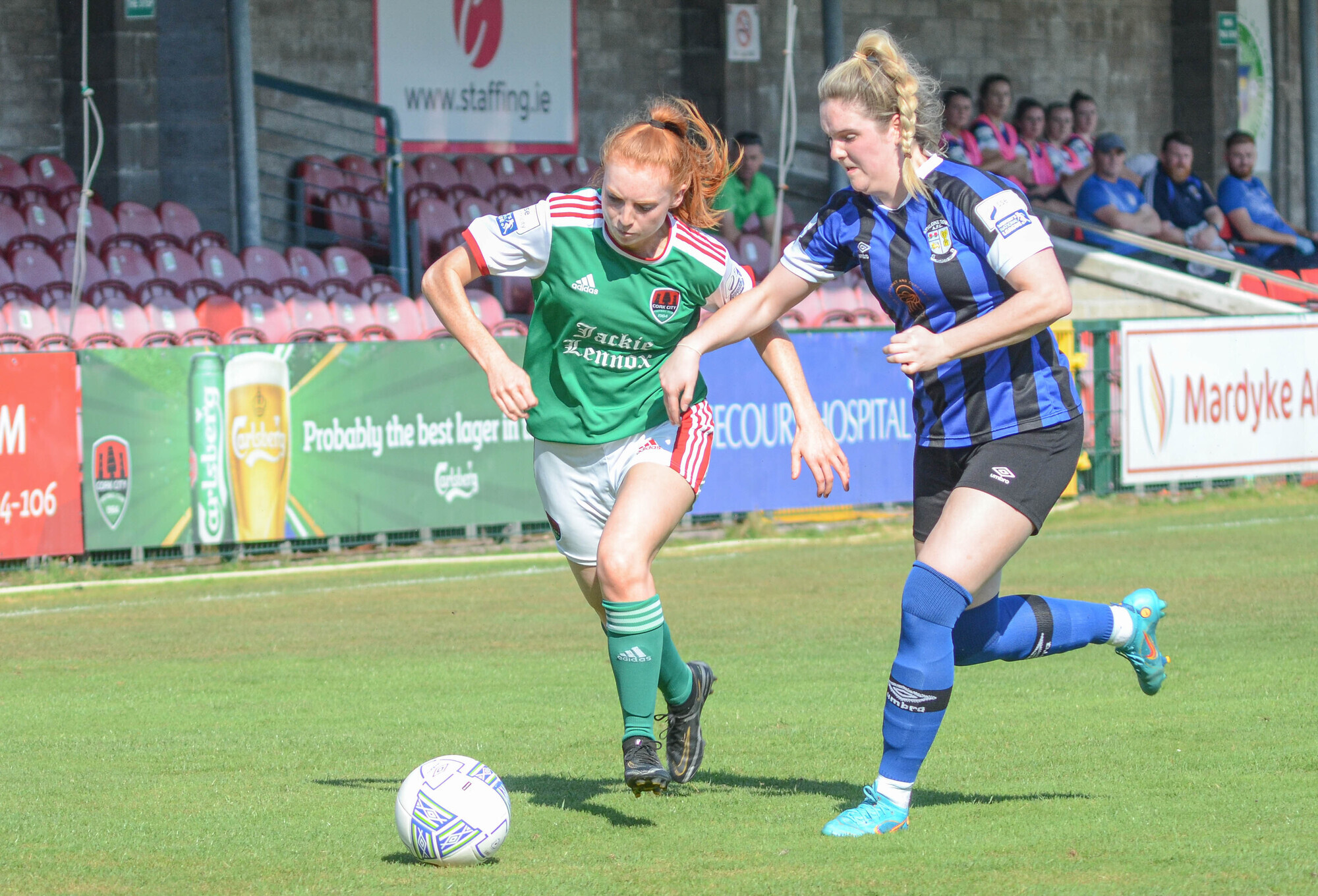
SUSTAINABILITY: Cork City's Nadine Seward and Athlone Town's Kelsey Monroe tussle for a loose ball during the SSE Airtricity League Womens National League match at Turners Cross. Picture: Howard Crowdy
N anticipation of all boats rising across the women’s premier division, few dare to caution about the prevailing risks in staying afloat.
Last season was all about ditching the ‘pay-to-play’ plague whereas the chatter for the campaign ahead starting in February is ‘playing-to-be-paid’.
Shamrock Rovers are leading the charge.
An eight-year hiatus from the senior women’s scene presented a window to learn from original mistakes and they’ve embraced the FAI’s upgrade of the domestic top-flight to professional status which facilitates contracts and wages instead of amateurs being paid subsistence.
Cork City aren’t there yet and their manager Danny Murphy isn’t convinced a perceived correlation between monetary reward and performance should hinder the Rebels for the new season.
They kick off on March 4 against back-to-back champions Shelbourne at Turners Cross.
Since City lost the 2020 FAI Cup final to Peamount, they’ve become accustomed to operating on the lower rungs of the table.
Results did improve following Murphy’s arrival in late May; five wins from his 13 games a foundation to build upon for his first full term at the helm.
Rather than hanker for a recruitment spree, the former City player will concentrate on adding selected personnel to a young squad not lacking talent, only the clinical side of the game.
City’s new owner Dermot Usher has made it clear he expects each section of the club to wash its own face, an approach Murphy agrees is essential to achieve sustainability.
Rovers are not alone across the league in committing funds to salaries and the disparity in flows of cash concerns a manager who experienced the carnage of financial mismanagement, at City in 2010.
“The reality is we’re not in a position to start giving semi-professional contracts yet,” explained Murphy.
“Costs associated with running a national women’s club in Ireland are substantially more than the income generated. That means running a loss from the start.
“Our objective is to attract larger attendances and sponsorship by improving the results.
“My ultimate goal for Cork City to be the most successful team in the country but it has to be sustainable at the same time.
“It’s great that clubs are using some money from their men’s section to invest in the women’s side. But the danger is that once the men’s team slip, the first area to be cut is the women.
“We’ve seen that with clubs in England. For example, Gillingham got rid of their women’s team. That situation will not change if there’s dependence on the men’s side of the business.”
Murphy admits the financial limitations impair his ability to entice Cork-born players currently with other league clubs to join their hometown outfit.
Retaining those in-demand players among his squad is a priority too, given the Ireland U17 and U19 squads that recently progressed to the elite phase of the European qualifiers featured three City players apiece.
It helps too, considering the age profile, that City harnesses the third-level hub of Munster.
Five of the nine players studying at UCC do so through the assistance of the club’s scholarship scheme while another seven attend Munster Technological University.
Others have benefited from links to industry. City cannot guarantee players a job but will utilise contacts where possible to point them in the right direction.
The selling point of being part of the country’s best-supported club, outside of Shamrock Rovers, is obvious but fundamental deficiencies had to be rectified when Murphy returned to the club where his still revered.
“It was well-known the squad were struggling for training facilities but, although it doesn’t belong to Cork City, Ringmahon Rangers now feels like our home,” he explained about their training base.
“We also organised food on matchdays, which may seem a little thing but it all adds up.
“Blame culture was a major problem at the start, with players having too much authority, and we had to ensure their only concern was playing instead of getting involved in background stuff.
“I think we have players well capable of being in contention for Ireland’s World Cup squad in the summer and of moving to the UK.
“I’ve been asking players, will joining a Dublin club for a few hundred euro per week make a massive difference to their life, when Cork as a club and city has so much going for it? They can still get the transfer abroad directly by staying here.”
So much of what Murphy values relies on trust. Inevitably, a cycle of defeats drains confidence. Murphy didn’t believe he had the strengths to address that side of things but he had a contact at the vanguard of mental wellness and resilience.
“Steve Sallis is a specialist who has worked with English Premier League players,” explained Murphy, who recently turned 40.
“I’m a part-time manager who has a day job and wasn’t qualified to concentrate on the mental side.
“I’m going back to college to study psychology, which is a massive part of the game, so I reached out to Steve for his ideas.
“I want this to be more about Cork City and our principles rather than other teams. I didn’t like seeing players hugging opponents after defeats, like they’re best friends, when teams should hate coming to Turners Cross. Players must take pride in wearing that Cork City jersey.”
An emphasis on sharpening fitness was also paramount. Murphy possesses the stats to demonstrate the late concessions that incurred losses against Bohemians and
Shelbourne formed part of a trend.
“I knew players were tiring and it showed in the statistics,” he summarised.
“Our research proved that 35% of our goals conceded during last season came at the end of each half. Only by getting fitter and lasting the 90 minutes can that figure be reduced.
“I don’t care if players make mistakes, but they must work hard.
“We gave them an off-season training programme and, if any player is not fit when returning on January 14, they won’t kick a ball until they are.”
Basics before ambition.
Notions of 2023 being a whole new ball game on the back of World Cup qualification can’t cloud the necessity to first avoid sailing too close to the wind.


CONNECT WITH US TODAY



Be the first to know the latest news and updates