Didier Deschamps, a serial winner, has a chance to make more history
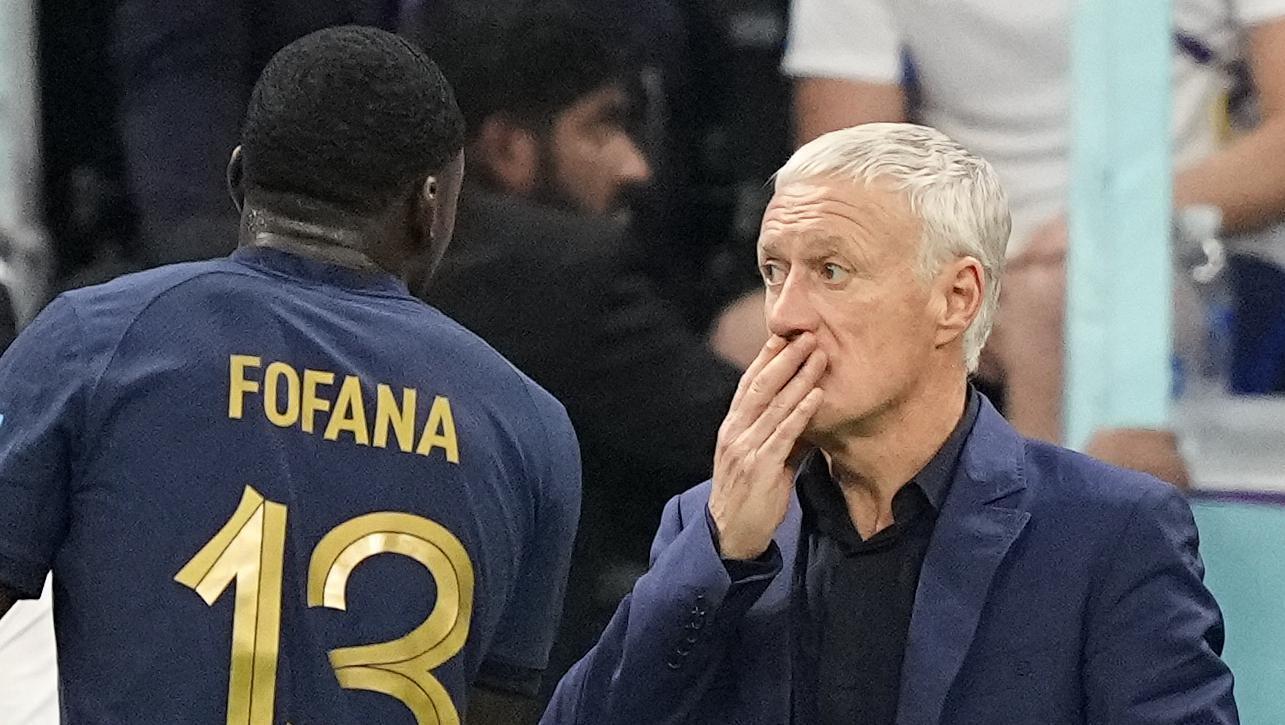
HISTORY IN THE MAKING: France's head coach Didier Deschamps, right, talks to Youssouf Fofana during the World Cup semi-final at the Al Bayt Stadium in Al Khor, Qatar. Pic: AP Photo/Martin Meissner
Seconds before the final whistle blew, Walid Regragui went over to Didier Deschamps for a congratulatory hug, perhaps in acknowledgement that he had finally met his match, out-thought by a master tactician. He and Morocco went close, but there was no cigar.
Neither was there any disgrace in losing to the World Champions, especially since Deschamps has made his side more formidable than the one that won in Russia four years ago.

And when the dust settled on this breathtaking battle that brought the curtain down on Morocco's extraordinary but ultimately unsuccessful campaign to become the first African side to reach a World Cup final, there were tears of joy and despair, celebrations and commiserations, and yet more hugs.
Regragui's next embrace was for Olivier Giroud, an old team-mate from Grenoble over a dozen years ago, when the Moroccan was winding down his modest playing days, and the young forward was embarking on a career that has now seen him become France's record goalscorer.
He could soon become a two-time World Champion too, as the French succeeded where Belgium, Spain and Portugal had failed, by beating Morocco, who just fell short despite an heroic effort on the pitch and spectacular support in the stands here at the Al Bayt stadium, where France had sent England packing on Saturday night.
Morocco did not go meekly, playing with the heart of Atlas Lions and only undone by two moments of class from Antoine Griezmann and Kylian Mbappe, France's outstanding players in this tournament.
They and their team-mates now face Argentina in the final on Sunday, and Deschamps can make history as the first man to win the World Cup as a player and then win it twice as a manager.
Not bad for a “water-carrier” as his one-time team-mates Eric Cantona dismissed him. In stark contrast to Regragui, Deschamps had a stellar career as a player and now as a manager, winning trophies galore as a midfielder with some of Europe's biggest clubs and then leading France as captain to the World Cup in 1998 and the European Championship two years later, amassing 103 caps on the way.
Regragui's playing career overlapped slightly, but was far more modest, mostly in France’s less glamorous clubs. He was also a full international, but never hit the same heights as a player or coach, and his appointment to the Morocco job earlier this year was met with scorn by some critics, who called him ‘avocado head’.
Yet by force of personality and with a smart tactical mind, he has moulded a team of undoubtedly talented individuals into a side to be reckoned with, arguably the team of the tournament, given the gulf between expectation and achievement. By the same logic, he is the coach of the tournament too.
In their defeats of Belgium, Spain and Portugal, three teams who were considered candidates to win the World Cup, lest we forget, Morocco defended with heart and resilience, and attacked with speed and intelligence.
But France were always going to provide a tougher test, with their depth of attacking talent and smart management by the wily Deschamps, who pulled off a masterstroke ahead of this tournament. Four years ago in Russia, France became world champions despite having a non-scoring centre-forward in Giroud. Their goal threat was largely provided by the precocious talent of Mbappe and the Harry Kane-like ability of Griezmann to play simultaneously as a goalscoring forward and a creative attacker.
But with Giroud back scoring goals for club and country, Deschamps decided to give Griezmann a different role, as a number ten, nominally in midfield but with licence to roam across the pitch and switch with Ousmane Dembele on the right wing from time to time.
For all Mbappe's brilliance on the ball and goals, Griezmann has been France's most important player, as he showed with another man-of-the-match performance following the one against England in the quarter-final.
Regragui's big test was to find a way to nullify the Atletico Madrid man, and unfortunately for Morocco, it did not work out. Only four minutes had gone when Griezmann slipped his marker, ran in on goal and cut the ball across, eventually falling for Theo Hernandez to volley home spectacularly. One-nil down and up against it, life did not get easier for the coach when he had to make changes 15 minutes later, with his gamble on the fitness of Romain Saiss failing, and the captain having to come off.
Regragui changed shape too, switching from a five-man defence to a flat back four, but with the outstanding Sofyan Amrabat providing a formidable shield.
His players gave their all, full of energy and fight, and they gave France a mighty fright. Hugo Lloris, surely a national treasure in France now, kept his side in the game with two superb saves in the first half. After the break, he was assisted by a goalline clearance from Jules Kounde and Morocco’s profligacy, as France showed the same resilience in defence that Morocco had mustered in earlier rounds.
Both coaches made substitutions, Regragui chasing an equaliser, Deschamps looking to close out the game by killing off Morocco, and two of his replacements were involved when Randal Kolo Muani made it 2-0 in the closing stages. The game was up for Regragui and Morocco, but he had never left his technical area until that final embrace.
His and his team's time will surely come again. Players wiped away tears and got down on their knees to bow towards their adoring supporters, having made history by becoming the first African nation to reach a World Cup semi-final.
Now it is the turn of Deschamps to break new ground, as France attempt to become the first side since Brazil in 1962 to defend their title.
Argentina and Messi stand in their way, but don’t under-estimate the water-carrier. He is a winner.