Billed as Modric v Messi, there was only one winner here
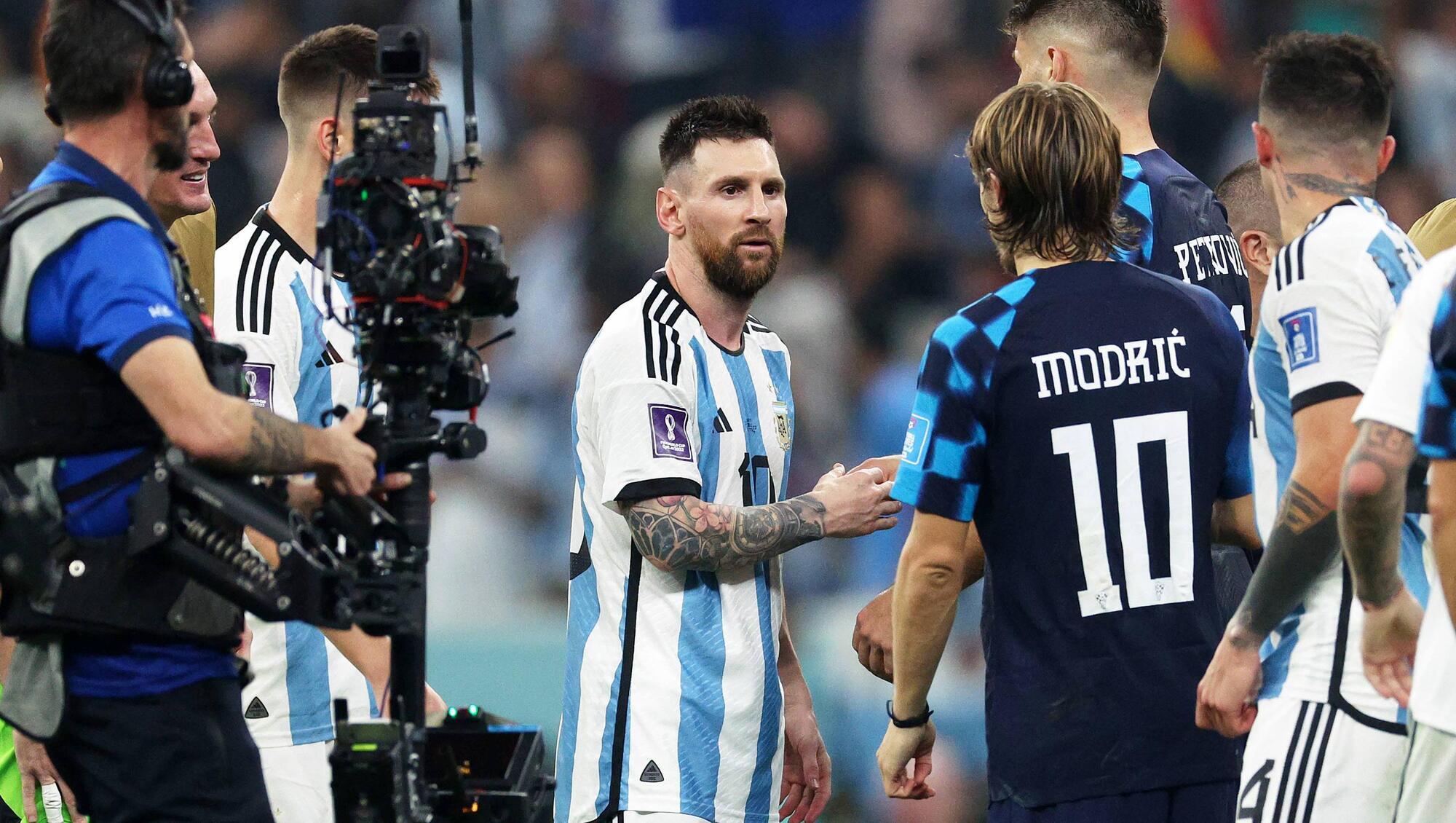
DUAL: Lionel Messi of Argentina and Luka Modric of Croatia shake hands after the FIFA World Cup semi-final match at Lusail Stadium in Lusail City, Qatar. Pic: Richard Heathcote/Getty Images
Forget Argentina v Croatia; in the modern era of global football and the new-fangled fan, this was billed as Messi versus Modric, the battle of two flyweights able to call themselves heavyweights, small in stature but giants of the game.
In the end it turned out to be a mis-match, so one-sided that if it had been a boxing bout, the towel would have been thrown in well before the game was up.
As it was, the only cloth on show at the Lusail Stadium was a mass of scarves, hankies and t-shirts that Argentina's fans twirl around their heads in that distinctive way to indicate the total defeat of an adversary.
Not even a panel of Panamanian boxing judges could have marked this bout as anything but a huge win for Team Messi, with the Croatians suffering a metaphorical and physical bruising. Their plight was summed up when Luka Modric, their talisman and leader, was led off with ten minutes to go having had his head rocked back by a ricochet from Alexis Mac Allister.
Dazed he may have been, but there was no confusion about who did the damage here. The knockout blows had been delivered by Lionel Messi much earlier, scoring the first goal from the penalty spot after Julian Alvarez had been fouled, and then setting up the Manchester City man for two goals of his own.
It was a classic Messi masterclass, made more mesmerising by the fact that he was barely involved in the first third of the match, going walkabout, as he does, and barely breaking stride until he put his penalty past Dominik Livakovic in the 34th minute.
He was seen rubbing his left hamstring during the first-half and before kicking off the second half, raising concerns about his fitness, but when he needed to find that deceptive burst of pace he uses to get away from opponents, nothing was stopping him.
He was, inevitably, involved in the game's decisive moments. Tucking a penalty away from 12 yards was straightforward, but the clever, clipped pass that released Alvarez to run in and score his first goal shortly afterwards was the mark of a past master.
And Messi’s genius was on show in the mazy run he went on from touchline to byline in the 69th minute, holding off the powerful Josko Gvardiol, before cutting back for Alvarez to score again and complete a 3-0 win. For Argentina and their ecstatic fans, it was sweet revenge for the reverse scoreline in Russia four years ago.
The raucous celebrations went on between supporters and players long after the final whistle, and Messi was front and centre, just as he had been in the build-up.
Time was when managers, players and pundits would trot out cliches that it was all about eleven versus eleven, no individual is bigger than the team, may the best team win, and so on.
But the cult of the personality has now invaded football, just like it has in politics, and nowhere has it been more evident than at this World Cup in Qatar. It is there in the gleaming streets of Doha, where skyscrapers are adorned with giant images of the star players from each country. Billboards, posters, cups, t-shirts and every imaginable form of merchandising follows suit – forget the team, focus on the face of Argentina, Brazil, Portugal or whoever else is flavour of the month.
Fans in this part of the world, perhaps lacking any linkage to the competing nations, seize on superstars to support, and they don't come much more stellar than Messi. Cristiano Ronaldo is close, of course, and Neymar not far behind, but those two have gone home.
And while Kylian Mbappe may be waiting in the final on Sunday, Modric was billed as the man who might steal Messi's thunder and rob him of a chance to finally win a World Cup, thus ending all arguments about who is the GOAT (Greatest Of All Time, for those over 30).
It is reductionist, and trite, and does a huge disservice to the other ten players on the team, or 25 members of their national squads.
And this was Argentina's best team performance by a mile at this World Cup, which started for them with a humiliating defeat by Saudi Arabia in this stadium three weeks ago to the day. No longer can they be dismissed as Messi and ten others, such were the contributions of Alvarez and Mac Allister in attack, while Cristian Romero and Nicolas Otamendi defended heroically in front of Emilano Martinez, whose displays in Qatar make it increasingly difficult to understand why Arsenal let him go to Aston Villa two years ago.
It was close to a perfect night for Lionel Scaloni, who was able to give game time to Lisandro Martinez, Juan Foyth and even Paulo Dybala – remember him? The former golden boy of Argentinian football has been displaced as pretender to the throne by the precocious Enzo Fernandez.
But the throne is still occupied by King Messi, who now has the chance to go one stage further on Sunday than he did in 2014 by winning the World Cup final – and perhaps proving he really is the GOAT.


CONNECT WITH US TODAY



Be the first to know the latest news and updates