Letter from Doha: How Qatar has scrambled our sense of place
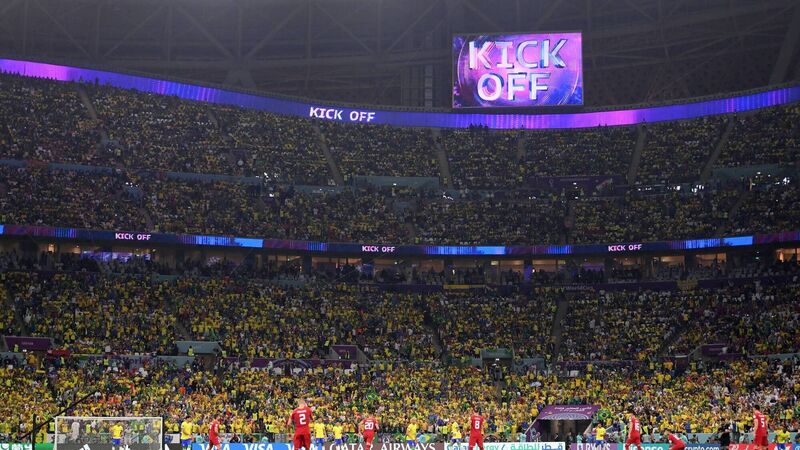
GET USED TO IT: The world didn’t just bring its cup here to Qatar…it brought its new, most globalised version of itself.
They were clapping and chanting ‘Iran’ with such pride and passion you could have been in Tehran, in the middle of the protests and fraught efforts that aim to bring new meaning to those four letters. Yet in between choruses they spoke to one another in Spanish.
The Indian ex-pat was wearing an Argentina jersey while waving a Saudi Arabia flag. He was from Kerala but “Saudi, it is my heart”.
The Canadian fans decked in red and white with maple leaves falling from head to toe hadn’t ever been there…but their kids went and haven’t come back. They’ve made roots somewhere new and passed new sporting passions back home to their parents in Pakistan.
Week one is almost in the books and there have been many lessons from crissing and crossing Doha looking for shortcuts that just aren’t here. The one that is likely to stick with us is this: in exchange for all those billions, the world didn’t just bring its cup here to Qatar…it brought its new, most globalised version of itself. We’d all better get used to it.
The ex-pat, migrant World Cup in this place where 92 per cent of the residents aren’t even from here has brought another 1.2 million visitors from all corners. But fewer and fewer of those corners are 90 degrees and linear. Routes here and life journeys that have dictated the colours on your back and in your heart have never been more circuitous and scrambled.
It’s as true on the field as off it, actually, and it’s all in keeping with these times. This is not a ‘let’s just park the labour exploitation and treatment of minority groups’ chat. By almost every measure and criteria, including most of FIFA’s own in 2010, Qatar is not the right host nation for a World Cup. Yet it does fit the bill as a place for this age of inter-connection.
There are times when it feels like you’re in the Middle East. Hearing the Isha call to prayer in the evening as you duck into a hole-in-the-wall Lebanese restaurant and have the meal of your dreams for, by relative Qatari costs, half nothing. But a lot of the time you could forget you’re in the Persian Gulf or even in the Arab world. You could be anywhere (mostly Vegas, actually).
The Souk Wakif, this ancient Arabian spice market that is the tourist hub is, in fact, a very modern creation in many parts, made to look as ancient as more celebrated bazaars. It all gives it an Epcot quality. By day and by night Qatar does a good job of scrambling your sense of place. If there was much of it left after the last couple of years.
This is not the first post-COVID World Cup because the pandemic has not gone away. However it is the first since we all went through those cycles of lockdown and opening up — to new ways of living. You’re probably reading this in a space that is your home but is also your work. The pandemic hyper-sped changes that may have been coming anyway. We all went with it, just kept on keeping on and now find ourselves in a new space where long-held perceptions of place fell to dust.
You no longer have to live in the same country, continent or hemisphere as where you work. You don’t have to be where you’re from because you are where you are and everyone is fine with it. If this is all starting to sound like a Saturday sermon from the Church of Scientology, we offer our apologies. It’s been a long first week at this World Cup that is so compact and yet everywhere feels so bloody far.
A contrast: the two most recent editions of this carnival. Russia in 2018 when the world arrived to a country that, sure, was a quarter century post-Glasnost but still felt insular and in certain places on certain days, very monocultural. Four years on, Russia likely feels even more that way. In 2014, it was Brazil. the island of South American nations, alone with its Portuguese tongue.
But Qatar this year will give way to the United World Cup of 2026, a bid that won on the back of its multicultural appeal. Canada is one of the most diverse countries on the planet.
The pace of football’s own globalisation remains relentless and here the international game is seeing what the club game saw first. When Argentina and Saudi Arabia met at the towering golden bath tub that is the Lusail on Tuesday, blue and white jerseys were evenly matched by Saudi dark green. But as the game began to drift and swing, it was Arabian voices that blocked out Argentine. That’s because a huge chunk of those in blue and white were there not to see and roar for Lionel Scaloni’s side, their country of origin, but to see Lionel Messi, the object of their devotion from afar.
Much like our sense of place, those of identity and nationality are more fluid now too. Over 130 players at this tournament are representing countries that aren’t their country of birth. All of which does actually lend some credence to one point Gianni Infantino made at his bizarre press conference, which was somehow just a week ago: the reaction, primarily through a western lens, to the groups of South Asian fans turning up at team hotels decked out in England or Argentina shirts was overblown. Of course they weren’t English fans…but they were fans of England. Which is perhaps even more unforgivable but that’s for another letter on another day.
This day and most here in Doha have gone by in whirr and blur. But it’s important to pause, because it’s not just the World Cup that has changed…the world has too. Time to get used to the place.
CONNECT WITH US TODAY



Be the first to know the latest news and updates