John Egan: 'The lads from home on the group chat would send a picture of you standing beside Aguero'
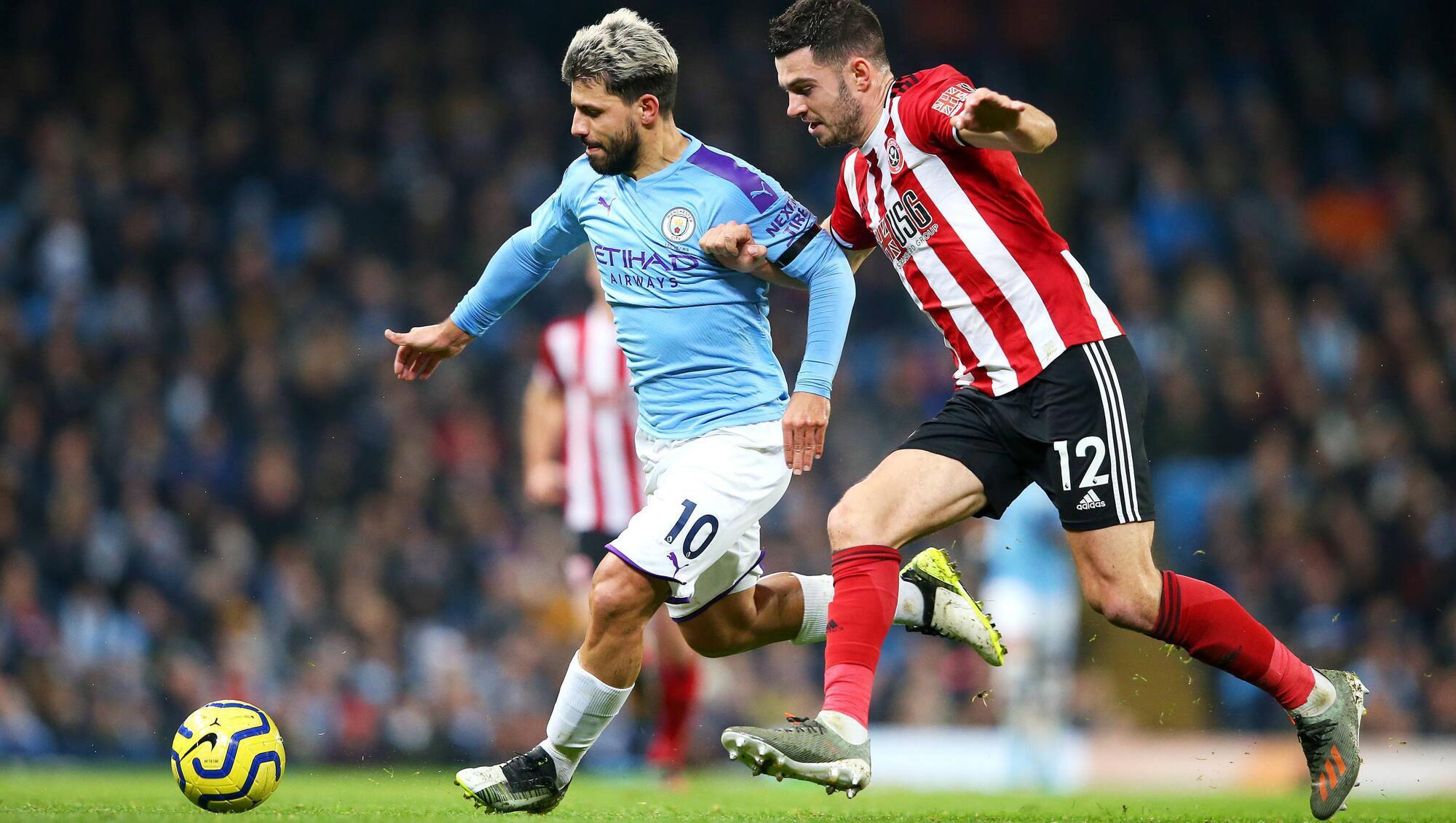
LOCAL BOY MADE GOOD: John Egan does battle with Sergio Aguero of Manchester City during the Premier League match between the sides in 2019. Pic: Alex Livesey/Getty Images
"I always had an unwavering belief that I would play in the Premier League."
Out on the local green, John Egan viewed every game through the eyes of an established Premier League footballer. Every tackle was combative. Every goal scored was glorious. Every moment was impactful. Right up until he was called in for his dinner, that is.
Every day was about playing football. Every day was about playing out that fantasy. As soon as he had raced home from school, it was out to his very own theatre of dreams. Come rain, hail or sunshine, Egan was there with his friends to play the beautiful game in the most beautiful way.
The surroundings of Bishopstown, a lively suburb in the south-west of Cork City, might not have been the amphitheatre that he saw in his mind’s eye but all it really needed to be was a lump of grass resilient enough to withstand a dozen kids trampling all over it. The other playground of choice was the Bishopstown GAA club, where he followed in the giant shadow of his father, John Snr.
A six-time All-Ireland winner with Kerry, his father was one of the very few men to be royally welcomed over the Cork– Kerry border, such was his glowing reputation as a legendary sportsman and respectable member of the local Gardaí.
Egan lived something of a double life throughout his youth. One life looked destined to follow a similar trajectory as his father in becoming a star of Gaelic games (he was just as good with a hurley and a sliotar as he was with a football). The other was on the soccer field, where he was excelling with Greenwood FC and earning call-ups to Republic of Ireland underage squads.
A decision had to be made. A hard decision. GAA or soccer? He didn’t want to disappoint his father, but then again his father never put any pressure on him to do anything other than what he enjoyed most. That made it easy: it was soccer.
It helped that scouts were making regular visits to Greenwood to nod simultaneously in acknowledgement of every good thing that Egan did on the pitch. They all wanted to capture his signature, but it was Sunderland who eventually succeeded.
Swapping the comforts of home for an unknown world in the north- east of England wasn’t easy. He had to leave behind family, friends and everything that he knew. Egan, though, has always been a strong-minded person, unafraid of making big decisions.
As for his time with the Black Cats, it’s probably best to allow Egan tell the story: "I started getting on the bench when I was 19,’ he says. "My first game [on the bench] was away to Manchester United at Old Trafford in November 2011 in the Premier League. On the Friday before I had been training with the first team, in the way that reserve team players make up the numbers sometimes, and then out of nowhere the reserve team manager Keith Birken rang me and said, 'You’re travelling with the first team'. I was absolutely buzzing. I didn’t get on that day but it was still an unbelievable experience. Actually, James McClean was on the bench that day as well. I got on the bench again against Fulham the following week. Something happened with Michael Turner during the game, I think it was his nose, and the manager Steve Bruce told me to get warmed up. I was running up and down the sideline, constantly looking back to see if they were about to call my name. But Turner was a tough man and played on, so it wasn’t to be for me."
Martin O’Neill replaced Bruce as Sunderland boss after the next game and he had his own plans, which didn’t include Egan. (Ironically it would be O’Neill who would give the Cork native his Republic of Ireland senior debut six years later, but in 2011 he viewed him as just another rookie defender.)
"We were fighting to stay in the Premier League so that was fair enough. But it meant that I was back at the start."
Egan understood it. The likes of John O’Shea, Wes Brown, Michael Turner, Titus Bramble and Matthew Kilgallon were ahead of him in the pecking order. He needed games to prove himself and that is exactly what he went in search of.
Once the January transfer window opened in 2012, he went on loan to Crystal Palace in the Championship but only registered one game there. Two months later he tried again, this time with Sheffield United, but it was the same result.
Only the previous summer, Egan had captained Ireland to the semi-finals of the UEFA Under-19 European Championships. Surely he deserved a better chance than what was coming his way? He returned to Sunderland, played reserve team football and waited for the pre-season to properly audition for O’Neill.
The opportunity arrived during a tour of South Korea, where he featured twice in a pre-season tournament. Yet the manager still opted to replace the outgoing Turner with Spanish centre-back Carlos Cuéllar. Egan knew that another loan spell was needed; this time, however, he would drop to League One in order to ensure game-time.
In November, he joined Bradford City and everything started well with three games and his confidence building. Then, in the fourth against Plymouth Argyle, he suffered a broken leg that would put him out of action for a year. Yet again, so close, but so far.
That was a tough year for Egan as, in April, he had lost his father. If he started to have doubts about fulfilling his ambition to play in the Premier League at that point, they would have been understandable. A return home to Bishopstown, where a shot with the Cork county team would be a possibility, was an option. Nobody would have deemed him a failure. After all, 99% of academy players don’t make the grade in professional football. He had a decision to make.
Except Egan saw it only one way – he would do everything possible to make it as a footballer. "I wouldn’t have continued to play football if I didn’t believe that I could do well. The ambition was always to play in the Premier League and to play for my country. That’s what keeps you going through the hard times, believing in that and believing in yourself,’ reaffirms Egan. "Deep down, when I was on my way back from that injury, I knew that when I came back that I would have to prove myself all over again. I didn’t play a first-team game for about 14 months. I knew that I had to get a lot of games under my belt before I could start moving up the leagues again.
"For any young player when you get to 19, 20, I think Under-20 or Under-23 football isn’t ideal. You need to get out and play at first-team level somewhere, anywhere. You need to make a career for yourself, so you should go out quickly. When you do play regularly at first-team level then there should be no going back to the Under-23s. I looked at the likes of Jordan Pickford and Jordan Henderson, who went out, played a lot of games and came back with real confidence in themselves. They broke into the first team at Sunderland and then went on to other clubs. They are examples of what I saw at first hand. So I think when you do get that experience you are a different player."
Motivated by what fellow academy graduates Pickford and Henderson had achieved, Egan decided to leave Sunderland behind to join Gillingham in League One – two tiers below the Premier League. It was the equivalent of taking two steps back in order to, eventually, make a giant leap forward.
Earlier in the season, he had benefited from a loan spell at Southend United, where he played 13 games. That alerted Gillingham boss Peter Taylor to his talents. Egan wasted little time in signing a two-year deal, which made the summer of 2014 the one when he really got going with his professional career.
The journey from Sunderland to Gillingham is nearly 500 kilometres and takes around five hours by car. The gap between the two clubs in 2014 was 38 places, from the Premier League through the Championship down to League One. It was a long way for Egan to go in order to make the ultimate comeback.
"In my mind, going to Gillingham was that giant leap forward. I may have been at a Premier League club in Sunderland but I hadn’t been playing in the Premier League. Gillingham put a lot of faith in me, I think I played near to 50 games in my first season. It was really enjoyable and a great experience. We just missed out on the play-offs in my second season but if we didn’t have a couple of injuries to key players then we might have got promoted."
Soon Egan found himself moving up the ladder anyway. "Then Brentford came in for me and that was exciting. They are very thorough in their signings, they are a well-run club and it was a no-brainer for me as they were in the Championship at the time. I learned a lot from playing in a really good team under a really good manager in Dean Smith. Brentford was perfect for me in many ways and I thought that my route to the Premier League was going to be with them, but it didn’t happen during my time. We went close but missed out. And when Sheffield United came in that was a tough decision to make because they were flying and I was happy with Brentford. But I was really excited by what Sheffield United were doing, the players they had, the manager and I felt that they had a really good chance of getting promoted to the Premier League. Promotion in my first season there was special and it’s been the best part of my career to date being with Sheffield United."
From Gillingham in League One to Sheffield United in the Premier League within five years. Egan’s decision-making had paid off.
That first year as a Premier League player in 2019 was indeed special. Sheffield United finished ninth after seeing their unique style of play – overlapping centre-backs – produce big results away to Chelsea and at home to Arsenal, Manchester United and Tottenham Hotspur. As a defender, Egan was the one chosen to mind the house whenever Jack O’Connell and Chris Basham tore off on their overlapping runs forward. Not that he minded. "I think I would have had to be taken off at half-time such was the amount of running that the boys did galloping around the pitch," laughs Egan.
Even though he had achieved what he set out to, there was little time for Egan to bask in the experience of being a Premier League footballer, as there was work to do. "When you’re in the middle of it you’re just thinking about the next challenge or the next game. We knew coming into the Premier League that our style of play would cause problems. We had belief in ourselves, even if a lot of us were going into the unknown.
"There were some really big highs that season and it really was special, because we had a really good team, some really good lads in the dressing room and we played some good football too. We were up in fifth and sixth spot with only a few games to go in the season, but we lost the last three. So we almost made Europe in our first year up in the Premier League.
"Personally, it was a really good season. I scored my first Premier League goal against Burnley on the Saturday and then three or four days later I scored the winner against Wolves. In the space of a few days I had scored two big goals for the club and two big goals for myself. That was an unbelievable feeling.
"Sometimes it hits you when you are going out to play against Liverpool, Man United or Man City. And the lads in a group chat from back home might send through a picture of you standing alongside someone like [Sergio] Aguero. It’s probably more surreal for them because when you are in the thick of it you just want to compete and prove that you are a Premier League player."
Egan certainly proved that with 67 games accumulated over two seasons before Sheffield United were relegated. Now he starts over once again, attempting to get back to the Premier League.

CONNECT WITH US TODAY



Be the first to know the latest news and updates