Ireland's historic triumph driven by heartache and failure
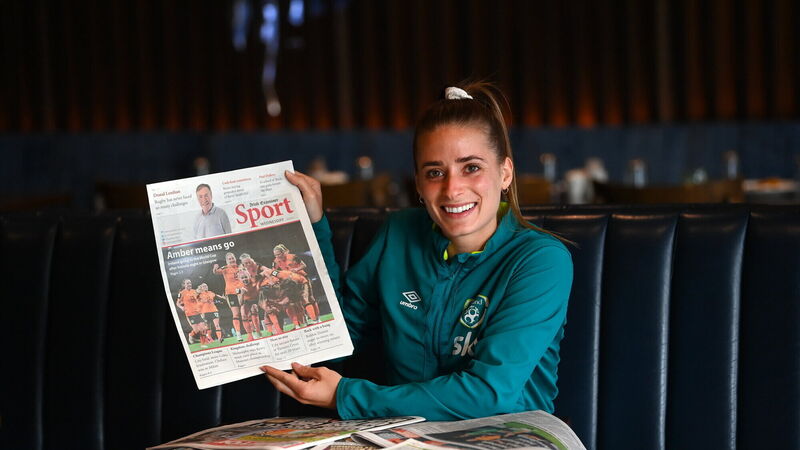
JOURNEY: Chloe Mustaki holding the Irish Examiner during a Republic of Ireland Women media event at the Hilton Hotel. Photo by Stephen McCarthy/Sportsfile
As Denise O’Sullivan leapt into a giant tricolour that doubled up as a trampoline, the Irish team were beginning to realise the bounce that their World Cup qualification has given Irish football.
For far too long, there was a flatness about the women’s international team, a sense of inevitability about their failures but not until five years ago did we have an insight into the difficulties they encountered before a ball was kicked.
Incrementally, the building blocks emerged from their strike action of 2017.
A scoreless draw a few months later away to the European champions Netherlands was followed by a rare victory over a higher-seeded nation in Ukraine in 2019.
But those gains were eroded by slippages in Stavanger, Athens and, most painfully, Kyiv.
Inconsistency bedevilled Ireland.
This time it was different, illustrated by the last three results.
Each carried significance. Beat Finland last month and a coveted playoff place was theirs. Ditto in Slovakia five days later when the prize was a bye into the playoff finals. Tuesday’s trip to Scotland had the ultimate prize at stake.
Three games, three wins and three 1-0s.
Is it any wonder then that the team’s superfan, seven-year-old Annie Mulholland, got the score prediction correct each time?
Winning by the slenderest of margins earned Arsenal more trophies than friends in the 1990s and the successful approach here ought to remind the male side of the FAI house what can be achieved by optimising resources.
“We beat Scotland due to tactics and a game plan,” said Vera Pauw, never shy about leaning on her pragmatism.
“Scotland had better players but ours is a better team.
“Nobody believed in us. Opponents didn’t believe in us, that was their fault, and we’re now going to the World Cup.”
Katie McCabe was similarly unapologetic, preempting the stereotypical descriptions that the three nations they’ll be grouped with in Saturday week’s draw are likely to churn out.
“People might not like our style of play, defending deep, but we are passionate about it,” beamed the skipper.
“We know, if we nullify the spaces in behind, that we can catch teams on the counterattack.
“We showed that against some of the best teams in the world, continued to work on it in training and got our winner at Hampden on the break.”
Amber Barrett’s winner, and subsequent emotional goal celebration, spoke of a squad unafraid of making their feelings known.
The tears Áine O’Gorman swept from her face two years ago in Kyiv, were this month replaced by tears of joy; the centurion, a constant presence for 16 years, bar a brief sabbatical in retirement prior to Pauw’s arrival.
Her overhit backpass, Courtney Brosnan’s inability to stop it crossing the line and Katie McCabe’s missed penalty combined to lose a game they required only to draw to face Northern Ireland for a place at the last Euros.
“It doesn’t get worse than that,” Louise Quinn reflects on that disaster, contested during Covid times to empty Ukrainian stands and followed by silence on the long return flight.
“Nobody got blamed; mistakes happen in football and we stuck together. Look at the people it happened to. Áine is one of the strongest people I know, doesn’t let anything faze her and she came back even stronger. Courtney has been brilliant in goal throughout the campaign.
“None of us wanted anything like that to ever happen again. Everyone’s mindset changed; learning to take the fear out of football.
“Yeah, there was heartache, and though all these games were like Cup finals, sometimes you think, ‘Go out and play football like you’re a kid and remember that it’s just a game’. Look at the tragedy in Donegal. Everything is about perspective.”
The undeniable perspective is the fact of Ireland smashing their tournament hoodoo in style. A first-ever World Cup for the women’s team comes 21 years after the men last reached their global showpiece.
Ballinasloe’s latest sporting hero, Heather Payne, returns to her campus digs in Florida not carrying with her the traditional FOMO.
“A few of my teammates have been at the World Cup, representing the US, China, Nigeria and Canada,” she explained.
“I’d been telling them we were going to qualify and it’s absolutely unreal to make it. I live in the country of the world champions and see how big a deal the tournament is.”
Quinn’s sister has been informing her too of the buzz ratcheting up in Australia about them co-hosting the extravaganza with New Zealand next year.
“She lives in Melbourne and I’ve travelled over there. Many of my college friends are based there too. I’d be confident that, apart from Australia and New Zealand, Ireland will have the largest volume of fans at games, given so many Irish live in those countries.”
Still nine months out and it’s almost possible to touch and feel the tournament where dreams are lived out.
A squad armed with Ireland’s bouncebackability won’t let it pass them by.
CONNECT WITH US TODAY



Be the first to know the latest news and updates