End of Ireland's World Cup but hopefully the beginning of something special
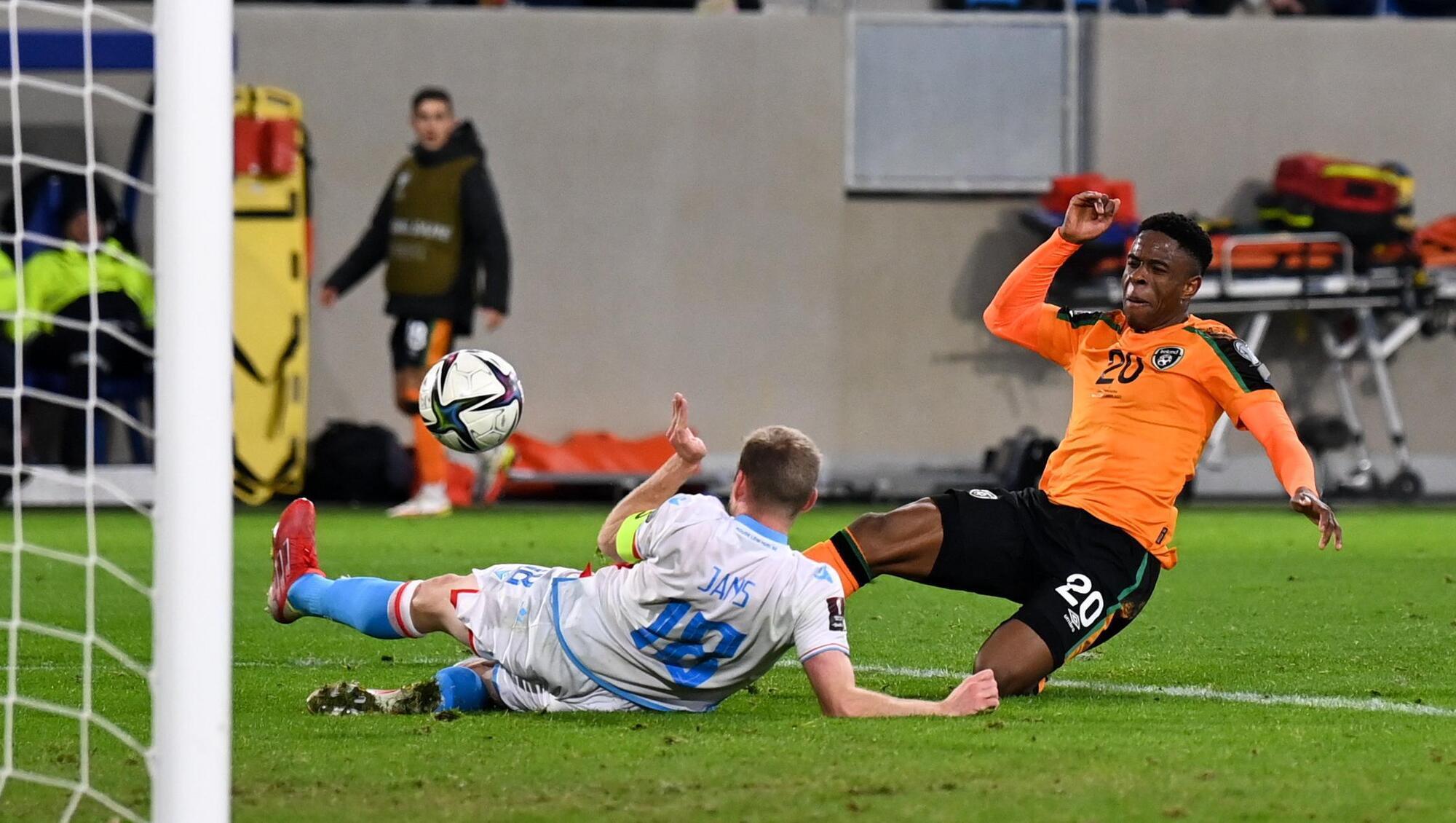
14 November 2021; Chiedozie Ogbene of Republic of Ireland shoots to score his side's second goal despite the efforts of Laurent Jans of Luxembourg during the FIFA World Cup 2022 qualifying group A match between Luxembourg and Republic of Ireland at Stade de Luxembourg in Luxembourg. Photo by Stephen McCarthy/Sportsfile
Not quite a case of all’s well that ends well. The fact that the Republic’s World Cup campaign has ended in Stade de Luxembourg and not Qatar marks this one down as a failure but it’s hard to argue with the notion that it leaves the side better positioned to succeed going forward.
Let’s look back at how it started.
Ireland hadn’t scored a goal in 660 minutes when they pitched up in Serbia for their opening Group A last March. Darren Randolph, James McCarthy and John Egan were all considered central to the future and yet none were available for that assignment in Belgrade.
Only Egan would return to play a key role thereafter.
Mark Travers was in goal and Ciaran Clark was preferred at the back to Shane Duffy whose season had collapsed at Celtic. Jeff Hendrick and James McClean were alongside him on the bench, their international careers apparently winding down.
Stephen Kenny had lost Damien Duff and Alan Kelly from his coaching staff after a November window which had added ‘Videogate’ to the lexicon of Irish football but the manager himself was sticking to his principles while declaring a tactical flexibility.
“Depending on the players we have available, you have to change (formation) to suit the players, but we are definitely not changing out intent to dominate possession or try and control games,” he said. “We definitely won’t do that. I will never stop doing that.”
He was as good as his word.
An advocate of the back four until then, Kenny switched to a 3-5-2 against the Serbs and a starting side that was the Republic’s least experienced in 29 years. It was a template for the mixing and matching that would continue through to the very end.
That he was under pressure from the outside goes without saying, but a squad coping with the strain of longer international windows and suffocating Covid restrictions was leaning on former goalkeeper David Forde, now a qualified sports psychologist, for support.
One way or another, the pressure was on.
The road from there to Luxembourg this weekend has been covered in less than ten months but it has spanned a dozen games. So much has happened and, while progress has been undeniable, the line on the graph has dipped and peaked. Even now, with a 3-0 win.
There has been legitimate scepticism of Kenny through much of this. Even supporters of his strategy, enthused by the changes to the DNA of the team in terms of style and personnel, have expressed reservations about his tactical ability to deliver on it.
There have been times when the manager has overegged the pudding after games, starting with his gushing declarations in the wake of the 3-2 defeat away to Serbia, but the positivity has been easier to digest since the nadir of that 1-0 loss at home to Luxembourg.
Arguments made on the basis of the group table hold some water but are diluted by the unique set of circumstances. The fact is that Ireland approached this last fixture with the core of a settled team and burgeoning confidence in what they are doing.
Gavin Bazunu has been a revelation, Matt Doherty and Seamus Coleman can – shock, horror – prosper in and on the same side, Josh Cullen has emerged as the midfield general while Duffy, McClean and Hendrick have all been reintegrated and rejuvenated.
That balance of youth and experience came late but better that than never.
Bazunu and Cullen aside, Dara O’Shea, Jason Knight, Jamie McGrath, Adam Idah, Aaron Connolly, Jayson Molumby, Troy Parrott, Andrew Omobamidele and Chiedozie Ogbene now know what is to start a World Cup qualifier.
That’s a brand new starting XI and the endless debate about where the team is at and where it’s going is not being reflected in the stands. There was no threat of civil war at the Aviva when the crowds returned for games against Azerbaijan, Portugal and Serbia.
The sense was that Kenny had enough credit in the bank by the time he arrived in the Grand Duchy regardless of the result. The manner in which they made safe a game that had been far too loose and fraught for too long summed up just why.
There was a time when an Irish move from one end of the field to another was a once-in-a-campaign event. This side has made it a staple of the diet with Chiedozie Ogbene and Callum Robinson both scoring on the back of this ambition and execution.
This is not the end, it's a beginning.

CONNECT WITH US TODAY



Be the first to know the latest news and updates