It’s all about points for Enda Stevens in Luxembourg on Sunday; one to prove, and three to take.
To complete their rehabilitation from the drudgery of virtual qualification elimination after just two games in March, a win before a sell-out crowd on Sunday is the only palatable outcome. Especially so to Stephen Kenny, if the endless speculation around his employment security is to cease.
Another full house will greet the manager and his players — only the national stadium in the Grand Duchy houses a fifth of the 51,000-capacity crowd that provided a powerful backdrop to one of Ireland’s best-ever scoreless draws on Thursday.
Luxembourg won’t be anything in the realm of Portugal’s calibre, even the understrength one they fielded to avoid yellow peril, but Luc Holtz’s side have their own motivation for seeing out the campaign.
Already, they’ve accumulated their record points total in a World Cup qualifying campaign since they entered in 1934, with three of their nine points extracted from Ireland in March.
Stevens still bristles when reminded of that wretched night. The silence in the Covid-19-enforced empty stands prolonged into the dressing room after Gerson Rodrigues punished defensive hesitancy by rifling in the solitary goal five minutes from the end.
“It was definitely the low point for us,” recalls the Sheffield United left-back.
“I can’t really remember much, only that the performance was flat, and the dressing room was flat.
“I thought we’d been unlucky to lose the opener in Serbia a few days earlier, and we wanted to kick on, but it just didn’t happen for us.
“It was just a huge disappointment.
“We’ve got a point to prove against Luxembourg this time. There’s something to play for, as well as pride, as we want to finish as high as we can in the table. It will be tough.”
At least this time Ireland will be invigorated by their recent form.
But for Cristiano Ronaldo’s 96th-minute winner in Faro, their revival stats would read unbeaten in nine. The important figure now is two — the number of wins they need to finish what Liam Brady branded the worst campaign for 20 years.
When Kenny took over in April 2020, one of his first observations was the quality of defence he inherited from Mick McCarthy. Stevens, along with Séamus Coleman, Shane Duffy, and John Egan, in his mind, formed a rearguard quartet to rival any nation across Europe.
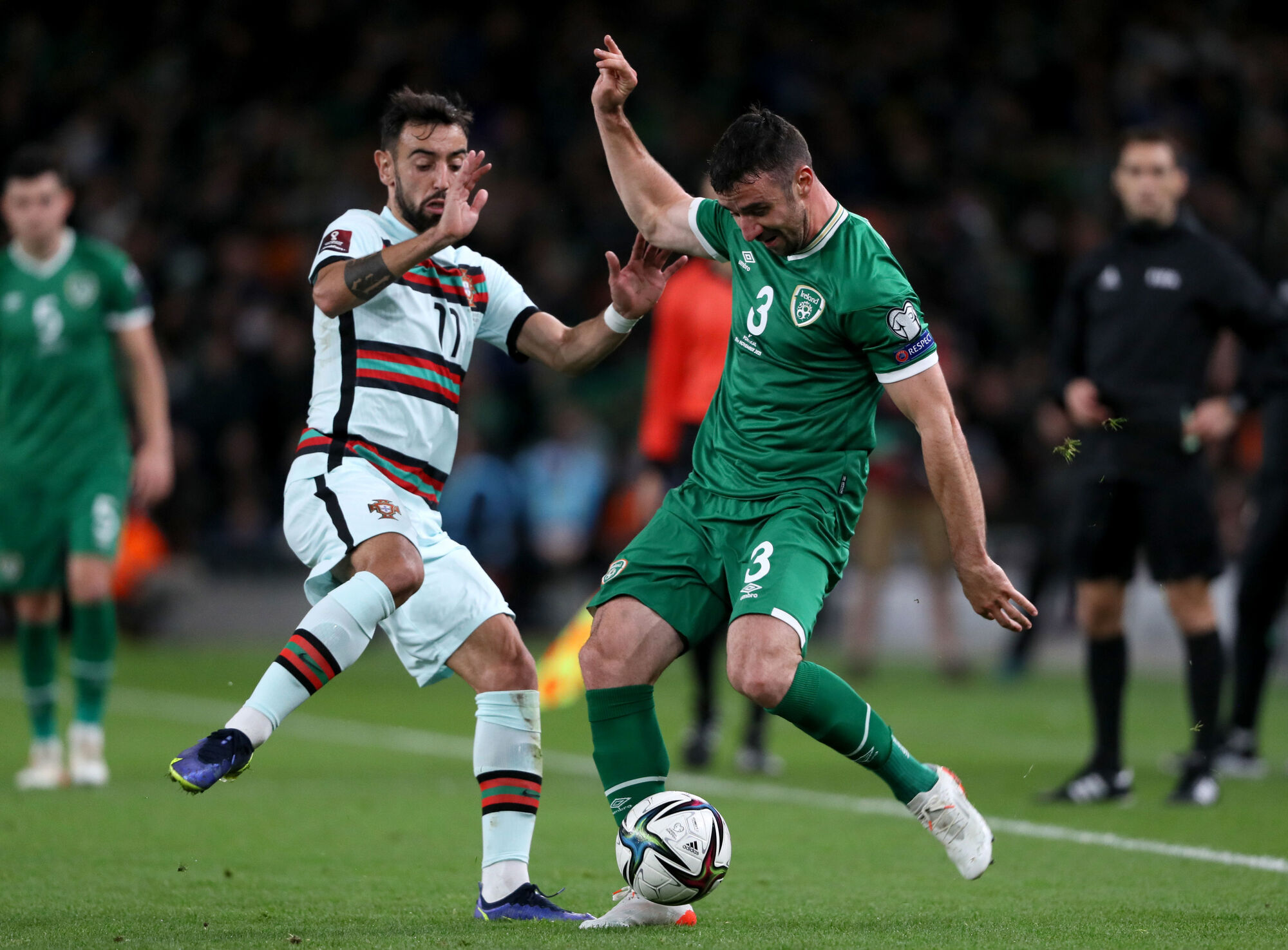
Timely, then, that Thursday’s stalemate marked the first time for the four to start in any of Kenny’s 19 games at the helm. The band was back together, humming in tune.
All the better was the fact one of Ireland’s other best players, Matt Doherty, swelled the unit to five that the top seeds had to unlock.
It was striking during the first half how often Coleman beckoned Doherty back from the halfway line as Ronaldo began to profit from the gap between the pair on Ireland’s right.
That aspect improved after the break, as did the cohesion elsewhere on the pitch.
This week last year, Stevens cut a frustrated figure in Helsinki after a misunderstanding across their six-yard box gifted Teemu Pukki a winner for Finland in the Uefa Nations League.
Reflecting on the turnaround since he blamed unnecessary risks on the concession, the 31-year-old feels time was the healer.
“We were a bit more naïve in that Finland game,” he reasons.
“We weren’t really set up, not ready to play short, and it cost us the goal. Whereas now, we look more set up to play short or go long. Knowing what’s coming next — that was the biggest thing.
“I think just everyone has kind of clicked, you know?”
It had been a long time coming, but Thursday’s performance, the best under the manager, yielded a degree of vindication to his methods.
Despite the international team’s seamlessly endless struggles, Ireland’s record against the group’s top seeds has been decent.
Not since Germany inflicted a 6-1 hammering in September have Ireland lost to one, with the Germans, Wales, and Switzerland failing to record victory in Dublin.
Portugal boss Fernando Santos stressed afterwards that one or three points made no difference to their task in Sunday’s shootout against Serbia for top spot, although he could hardly have cribbed if they’d left with nothing.
The chance that fell at the feet of Stevens presented Ireland’s clearest opportunity of claiming glory, for replays clearly showed Will Keane tugged Rui Patricio’s shirt in stoppage time, prompting the referee’s whistle before Doherty stabbed the ball home.
“I probably should have left it, because two lads were behind waiting for a tap in,” he said of the opening that landed on his weaker right foot.
“It just shows when to recognise when I can push further up the pitch and when I can’t.
“That’s a big thing we’re working on; the partnerships around the pitch in recognising when you can go and when you can stay.”
Luxembourg’s 3-1 win over Azerbaijan on Thursday — started by Rodrigues’ brilliant overhead kick — left Ireland aware that nothing less than four points would suffice to usurp the Principality for third spot. Ireland’s superior goal difference could be decisive.
“I’ve a lot to consider,” said Kenny about juggling his side to meet the demands of two matches spaced just three days apart.
“That’s three clean sheets in a row, and we look defensively better now, not giving up many chances.”
Overloading Coleman in September triggered his latest hamstring trouble, and Kenny has the option of parachuting Nathan Collins into defence for his competitive debut.
Andrew Omobamidele was also on yesterday’s flight, confident of shaking off the achilles knock that mothballed a reunion with Ronaldo.
That illustrates the depth in the squad, removing any scope for the manager to float excuses should they relapse against the underdogs.
After Kenny had Dan McCabe in the Castleknock Hotel earlier this week belting out ballads to rouse his team, they can conclude his first full album on song by lancing the Luxembourg albatross that has weighed so heavily on his tenure.
CONNECT WITH US TODAY
Be the first to know the latest news and updates