Before Roman Abramovich and Sheikh Mansour; before Stan Kroenke and the Glazers and Vichai Srivaddhanaprabha. Before Angela Staveley and Mohammed bin Salman, a businessman emerged at a slumbering club which he had followed from the terraces since he was nine.
On his watch Chelsea invested in new players such as Dan Petrescu, Ruud Gullit and Mark Hughes; Glen Hoddle was backed as player-coach only to be prematurely tempted away by England, an error of judgement from which his managerial career never recovered; work started on an extensive modernisation of the ground.
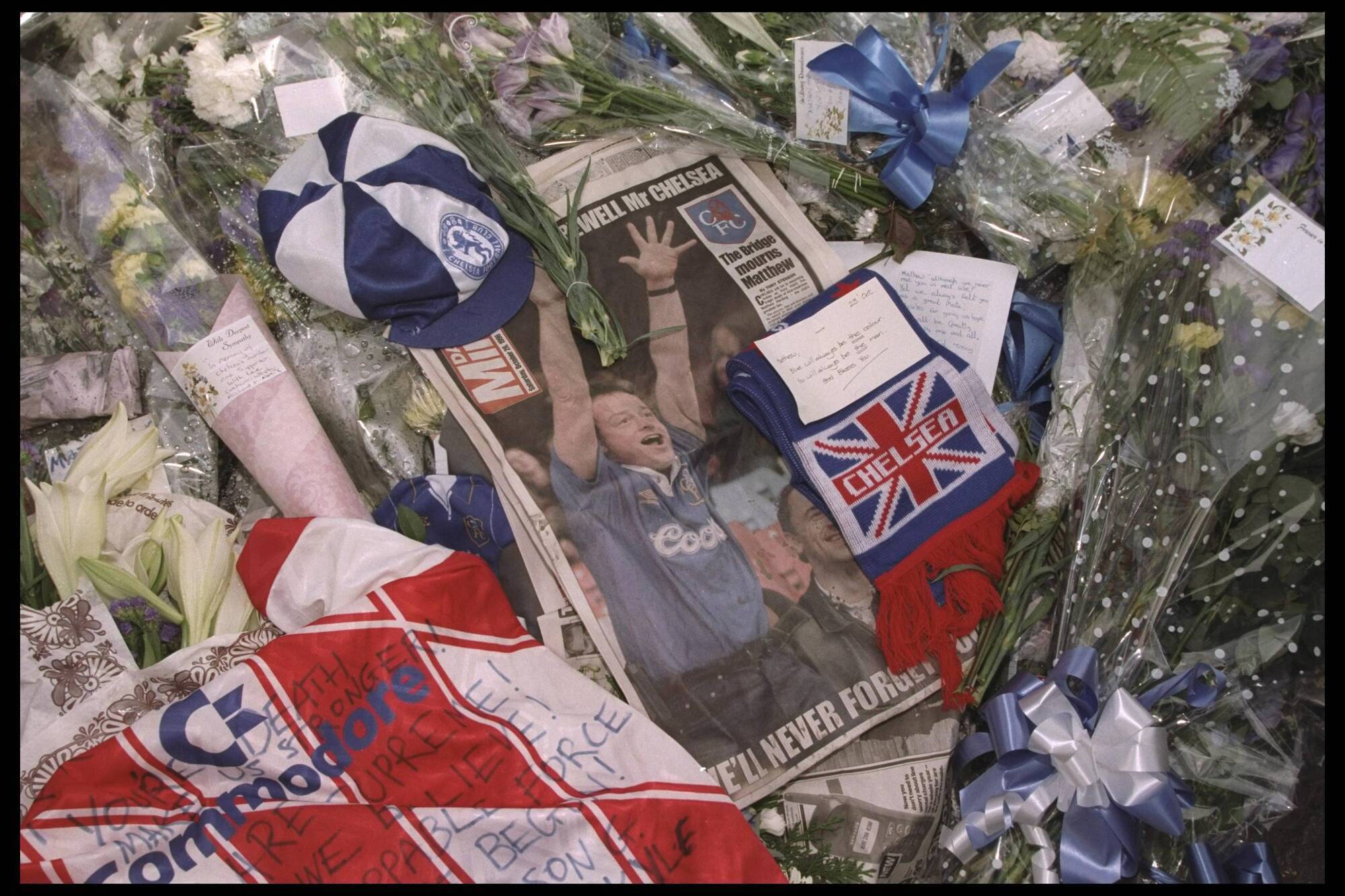
The loss of Matthew Harding cast a dark pall over the newly sunny disposition of Stamford Bridge. But within weeks of his passing the next manager, Gullit, had recruited Gianfranco Zola, the most telling piece of business in the club’s history, and a player who inspired them to their first trophy in 25 years, then to European silverware and then to a place in the Champions League, an achievement which tipped the balance in their favour when a Russian oligarch was looking for a team to buy.
The club brought in French World Cup centre-halves Marcel Desailly and Franck Leboeuf; charismatic Italian striker Gianluca Vialli; elegant Italian midfielder Roberto Di Matteo and a stream of other continental talent. The club attempted, and narrowly failed, to sign Matthew Le Tissier and Paul Gascoigne. The cosmopolitan squad was knitted together by West London-born midfielder Dennis Wise for whom the term “chippy” could have been invented.
It was an era of ambition and “sexy football” overlaid with Tony Blair’s Cool Britannia. Blur’s Damon Albarn and actor Phil Daniels watched from the stands, and still do. Park Life.
It’s quite possible to argue that without Matthew Harding there would be no modern Chelsea, and the same can also be said of Ken Bates with whom he had a fractious relationship.
Bates even withdrew Harding’s car parking space and banished Harding from the director’s box after a particularly severe row over Chelsea Village, the hotel and entertainment complex which Bates hoped would offset the lower revenues created by building a small stadium on the once enormous footprint of Stamford Bridge.
Harding went instead to sit alongside his three children, Hannah, Joel, and Luke, endearing himself even more to the core support. When Bates told him of the ban Harding replied: “Never mind. I will go and sit in the North Stand. I presume that’s ok. After all, I did pay for it.”
Hannah spoke to Times journalist Alyson Rudd for her 1997 biography of Harding: “‘Dad was quite obsessed. We couldn’t go on holiday for a whole week because we’d have to be home for the matches, so we could only go on holiday from Monday to Friday.”
His grandfather became a Chelsea supporter when he was stationed at Chelsea Barracks; his father followed him and he introduced Harding in November 1962 when they were in Division Two after the transfer of Jimmy Greaves. His early favourite player was Bobby Tambling who now lives in Crosshaven. They beat Newcastle 4-2 in his opening game, and Harding would test whether he was dealing with a genuine football person by asking them to name the members of the team they supported in the first game they saw. He also admired the brio of Terry Venables and, like most men of that generation, fell in love with Peter Osgood.
“Here comes the King” Harding would say whenever Osgood entered a room or a bar.
His children and their grandchildren can still be found in the Matthew Harding Stand, as it is now known, on matchdays. It may not be the House of Saud, but it is a dynasty of a different kind.
His son Luke described matchday experiences to Rudd: “Songs would be sung. And then we’d go to the Imperial pub. He was all about the pre-match really, as much as he was the match. It was about the journey up and the whole day out.
“We’d take the 10 o’clock train in the morning, if you miss it you miss out, and we wouldn’t get home until eight o’clock at night. He loved meeting new people and chatting and he’d be talking forever and we’d be telling him we had to go. He’d just be talking Chelsea to anyone who would listen.
“He used to love the East Anglian games because they weren’t dry trains, you could drink alcohol on the East Anglian trains.”
Harding hated the alcohol bans imposed by British Rail and the police, viewing them as an imposition on ordinary people. He famously told a group of his friends to buy the beer for a dry train and he would pay for the fines. There were 10 in the travelling party. Fines in those days were the equivalent of €500 per head.
Harding was a paradox; a privately educated man who despised private education yet bought a £500,000 (€593,000) technology and careers studio for his old school, 16th century Abingdon, where he would visit to impart careers advice (“for God’s sake, do something you enjoy”); a strong family man who had two families, one that he lived with during the week, and one at the weekend; a successful product of the Thatcher deregulation of the City of London but the first million pound benefactor of Tony Blair’s “new Labour” party. A Jack-the-Lad who loved the music of Wagner but who also treated Old Trafford chairman Martin Edwards to a rousing chorus of “who the fuck are Man United.”
Someone who didn’t agree with football clubs becoming PLCs but who went along with Ken Bates’s plans to list Chelsea on the Alternative Investment Market, a status which ceased with the Abramovich acquisition.
Someone who could be generous to a fault. The former Republic of Ireland centre-half John Dempsey, scorer of a memorable opening goal in the 1971 Cup Winners Cup replay against Real Madrid, became a care worker after retiring from football. When he needed a replacement minibus to transport the children and young adults with learning difficulties and Down’s Syndrome in his care, Dempsey approached Harding to ask him if he could make a small contribution to the fund he needed. Harding immediately bought him a new coach.
Harding started his career as the tea clerk and stationery organiser for Benfield’s insurance in 1973. By 1982 he was a director and in 1984 he became MD of its broking division before leading a management buyout in 1988.
Within six years he had become the key player in the reinsurance market and a major operator in Germany, progress which was assured by his quick wits and networking ability.
By 1994 his personal fortune exceeded £150m (€178m) and he was drawing a salary of £3.2m (€3.8m) with dividends of £2.4m (€2.8m) annually. Then an advertisement in the Financial Times seeking people of high net worth to become involved in Chelsea Village caught his eye, and he was off.
Ken Bates contacted him to say: “I’m told you think you’re richer than I am and I thought I’d better ring you to find out.”
Harding became a director in 1994 and a meeting known as “the Marriott Accord” (because of the Heathrow hotel where it was forged) between Bates, Harding, Hoddle and managing director Colin Hutchinson agreed to build on the momentum which had been created the previous year, ironically as a consequence of a 4-0 Wembley thrashing by Manchester United. United did the double that year and Chelsea took their place in the European Cup Winners Cup.
It rekindled the taste for continental football which had lain dormant since 1971.
Harding and Bates, as soon became apparent, were not natural allies.

Harding distrusted those he regarded as “professional chairmen” and proclaimed the view that “clubs were the custodians of the dreams of supporters.”
He knew with a fan’s eye that Chelsea had wasted more than two decades.
“We were a serious side 25 years ago with better management at all levels,” he said. Then, tellingly, “the day when Mears backed Sexton against Hudson and Osgood was the beginning of the end, 20 years in the wilderness continually losing to lesser clubs.”
Bates can correctly be applauded for standing out against avaricious property and land developers who wanted to dispose of the prime real estate on which Stamford Bridge stands and condemn the team to a ground share with Fulham, or QPR, or indeed anyone else who would have them.
But what Harding gave to supporters was hope about the quality of football they might watch.
He even stopped Bates from reducing the size of the pitch because he thought it would constrain the expansive style being planned by Hoddle.
In the first game after his death the immaculately observed silence by Chelsea and Tottenham fans was marked, also, by the placing of a pint of Guinness Harding’s favourite pre-match drink on the centre spot.
Tomorrow, before the game with Norwich, fans will remember Harding again. His old watering-hole on the King’s Road is unrecogniseable from the 80s and 90s. The Howard Hotel on the Embankment where he would entertain customers and friends has changed totally from the days when he was at the height of his fame and powers.
But the Stamford Bridge support are likely to beat out another chorus of “Matthew Harding’s Blue and White Army” in honour of the man who died before he could share all their triumphs. And they may reflect on the poem penned by Jimmy Hill, then chairman of neighbours Fulham, for the memorial service:
“A game, a deal, a drink, a laugh
shall surely be an epitaph.”
Harding’s parting words to everyone were “enjoy the game.”
It is good advice for fans and would-be fans alike. It could even resonate 280 miles away on Tyneside as they begin their own adventure and efforts to raise themselves from generations of stupour.

Continue reading for €5
Unlock unlimited access and exclusive benefits
Already a subscriber? Sign in
Cancel anytime
CONNECT WITH US TODAY
Be the first to know the latest news and updates