Irish duo Paul McShane and Gary Dicker mentors at forefront of new Premier League trend
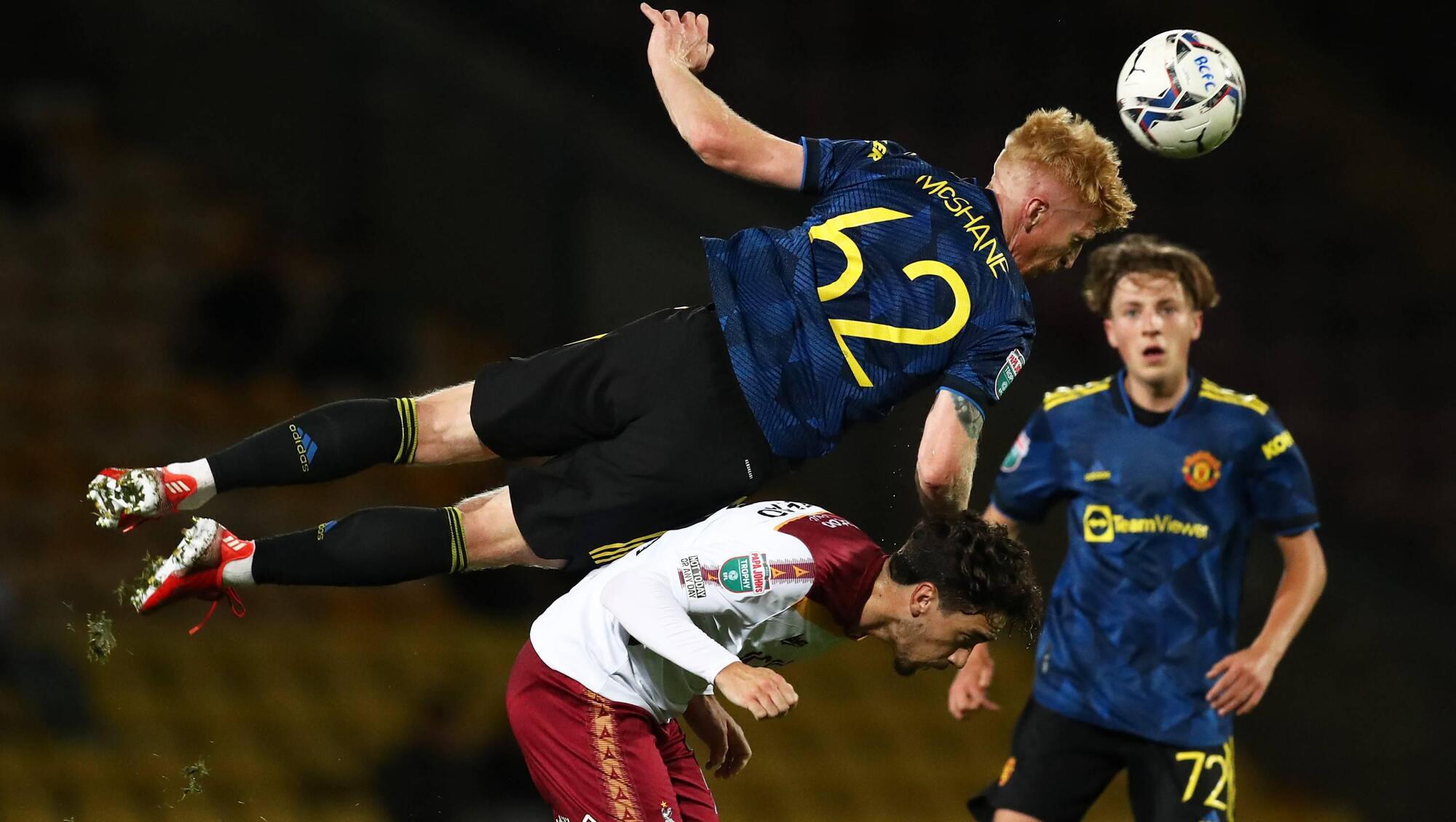
BRADFORD, ENGLAND - SEPTEMBER 21: Paul McShane of Manchester United U21 wins a header above Alex Gilliead of Bradford City during the Papa John's Trophy match between Bradford City and Manchester United U21 at Utilita Energy Stadium on September 21, 2021 in Bradford, England. (Photo by George Wood/Getty Images)
For Brighton, the seed was planted a couple of years ago when Bayern Munich fielded Nicolas Feldhahn, a strapping 32-year-old defender signed solely to help develop the Bundesliga club’s next generation, in an under-23s game at their Lancing training base. It struck Dan Ashworth, Brighton’s technical director, as an innovative way of smoothing the path to the first team and that summer they decided to experiment. Andrew Crofts, then 35, rejoined in a similar role as a player-coach.
In June, Crofts stepped up to become under-23s head coach and his former Brighton teammate Gary Dicker, who turned 35 in July, returned to assume the overage player and mentoring role. Brighton are fourth in Premier League 2 and given the way teenagers such as Antef Tsoungui and Ed Turns, who last month became the seventh academy player to make his first-team debut this season, have seamlessly slotted into Graham Potter’s high-flying side, it is a formula that appears to be yielding results.
Brighton are pioneers of an apparent Premier League trend. In the summer Manchester United and Southampton appointed former academy players, the 35-year-old former Ireland international Paul McShane and 32-year-old Olly Lancashire respectively, to specialist roles with the aim of imparting their experience on peers sometimes little more than half their age.
McShane is a player-coach and Lancashire, who is working towards his Uefa coaching badges, is a “support player”. Lancashire, who left Crewe in the summer, rejected offers to stay in the English Football League to take the position.
The methods at Brighton’s booming academy, which developed Ben White, who joined Arsenal for £50m in July, and Robert Sánchez, who made his Spain debut last month, have attracted intrigue.
“I think there are probably a lot of clubs thinking: ‘Cor, why haven’t we done that before?’” says Crofts.
“The first ones are always the brave ones, to test it and give it a go. It looks like it has been successful at Brighton because of the players [that have progressed] and the impact that it has had on the age group.”
Those who object to the idea usually come back to the same question: does the inclusion of an overage player not hinder the progress or block the pathway of youngsters?
“It is the total opposite,” says Crofts. “It is about trying to enhance them as players, and staff need to recognise when a player needs to be used and not used. For example, a first-year pro might not be ready to play every under-23s game. You don’t want to take away someone’s game time if they’re on the right bit of their journey.”
Dubliner Dicker is not guaranteed to play – he has started three of Brighton’s eight matches – and neither is he immune from criticism, though Crofts insists Dicker’s red card against Walsall last month was harsh.
“It was a yellow all day,” he says. As for the role, there is a mutual understanding. “They know you’re not there as a threat, not there to step on someone’s toes,” Dicker says. “You’re there to help, to push someone else along, and to give them experience.”
Crofts, who played for Norwich in the Premier League, went into the role fresh from playing for Newport and Dicker after six seasons at Kilmarnock, where he coached the reserves for four years. “Consistency with young players is maybe one of the toughest things to achieve and I think experienced players know how to be consistent in their behaviours and their actions,” Crofts says.
Dicker often coordinates set pieces in the week but knows his principal task is to train as a regular player, driving standards and sharing “golden nuggets”, as Crofts puts it, when it comes to matters such as communication and game management.
“You’re never standing around thinking: ‘Am I in the way here? Should I be doing this or doing that?’” he says. “You don’t feel like a bit of a spare part, which you can at a club. I think it is an area where you will see a lot more clubs join in and try and replicate what Brighton have started.”
While the under-23s programme may be short of “blood and thunder” and the music taste of his teammates can make him feel old, Dicker is enjoying the dynamic.
“It does take a bit of adapting,” he says. “Sometimes you can think ‘I’m desperate to win’ but the bigger picture is the development of players.”
There is a balance to his work. “There is no point coming in and caning everyone, giving them pelters after every little mistake,” he says. “You’ll have a word with a few lads and say ‘that’s not good enough’, but it is about being the right character and understanding the role.”


CONNECT WITH US TODAY



Be the first to know the latest news and updates