The shadow of Covid-19 has long lurked over Stephen Kenny’s Ireland reign but this latest episode is one his players had some control over avoiding.
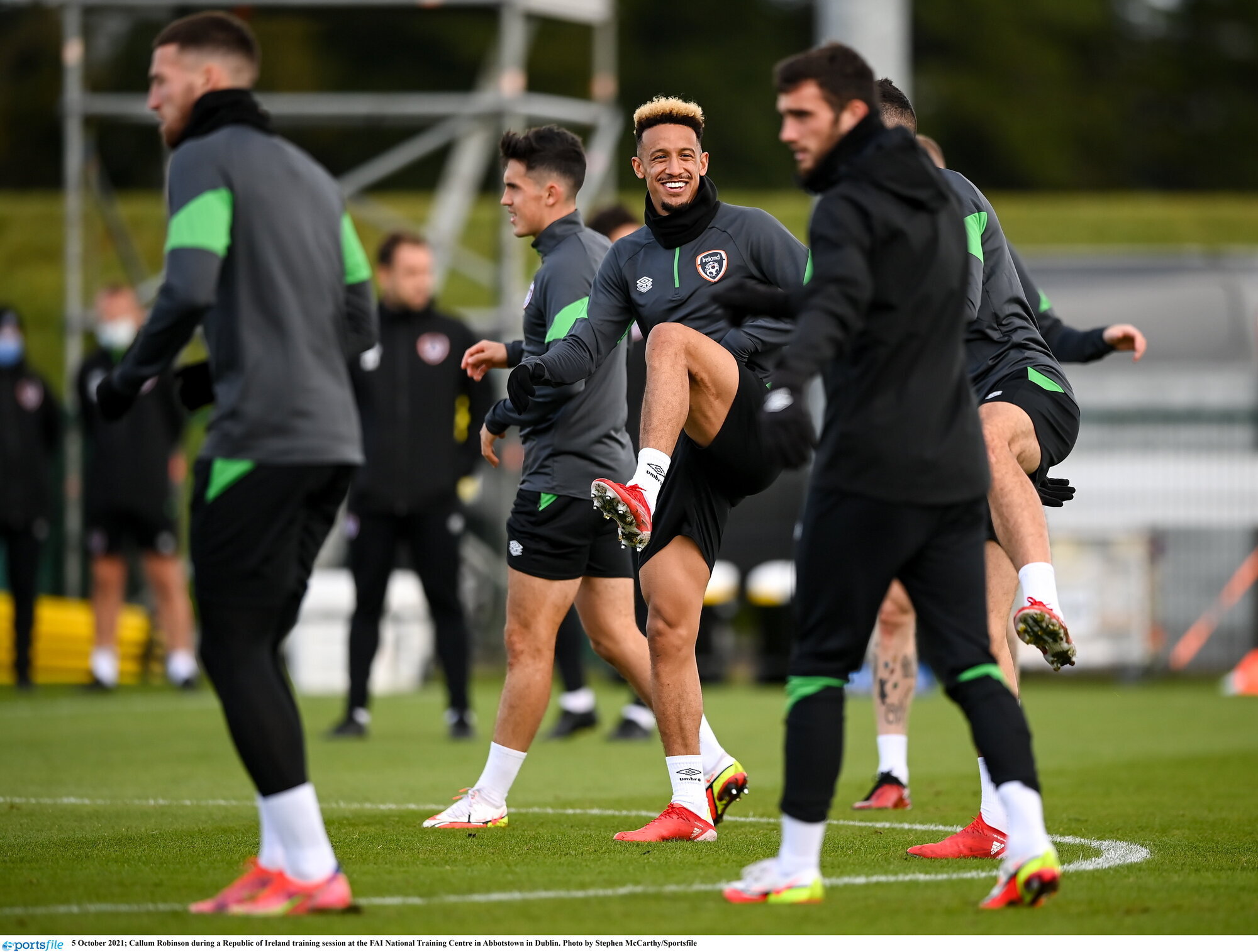
Fresh from Callum Robinson admitting he had declined being vaccinated against the virus, Kenny revealed minutes later that the striker is just one among approximately 40% of the squad applying the same approach.
Robinson knows all about the effects of Covid, having missed six of Kenny’s 16 games and seeing his involvement in last month’s World Cup qualifiers against Azerbaijan and Serbia limited to cameos off the bench.
Twice the West Bromwich Albion attacker contracted the virus, the latest resulting in breathing difficulties and fatigue.
Neither the illness nor the prolonged periods of isolation, however, have convinced him to be jabbed.
“I haven’t been vaccinated, no,” Robinson said, refusing to elaborate on his rationale, be it medical or moral. “That’s my choice at this moment in time. It’s your choice and your body and I wouldn’t force anyone to get vaccinated.”
As he sat at the top table of the conference room at FAI headquarters, journalists interviewing Robinson could only access the Abbotstown indoor facility if a vaccination cert was furnished at the door.
Some removed themselves from the front row upon the player’s revelation.
The same requirement is in place for anyone wishing to dine at the Castleknock Hotel that Robinson and the rest of the squad are housed in. Ditto in cases of entry into foreign countries by air.
Medical science has decreed that fully vaccinated people are far less likely to suffer sickness or be contagious.
The easing of restrictions around distancing in Ireland has only arisen from the high uptake of vaccines, yet a rump of Kenny’s 26-man squad for Saturday’s World Cup in Azerbaijan and friendly at home to Qatar on Tuesday are reluctant to do so.
Players on international duty are mingling in dressing rooms, dining rooms, travelling together by bus, and will share the same cabin oxygen on an eight-hour flight to Baku on Wednesday.
Kenny was left puzzled as to how Shane Long became the latest player diagnosed last month. He tested positive on the day of Ireland’s game in Portugal, making him the 15th different player in 11 months to miss an international game due to coronavirus.
When it was put to Robinson that his inaction is putting teammates and staff at risk, he was unflinching in his stance. “We all do our Covid tests before we come in and every two or three days while we are here. So you could say it’s a risk — but it’s a risk for everyone because you can still catch it.”
Irish players galore were either catching it or getting caught in the close-contact crossfire during the early throes of the pandemic.
Kenny bemoaned the unavailability of Aaron Connolly and Adam Idah for the European Championship play-off semi-final in Slovakia last October.
They were deemed on the flight to have been marginal close contacts of a deputising press officer, who returned a positive test on arrival in Bratislava which was later discovered to be a false positive.
Compounding the manager’s annoyance was that he considered the original victim a “non-essential member of staff”, a view he drew scorn from his employers for. “He doesn’t take the corners,” was Kenny’s attempt at clarification.
All of that, and the subsequent disruption of the November camp, unravelled before the vaccination became publicly available.
And a decision by Robinson to snub it went some way to denying the manager a livewire who could not only take corners but score from them, when Ireland travelled to Faro last month.
“I know that but, as I said, it was my choice,” the 26-year-old replied about his position costing him a cap.
“The first time wasn’t as bad as the second. [Loss of] smell and taste — the normal symptoms. For the second time, I had a little bit of a bad chest, which was a little bit annoying, so it probably took longer to get back to my full fitness and regain my energy. It took a little bit more out of me than the first time.”
Vaccine hesitancy largely stems from the English game, where only seven of the 20 Premier League clubs have over half their players double-jabbed.
Jurgen Klopp’s tirade at the weekend — comparing vaccine opposition to questioning the purpose of drink-driving laws protecting other people — focused minds on the topic.
The Liverpool boss, whose vast majority of players have received both injections, is perplexed at the unwillingness of players to do their part in suppressing the spread.
Kenny was more diplomatic, refusing to countenance a suggestion that, to lead by example, only those double-jabbed be permitted into camp by the FAI. “That would be extremely radical,” he asserted.
The indifference towards available medical measures, it was pointed out to him, conflicted with an initiative by the association through sponsors Aviva of issuing free tickets for internationals to frontline workers.
“I was very happy to be vaccinated myself and encouraged staff and players to do the same,” said Kenny, confirming a coterie of his squad, “not too many more than” 10 have opted against it.
“Of course, it seems like the most sensible thing to do (get vaccinated), and the safest with regard to our environment. Although I’m not a medical expert, I trust their recommendation.
“I don’t think players are being blasé about it; it could be a strongly held opinion. There are various theories that people have and so forth, which you might not agree with.
“There are a lot of myths and a lot of issues around virility that people are concerned about. I do think it is complex but believe it is better to be double vaccinated.”
It was a subject that dominated Kenny’s final press briefing before his departure to Baku, usurping his own future on the news agenda.
While normal order will resume, there was a sense this was another headache the manager could do without.

Cancel anytime
CONNECT WITH US TODAY
Be the first to know the latest news and updates