Azerbaijan boss Gianni de Biasi knows the value of patience - the FAI may well take note
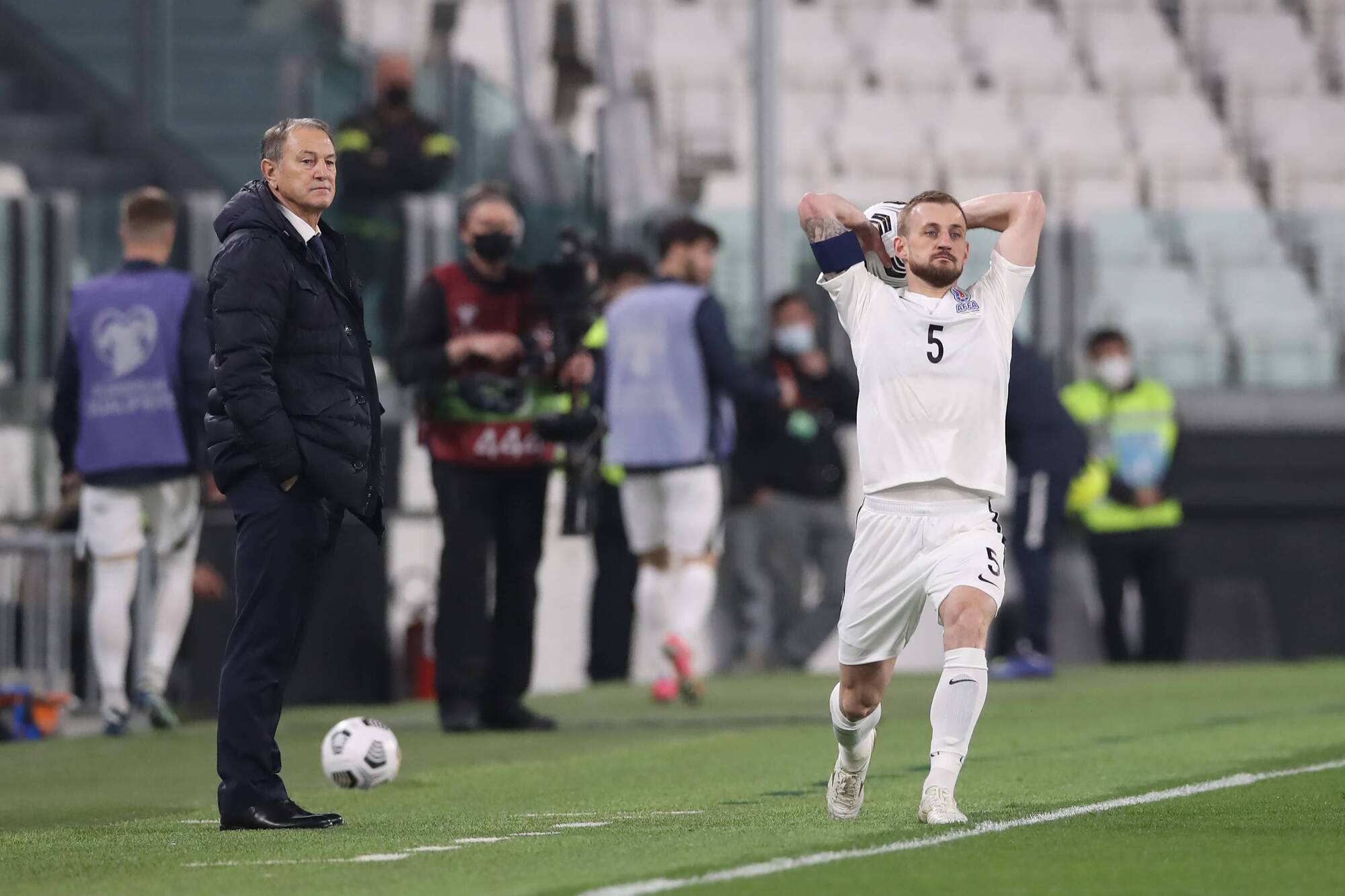
Azerbaijan coach Gianni De Biasi aims to create a squad which can last over time and says Ireland have good qualities.
Once the points from Saturday’s meeting of Ireland and Azerbaijan in Baku have been allocated, Stephen Kenny has an ally in opposing manager Gianni De Biasi.
The Italian may not share the view held by Kenny that Ireland deserved more from the nations’ draw a month ago. But unlike many visiting managers to Dublin, De Biasi has noticed Ireland’s stylistic changes under Kenny and is testament to the argument that managers need time to make that kind of shift stick.
“In Dublin we played a good game, especially in the opening half. In the second half we had more difficulty in controlling the game and we didn’t manage to take home the three points, which would have been amazing for us. It’s a pity, because for Ireland’s goal we could have done much better, and more than one of our players committed naïve mistakes. All in all, I believe that the draw was the fairest result. It still left a bitter taste though, for the points thrown away.
“Ireland is a team which looks to play out from the back, starting with the goalkeeper. It has good qualities, both technical and physical, but it probably still hasn’t found an identity and a balance.”
That won’t happen overnight, and although Stephen Kenny is under pressure due to poor results so far, De Biasi suggests time is a key ingredient in remodeling Ireland’s identity as a football nation.
“The haste and desire for immediate results doesn’t always combine with the reality. It’s clear that when you want to change the way of playing and build a group, it’s certainly not easy.
“Firstly, because you don’t have the players available which you would have with a club, and also because you don’t have much time with your players. You need to optimise that limited time, while trying to be consistent and sticking to your objectives.”
De Biasi appreciates what can happen when a new coach is given time. He is still regarded as a hero in Albania for what he achieved with their national team, taking them to Euro 2016, their first ever major tournament. It wasn’t an overnight success, however, as he had taken over in 2011.
“I inherited a squad ranked 83rd in the world, and by August 2015 we were at number 22, just six places behind Italy. I started a project with new players because the squad was quite dated. The first couple of years we did a basic reconstruction, without great results, finishing fifth in a group of six.
“In the following qualification series, we managed to arrive second in a group containing Portugal, Denmark, and Serbia. I believe we achieved something really extraordinary.”
Before the opportunity arose with Albania, De Biasi had not only given up on Italian football but was ready to quit the game altogether. His last job in Serie A saw him last just eight games with Udinese, and before that he had been sacked and recalled by Torino on more than one occasion.
“Ten years ago, I thought about quitting football, because I believe that if a manager is not a primary role when it comes to building a squad, then it doesn’t make any sense. I wanted to leave, but in life, never say never. If there is a possibility to return, maybe not in Italy, but abroad and even with a club which has a serious project, I’m always ready to take that eventuality into consideration.”
As it turned out, it was Albania who came calling. It gave Gianni the chance to show that he still had plenty to offer to the game.
“Albania was a sort of vindication. I wanted to show that I know how to do my job, for myself first and foremost, but also to those who had written me off so easily in Italy.”
Despite guiding quite a few clubs to promotion in Italy, De Biasi was never given a chance at one of his homeland’s traditional powerhouses.
“I was successful in the leagues I competed in, I won titles in the third and fourth divisions and promotion to Serie A on more than one occasion. I also kept clubs up when survival was their main objective.
“I’m not sure why I never got the chance, maybe the fact that I never had an agent, or I’ve never been a part of certain closed circles. I see myself as a free spirit and have always done my own thing without feeling the need to be part of some clan.”
Even though he possibly could have had a job for life with the Albanians, in 2017 he decided the time was right for another challenge.
“There are moments in life where you need to move on and try something new. I ended things because I believed it was the end of that cycle. I couldn’t see the possibility of inserting new players which would have given me further motivation.
“I gave up, and I was aware that I was giving up, so I resigned at that stage to give my replacement the possibility to have at least four games available in which to get to know the squad and to start a new project with clearer ideas.”
In July of last year, the chance came to move to Baku.
“I chose Azerbaijan because I wanted to try and recreate a similar situation to the one that I had in Albania. It’s a beginning which is more or less the same as I had there. The objective is to create a group, a squad, which can last over time. I found a football association which is well organised and with a very high quality of infrastructure, and with a will to grow. This is the aspect which gave me the incentive to come here and to try and give my 110%.”
De Biasi is enjoying life in the capital, which also gives him the chance to see most of his players in action.
“Life is good in Baku, which is a beautiful city by the Caspian Sea. It’s a city which also has its historical old town, wonderfully preserved and it’s a UNESCO heritage site. The national league is practically all played here in the capital, as there are only two clubs which are located outside of the city.”
The league in Azerbaijan is ranked higher than the League of Ireland and has seen Qarabağ reach the group stages in European competition. For the manager of the national team however, it’s the size of the league which poses the biggest obstacle.
“There are only eight clubs in the Azerbaijan Premier League, and many of those squads are made up of a lot of foreign players.
“This leaves a very limited pool of players to choose from. It’s not easy here because it’s still a fairly closed world, where only now a few players have started to go abroad to play.
“From that point of view, let’s hope that more players will have the possibility to leave and to gain more experience internationally.”
De Biasi travelled to Poland in August to watch two of his players in action, and one of those, Mahir Emreli, has been an instant success. A proven scorer in his domestic league, with 18 goals in 22 games for Qarabağ last season, he joined Legia Warsaw in the summer. Since then, he has found the net ten times, with six of his goals coming in Europe. The most recent of those has seen him attract plenty of attention. He scored the only goal of the game when Legia shocked Leicester City in Warsaw and took his new club to the top of their group in the Europa League.
Troy Parrott, Aaron Connolly, and Matt Doherty are among the players who impressed him in Dublin, as well as a few others.
“Shane Duffy for his physicality and of course he scored the header against us. Adam Idah looks like a great prospect, and I was very impressed with Gavin Bazunu. He’s a very young keeper, with good technical ability.”
There is a word for Ireland’s record goalscorer Robbie Keane — and a fond recollection of his close-up view of an Ireland hero of yesteryear.
“I played against Liam Brady in the 1980/81 season. He had just joined Juventus and I was with Brescia, and I was the one marking him when we met early that season.”
When it comes to the remainder of this qualification series, the ambitions are clear and simple.
“We want to try and take some points from the games that are left. It won’t be easy because we have opponents which, on paper, are stronger, but football doesn’t usually take much notice of that. Whoever wants to win more, whoever is more determined and more organised, at times, even with less quality, can win games which seem impossible.
“I believe that the Azerbaijan team can grow and have a better future that will definitely be more interesting. At the start, like everyone, we have big dreams and great plans. You then need to adjust to reality and right now we’re in a very difficult group, with both Portugal and Serbia who certainly have a technical value superior to ours. The same with Ireland, who have players competing in the English league. Then we have Luxembourg, who are carrying forward a project for 12 years now with the same manager.”
If we take Luxembourg as an example of what a country can do when they stick with a manager and have a long-term plan, then maybe, as Gianni De Biasi also alluded to, Ireland shouldn’t be too hasty when it comes to deciding on Stephen Kenny’s future.
As for Azerbaijan, they’ve only been competing on the international stage since 1994, but it’s clear from speaking to De Biasi that they have an ambitious federation.
It remains to be seen how De Biasi’s bosses will view his tenure once this qualification series ends. The game in Baku with Ireland could be a determining factor for both his, and Stephen Kenny’s future. In both cases, maybe patience should be the name of the game for now.
CONNECT WITH US TODAY



Be the first to know the latest news and updates