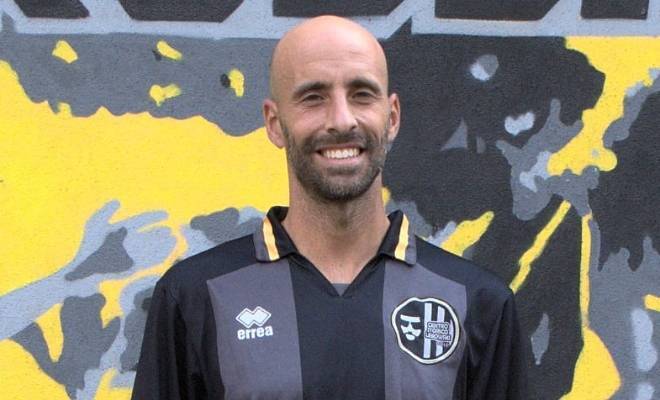
WHEN Serie A player Borja Valero recently signed for a fan-owned club in the sixth tier of Italian football, it understandably made the headlines.
After Fiorentina, who entertain Internazionale tonight in Serie A, decided not to renew the 36-year-old’s contract, the Spaniard announced his retirement. All that changed, however, when he was contacted by CS (Centro Storico) Lebowski, another club in Florence, where the player had decided to make his home.
Back in 2004, the start-up club were at the bottom of the Terza Categoria, the lowest level of the league system, but now after three promotions and being reformed in 2010, they play in the Promozione (the sixth division of Italian football). Back then, they still attracted the attention of some bored teenagers. Duccio and his friends spent their afternoons on park benches in one of the city’s piazzas. One day, while flicking through the pages of a local newspaper, they found something which even they hadn’t known they were looking for.
In a report of an 8-2 loss, there remained a note of defiance. “Lebowski would break, but not bend.”
“We were struck by everything, the name, the disastrous goal difference, their league position, but especially one line of the article,” recalled Duccio, one of the founding fathers. “We knew then that this was the team for us.”

This model is unique in Italy; anyone who has a €20 season ticket has a say in the running of the club and the decision-making process is democratic.
What started out as a small group, soon began to grow, as Duccio remembers: “New people arrived and some had been regulars at Fiorentina’s stadium, but it was becoming more difficult to enjoy yourself there. Along with increasing ticket prices and the game controlled by Pay TV, you now had bans on flares, banners, and drums.”
In 2010, those fans decided that something needed to change: “Along with some of the players, we decided to take over the club, which seemed to us a natural progression of events. We felt that need, without having the minimum idea of where we wanted to go, to bring fans back to the centre of events, where they deserve to be, and not just customers,” explained Duccio.
Pietro Lazzerini, now a journalist covering Fiorentina, was at the time, a player with AC Lebowski: “The president of the club was one of my team-mates, but there was no direct relationship between the club and the fans. Those fans, who were the reason the team were known around Florence, wanted to take a more active part in the club, but the president refused.”
A new club was formed, which is the cooperative club we see today. A club where no member’s voice is worth more than anybody else’s.
Matilde Emiliani, the current club vice-president, discovered Lebowski 10 years ago. She admits that she had little interest in football: “I began going because of friends, it was somewhere to go on a Saturday. I bonded with the fans there, and since then I’ve grown along with the club.”
The club won three promotions, but it’s what happens off the pitch which has seen people take Lebowski to their hearts. Away from the tourist area of Florence and across the Arno River, is the San Frediano area (named after an Irish monk, who became Bishop of Lucca).
Here, the club has been running a soccer school for children for the past six years.
As Matilde explains, Lebowski are committed to maintaining a presence in the heart of Florence: “It’s very important, a lot of local people have already been forced out of the city, which is why we need to keep those strong roots here. The soccer school, which hosts 150 local children, is one way of building and keeping a connection with the area.”
LEBOWSKI may sometimes be stereotyped as a club fighting against modern football, but what they try to achieve goes deeper than this. Matilde feels that the club are battling against the difficulties facing society as a whole: “One of the problems is that struggle to feel you belong somewhere, to create relationships and a community spirit. The club has a vital role to play in these areas, it represents something and helps forge friendships and connections.”
Lebowski is a club where all are welcome, and their values are more than just a slogan. It’s a club that prides itself on being anti-racist, anti-fascist, and anti-sexist, as well as promoting solidarity, co-operation, and direct involvement.
The soccer school is one of the many activities which makes them a club of the community, and the arrival of Borja Valero is seen by Duccio as a reward for what they’ve achieved: “In some way, it’s a recognition for all that we have sown over the years. It shouldn’t, however, be seen as a point of arrival, it has to be a springboard.”
Matilde admitted that she hadn’t really heard of Borja Valero: “I needed people to explain who he was, but it was still very emotional when a professional player decided to come to Lebowski, and was convinced not by agents, but by what the club represents.”
The Covid-19 pandemic had seen the last two seasons cut short, but with fans now set to return to stadiums for the upcoming campaign, there is an air of optimism around the club. This, along with the arrival of Borja, is a much-needed boost after a difficult period for those who see Lebowski as more than just a football team.

Duccio is ready to support his club once more, and to defend everything that they have fought for: “The greatest difficulty will be to remain true to ourselves and to defend our spirit. This will mainly be the task of those of us who have been here from the start, so it will primarily be the responsibility of the Ultras.”
Matilde is convinced that the club would be able to deal with playing at a higher level should that ever happen: “We never once imagined at the start that we would be where we are now, with a soccer school for children or signing a player like Borja Valero.
“I’m sure if it does happen, we will be well able to hold our own. If we do make it, it will be thanks to the people, the club members. It will mean that they will have invested the time, money and energy needed to arrive at that level.”
As for one of the people who started it all, Duccio is less clear about what lies ahead, but no less excited “I really haven’t got a clue, which is the thing I like most about this story. We’ve always moved ahead driven on by a type of romantic chaos, and I like to think it will always be like that.”
As long as people like Duccio and Matilde are involved in the club, then CS Lebowski will surely stay on the right path. The Ultras here refer to themselves as ‘the usual troublemakers’, but they are the ones who created this club and made it what it is today.
The comparison to a small, community GAA club is not out of place. It is clearly the hub of the community, a place where all embers feel a sense of belonging. It is also volunteer-led, fostering a clear sense of identity and place. Plus, just like the GAA membership, the members of Lebowski are heavily involved in projects which help those in the surrounding area.”
The future is in their hands. It’s a pretty good story, dontcha think?

Subscribe to access all of the Irish Examiner.
Try unlimited access from only €1.50 a week
Already a subscriber? Sign in
CONNECT WITH US TODAY
Be the first to know the latest news and updates