Commercial reality may force FAI’s hand to arrest Ireland malaise under Stephen Kenny
When he took the manager’s job in 2020, Stephen Kenny spoke about a year like no other that Ireland faced.
“It’s an incredible year ahead really; unprecedented. We have got the 2020 Euro play-off against Slovakia, six games in the Nations League and also World Cup qualifiers.”
Twelve months on from the first game of the Kenny era and his record is certainly unprecedented.
Ireland are on the worst competitive run of their 100-year history and, should they fail to beat Serbia tomorrow, Kenny will become the first manager in 50 years to preside over an Ireland team out of qualification reckoning with three qualifiers remaining.
Eliminated from two competitions last year, last rites on the third he looked forward to should be applied by Serbia tomorrow.
Dragan Stojković’s side are now engaged in a direct shootout with Portugal for the automatic ticket to Qatar next year and felt they were more convincing winners than the 3-2 margin in the sides’ March meeting in Belgrade.
Ireland were primed to be a second seed themselves for the World Cup draw last December, thereby avoiding Serbia, only to falter in failing to overcome Bulgaria at home in the last of their winless Uefa Nations League series.
Blame John Delaney, Ruud Dokter or feisty factions fighting over the youth development responsibility but the slump in results under Kenny’s watch is sending Irish football hurtling towards oblivion.
The return of fans for international football at the Aviva Stadium for the first time in almost two years, on a Saturday evening too, only sold 21,287 of the 25,000 tickets available.
Tomorrow night’s turnout for the second part of the World Cup qualification double-header could be lower, debunking the myth about pent-up demand.
The fear within the FAI boardroom, based on this trajectory, is how many will pay to watch a friendly against Qatar next month. Reaching five figures might be an achievement.
Commercial imperatives render redundant the romantic notion of affording Kenny the next European Championship campaign to arrest the malaise.
Speaking after the shocking loss to Luxembourg in March, FAI Chairman Roy Barrett denied that the association’s €70m debt would be an impediment to prematurely ceasing the manager’s contract if a decision had to be made.
In one of the several bizarre legacies of the Delaney years, Kenny’s deal runs until next July, midway through the next Nations League campaign. Any payoff due by the end of this series in November, or before, amounts to around €300,000.
The Euro qualifiers don’t kick off until March 2023, due to next year’s World Cup taking place in the winter, and the FAI can only rely so long on government bailouts to plug gaps in their income streams.
It’s not just ticket revenues at stake here, for the association still remains without a main sponsor.
The price tag for the rights of €2.5m per annum took a hit on Saturday, as it will further when this campaign officially degenerates into a battle for third spot with Luxembourg.
From 23rd in the world rankings four years ago, the latest results have Ireland tumbling at pace beyond 50 for the first time since 2015.
Companies favour being linked to brands lifting the public, not deflating them, and Jonathan Hill, the chief executive recruited last November primarily for his track record in attracting blue-chip partners, is finding the pitch a hard sell.
Getting fundamentals like equal pay in place are a start, but beyond his control is the image results on the pitch shapes.
Kenny must placate the diehard supporters before the FAI can even contemplate tapping into any bandwagon brigade piggybacking on an upturn. There’s a reason why the association’s annual accounts itemise the success of their senior team as a prerequisite to financial health.
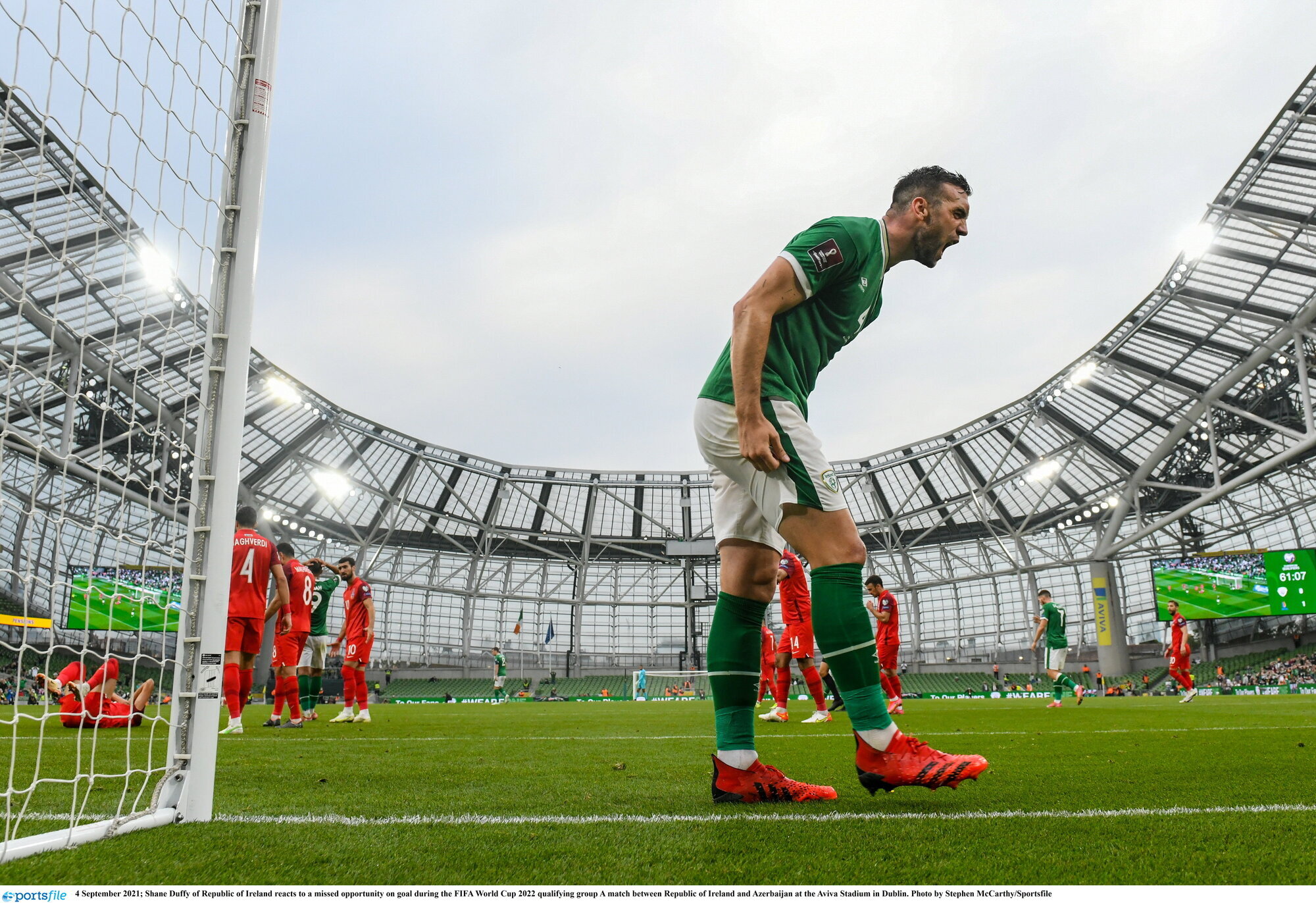
Some of those who shelled out good money for the weekend fare against Azerbaijan would have done so on the basis this reign was indoctrinating a revolution in style, building a foundation to rid the patronising stereotype of Ireland as route-one merchants. Yet that’s exactly what unfolded once the nation ranked 112 in the world hit the front on the half-time whistle; the crowd treated in the second half to an aerial bombardment culminating in Shane Duffy plundering that oh so stereotypical equaliser.
“If the opposition has nine men behind the ball, camped in their half, outside their box, there is limited space to go through the middle with intricate passing,” said Kenny about abandoning the free-flowing concept.
“Sometimes you have to go wide. We had more crosses than we normally would as it was the best option and we created chances from that.”
Ditto Portugal when Ireland assumed the Azeri role under pressure in Faro last Wednesday.
They were undone by a couple of right-wing crosses and textbook headers by Cristiano Ronaldo.
Predictable but effective.
As Ireland scrambled for a rescue remedy in the final stages against the Azeris, fortunate not to concede a second on the break, Kenny stood silent on the touchline, arms folded.
His passivity was broken only by Duffy’s bullet-header, celebrating the reprieve like it was a goal to clinch qualification rather than prevent the FAI’s centenary year featuring its worst-ever result.
Afterwards in his press conference, Kenny spoke in hushed tones, choosing to emphasise poor finishing over the fact that his team reverted to the default approach adopted by many of his predecessors.
There was a sharp contrast in volume to the last time he messed up at home to a lower-ranked team; Kenny unloading at the detractors emerging from the “woodwork” in response to the Luxembourg defeat.
If he was referring to Paul McGrath and Richard Dunne, they remained consistent in their assessments over the weekend.
And if woodwork is where they reside, it must be of the finest mahogany variety given their contribution to the Irish cause.
Another legend from the international sphere is closer to the decision-making cockpit these days.
Packie Bonner returned to the FAI in May as an independent director, specialising in the high-performance aspect of affairs, and is part of the delegation for this three-match window.
His input will be sought when the “review” both Barrett and Hill referred to takes place.
Originally scheduled for the end of the campaign, that could be later this week.
Like any manager, the main judging criteria revolves around progress and extracting the best from his players – it would be a hard case to make that either has been achieved.
Saturday proved that the Luxembourg lapse was not a one-off. Whether it showed the Faro feat was a flash in the pan shall only be discovered tomorrow.

CONNECT WITH US TODAY



Be the first to know the latest news and updates