A different kind of pitch: FAI still trying to net €2.5m sponsorship winner
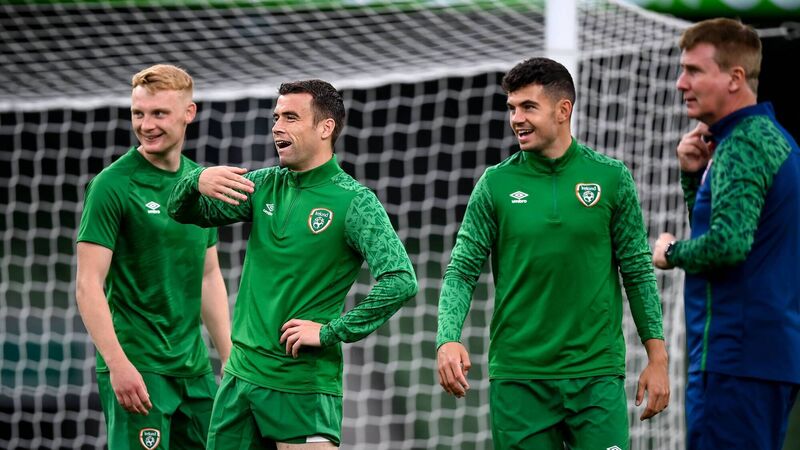
Seamus Coleman with team-mates, Liam Scales, left, John Egan, right, and manager Stephen Kenny during a Republic of Ireland training session. Picture: Stephen McCarthy/Sportsfile
For 89 minutes on Wednesday the Republic of Ireland finally demonstrated that the FAI’s €2.5m price-tag of its headline sponsorship may be a correct evaluation after all.
Prior to Faro, commercial analysts wondered whether such a high price in annual fees was realistic in times of performance paucity by the national teams.
FAI CEO Jonathan Hill said himself in recent weeks that finding a replacement sponsorship for Three was “not an easy process” and Ireland was “not an easy marketplace”.
What he really meant was that Ireland is a very easy marketplace when your international sides are competitive and qualifying for FIFA World Cup and UEFA Euro tournaments.
It was certainly an easier marketplace when Three paid €30m over 10 years to the FAI to sponsor the national team – when the good times rolled and Irish teams qualified for major championships.
In the 21 months since Three announced it was leaving football for someone else – live music events – the FAI has found it impossible to land the big game prize it so craves.
Until a performance of the calibre of Wednesday night can be replicated as a new norm, a true market value of the FAI headline sponsorship package is worth between €1.5m to €1.8m.
The FAI’s latest evaluation of €2.5m is still lower than the average €3m paid by Three but the times were very different.
Those fees were paid in the context of consecutive qualifications to the Euros, and considerable hospitality activations – Three’s large VIP area in the Aviva Stadium - the Players Lounge and largescale LED pitch-side advertising.
Three also had the benefit of a range of high-quality players operating at the top end of the game in the Premier League – John O’Shea, Robbie Keane and Shay Given – to call on for commercial activations, as well as a host of commercially attractive younger stars such as Shane Long and Robbie Brady.
Star names have now been replaced by ‘star potential’, with a number of exciting prospects emerging, but for commercial partners ‘possible’ and ‘actual’ are two very different things.
The marketplace also assessed that the valuation by the FAI was an overstretch with brand sentiment surveys showing that football languished down the charts, well behind GAA, Rugby, Olympics and Paralympics.
For the FAI Board and CEO the reality of international football is that what happens on the pitch will always dictate income – but doesn’t impact on large financial grants from Sport Ireland and Government to ease the pressure – almost €6m in grant funding (2020 accounts) and €13.2 in Covid relief funding.
It’s not known if such financial shots in the arm from the Irish state allowed the FAI to dig in with an over-priced valuation of its lead sponsorship package, or has created an unwillingness to undervalue what it believes a core asset to be worth.
The assets are many and varied: commercial lead ownership of the men’s and women’s senior teams, hospitality, LED, media activations with players around every international camp (an area of growing importance to partner brands today) and a large number of tickets for international matches.
There are many other elements including access to managers for corporate events, programme adverting and messaging, signage and VIP experiences. When all are added together it looks very impressive on a contract document.
Once again, such activations represent high risk and are relative to the performance on the pitch.
The women’s team is an area of potential – with the FAI having earned gold star commendation for its decision to pay female internationals the same as their male counterparts.
However, if future partners are jittery around teams not qualifying for major tournaments, they are even more nervous by controversy. A long-running spat between Women’s manager Vera Pauw and Tyler Toland - which has played out in the media - and Stephen Kenny’s Wembley-gate fiasco, are the kind of own goals that the FAI must stop conceding.
One potential commercial partner told me: “The stuff that makes us s***-scared.”
In response to that very query, the FAI told the : “(We) remain in active discussions with potential sponsors, at a variety of levels.”
Indicated earlier, but worth looking at a little deeper, is the level of difficulty facing the association and its CEO in scoring that bountiful commercial deal.
Jonathan Hill is still relatively new to the Irish football and business scene, but he was a mix of optimistic and cautious when he addressed the media to speak about commercial challenges at the July AGM.
“I am really hopeful that we will find really good new sponsor partners, as well as keep our existing sponsors and partners in the family, by moving forward,” said Hill.
“But it’s not an easy marketplace, it’s not an easy process, but we will be committed as we get fans back into the stadia in particular for those international games by finding the right brands and the right partner for us to work with, not just in 2022 but beyond that as well.
“But it’s a tough market and we keep talking and we keep engaging in brands and telling our news story and we’ll get there.”
Hill is in the job since November 1, and has overseen more than a dozen ‘new’, ‘renewal’ and ‘broadcast’ deals, including official logistics, beer, cereal, bus and FAI Cup partners.
In the short term yes, in the long term no.
Don’t forget Portugal came on the competitive back of Luxembourg – a humiliating moment in Irish football history.
Saturday evening’s shoot out with Azerbaijan – where anything less than an impressive win is needed – and next week’s game against Serbia are key sporting and commercial performance indicators.
In the long term, Stephen Kenny’s ongoing comments and references to a lengthy process of rebuilding – and effectively degrading the World Cup campaign to a blooding period for youngsters – are not helping the immediate sponsorship setback.
However, he will say his job is managing football and such a responsibility needs time, no matter the commercial desires.
What is clear is Kenny can no longer depend on the fulsome support of his board, if indeed it had ever existed – he was certainly unsure of his future following the investigation into a misguided ‘patriotic’ video montage shown to players before facing England at Wembley.
Recently chairman Roy Barrett told the press, when the question of a contract renewal was raised, that the manager was constantly being assessed at every monthly board meeting – a candid revelation, which can only have heaped more pressure on the manager.
Kenny’s appointment to the FAI executive is another interesting observation, as it means that the national team manager is also sitting at the business decision-making table.
Interestingly, Kenny entered the executive as a communications representative was deemed no longer required at such a forum – an astonishing move when you consider the vital role communications has in the relationship between sponsor and association.
Two interesting topics always seem to come up when discussing the FAI’s current sponsorship strategy.
One, we’ve touched on – is price – but the other is still impossible to work out, and it’s about ‘commercial sensitivity’.
At the beginning of the year, the association took the most unusual step of revealing that it would not ink a sponsorship deal with a betting company, despite months of negotiations.
Instead of making its feelings known directly to the people it had spent more than six months in talks with – the FAI took the strange decision to go to the press to announce their stance.
The company – Paddy Power – claims that they had actually pulled the plug on any deal. When they declined to remain at the table, the FAI pressed send on their release to the media.
One observer, with considerable influence and experience in sports sponsorship, said to me: “It’s certainly unusual that after such a lengthy and seemingly highly amicable process, that a rights holder would announce its intentions to the press first.
“There’s certainly a face-saving element to this. Even so, some of these FAI guys are new to the Irish scene - they probably don’t realise how much of a village it is. Revealing such highly confidential information is about as duplicitous as it gets, and I don’t think this cloud will disappear for some time.”
That was nine months ago.
While undoubtedly an unusual tactic, and no matter whoever walked away first, it seemed that the FAI believed such a move would create a PR aura for itself, where instead it has forced a market nervousness, where there is a perception that sensitive negotiation is ripe for a leak.
The FAI and future partners will watch with great interest the performances and outcomes of the Republic’s next two home games. Ticket sales (though limited by restrictions) will be watched keenly with FAI suits hopeful for a bounce following Wednesday night’s performance in Portugal. Group tables aren’t the only metrics that officials will study - attendance figures have never been more commercially important to Jonathan Hill and his future partners.
The former English FA commercial director is a self-styled ‘straight-talking Yorkshireman’ – the time for some sweet talk may be close.
CONNECT WITH US TODAY



Be the first to know the latest news and updates