Daniel Storey: All hail Thomas Tuchel, but Pep Guardiola got selection badly wrong
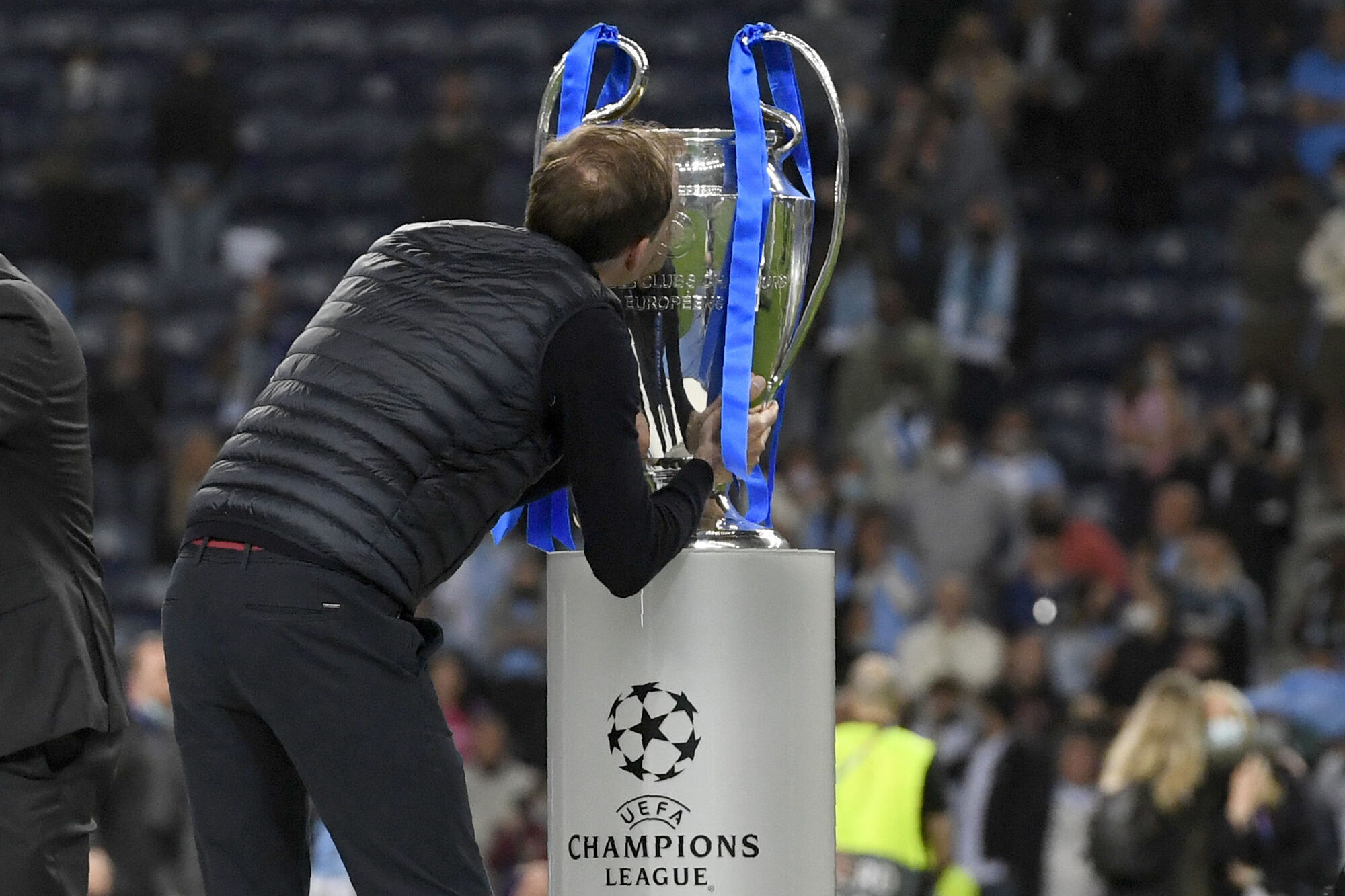
Chelsea's head coach Thomas Tuchel kisses the trophy at the end of the Champions League final. Picture: Pierre Philippe Marcou/Pool via AP
When Thomas Tuchel was appointed by Chelsea, their season had lost all its spark. They were still in the Champions League and FA Cup when Frank Lampard was sacked, but Chelsea had fallen to ninth in the Premier League table.
Qualifying for the Champions League looked difficult, let alone winning it. In those circumstances, Tuchel has performed an astonishing feat.
A year ago, in this exact scenario, Tuchel looked broken. He was forced to watch the final with his leg in plaster, watching on as Bayern Munich outplayed Paris Saint-Germain. This year Tuchel made up for lost time, a bundle of pent-up energy and nerves as he directed his Chelsea players like a caffeine-fuelled conductor.
In the final 10 minutes in Porto, Tuchel commanded Chelsea’s supporters to roar their side home.
And this has been a phenomenal season for Chelsea. They began it apparently committed to a new era in which they would no longer change managers with such haste; Lampard was their answer. They end it back in the grip of their old way of working, but if isn’t broken why would you try to fix it? No club combines managerial short-termism with the hungry pursuit of silverware with such astounding results.
We are used to Pep Guardiola pulling a surprise with his team selection, but this time we thought we had it nailed. Guardiola had changed his team so emphatically towards the end of the Premier League season that we believed we could predict the starting XI.

A front three, Kevin de Bruyne and Ilkay Gundogan in an attacking looking midfield with Rodri or Fernandinho offering protection for the defence.
Not a bit of it. Manchester City had only started one of their 60 matches this season without either Rodri or Fernandinho in the starting side, but dropped both to the bench and started Gundogan as the deepest-lying midfielder.
The plan was to control possession, with Oleksandr Zinchenko stepping into midfield as an inverted full-back when City had the ball.
The goal was the result of an error, Zinchenko failing to track Kai Havertz and sending him clean through on Ederson. But that individual mistake doesn’t change the fact that Guardiola got it wrong. City did have the majority of possession but it was Chelsea who had the best chances on the break Sometimes the obvious statement is the right one: It’s harder to stop counter attacks without a holding midfielder.
There is a misnomer that management at the highest level is easy, but Guardiola can speak to the contrary. When he was appointed by Manchester City, he was acutely aware that his mission was not just to establish a period of domestic dominance (which he has pretty much done) but to take this club to the pinnacle of Europe. That is why Sheikh Mansour bought the club.
In previous years, City have been undone by their own sloppy mistakes, beaten on the counter by lesser sides in Monaco, Tottenham and Lyon who used fluid, counter-attacking football to pierce their defensive line.
This year, it seemed so different. City had been defensively sound and had won 10 of their 11 Champions League fixtures. No team had ever won 11.
And yet the criticism for Guardiola will roar at a higher volume than ever before. When you spend the money they have on the players they have, that does not feel inappropriate.
It may have taken until the final match of an otherwise successful season, but this was a sorry return to over-thinking Guardiola and a City team that looked psychologically broken by conceding first and losing De Bruyne to injury.
The extra three places afforded to Gareth Southgate means that he might well take four players capable of playing at right-back. England’s manager was at pains to stress that Trent Alexander-Arnold could play in central midfield.
And you can see Southgate’s predicament. He has at his disposal Alexander-Arnold, a brilliant attack right-back but one who has never played consistently well for his country, Kyle Walker (a Premier League champion), Kieran Trippier (a La Liga champion) and Reece James (a Champions League winner).

James was superb in Saturday’s final, marshalling Raheem Sterling but still able to break forward and cause Zinchenko problems. With Timo Werner preferring to make his runs down that flank, James’ breaks were vital in creating overlaps that caused City issues in defence.
A word too for Ben Chilwell, who may well have lost his starting England place to Luke Shaw but was probably the final’s best player, expertly shackling Riyad Mahrez and dovetailing with Mason Mount when Chelsea broke forward. That is where Chelsea’s winner came from.
Finals between two clubs from the same country can feel anticlimactic. European Cup finals are, ideally, between clubs who have not played each other all season and perhaps not met in Europe for a number of years. These two clubs have now met each other four times in the last five months.
But this was an absorbing, often thrilling final. City’s odd formation and attempted control met Chelsea’s resolve and intent to counter; the first half was brilliant entertainment played at double speed.
The second half was always likely to revert to City pushing and Chelsea trying to hold firm, but that made for no less intriguing a spectacle.
And we should expect more finals similar to these. The Premier League’s elite clubs will not be immune from financial concerns after Covid-19, but they are better placed to cope than most.
With Barcelona and Real Madrid wobbling, Juventus sliding and Paris Saint-Germain unable to find the balance between star players and team cohesion, what price a repeat of this all-English spectacle next year?
If it’s anything like Saturday, bring it on.