Alan McLoughlin: Sharp edge, kind heart, and so proud to be Irish
Alan disproves the dictum you should never meet your heroes because they’ll only disappoint you. On the contrary, in eight years of friendship, he made me a better and a wiser man, writes Bryce Evans
Alan McLoughlin: Sharp edge, kind heart, and so proud to be Irish

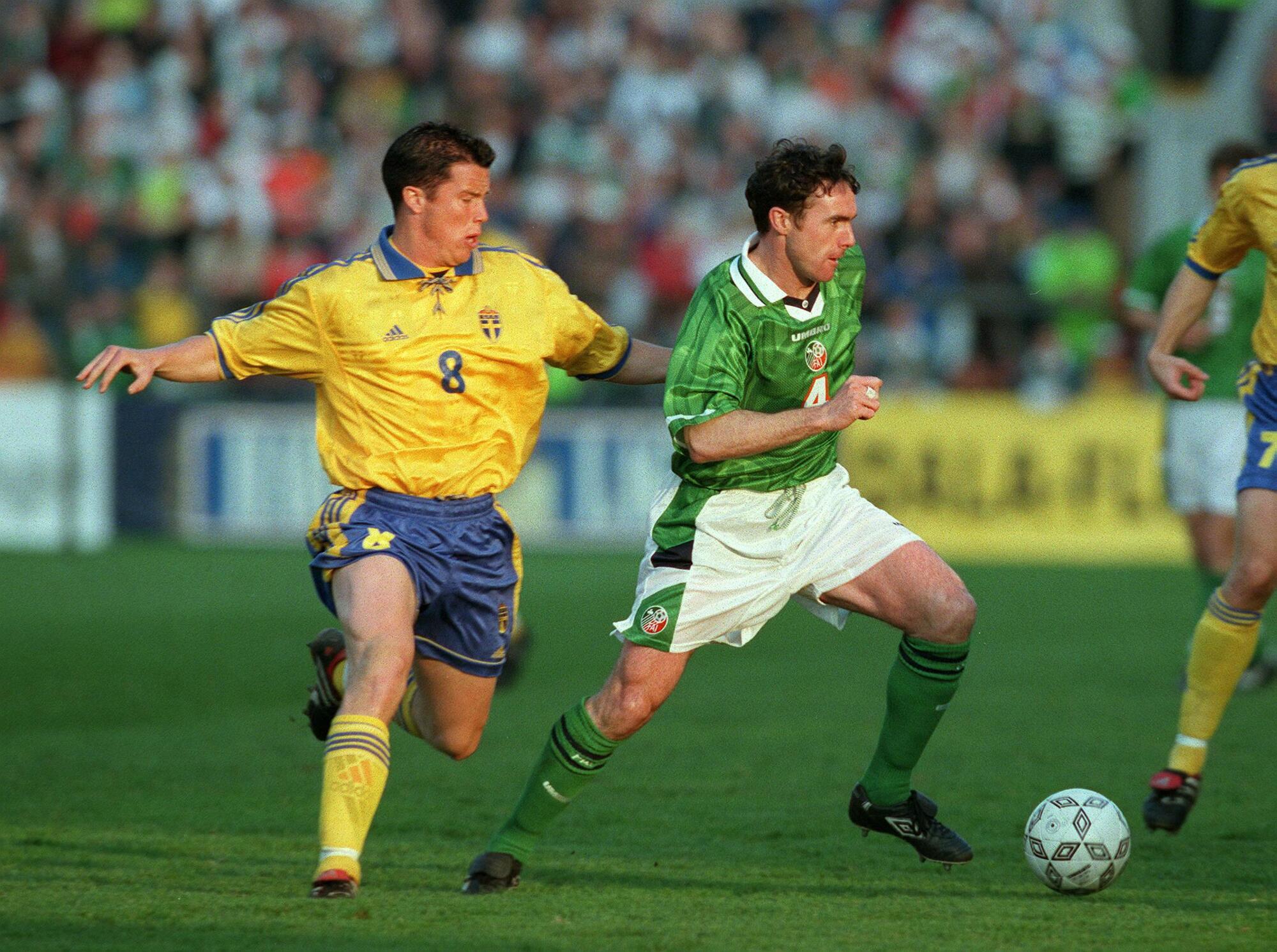
Alan McLoughlin of Ireland tries to get away from Daniel Andersson of Sweden. Picture: Billy Stickland

In a review of Alan McLoughlin’s 2014 autobiography, which I wrote with him, The Irish Times called it ‘flinty’. At the time I took this as a bit of a put-down, but I’ve since warmed to this description because Alan was a flinty character. All his life he’d had to be.

The flintiness didn’t just come from his long cancer fight after initial diagnosis in 2012 but a playing career in which he grafted harder than most to prove himself after failing to make the grade at Manchester United. This toughness came, naturally enough, from his parents, who had been through the uncomfortable experience of being Irish in urban working-class England during the Troubles.

Physical struggle and loss were the making of him: the death of a 14-month old sister to a heart condition, followed by a debilitating illness doctors said would scupper his future footballing career. Going through school sitting next to a young Noel Gallagher can only have built his resilience. At times Alan could be direct à la Oasis: “What the f*ck does this mean?” was his way of letting me know my language was getting too flowery.

Flint breaks into sharp edges, but that language — borne of our plain-speaking closeness — belies the fact Alan was kindness itself and spoke ill of no one. He had a stoicism he attributed to his mother, a Limerick woman who’d cycle from her factory job to watch Alan play.

As is the job of a ghost writer, I tried to squeeze as many stories from Alan about the halcyon days under Charlton/McCarthy, including the enmity between Mick McCarthy and Roy Keane which would boil over in Saipan in 2002. As an integral member of both squads but also — as Alan readily admitted — ‘a bench warmer’, he made the perfect ‘fly on the wall’, especially as a former roommate of Keane’s. On more than one occasion, I succeeded in getting detail on the McCarthy/Keane feud or the extent of Paul McGrath’s alcohol problems. On each occasion, though, Alan called me later to politely request that these passages be removed.

That was because ‘Macca’ remained intensely loyal to former managers and team-mates; there was an almost old-world charm how he conceived of those great Ireland sides as a band of brothers. Much of that spirit came from Jack Charlton and Alan’s recollections of Big Jack’s madcap genius often had us in hoots of laughter.

In the end, the book didn’t need to be bitchy: not only did we manage to convey the wit and togetherness of that great era, we succeeded in making a point about the shabby treatment Alan and others received from the FAI despite years of dutiful service, something the FAI attempted to redress with Alan in the years afterwards.

Former Republic of Ireland international Alan McLoughlin in attendance at the launch of 'A Different Shade of Green at Dubray Bookshop, Grafton Street, Dublin. Picture: Barry Cregg

Alan disproves the dictum you should never meet your heroes because they’ll only disappoint you. On the contrary, in eight years of friendship, he made me a better and a wiser man.

Yet Alan’s was always a rocky road. He retired just as the really big bucks started to roll into football. The big money transfer to the Premiership never materialised despite 42 international caps and club performances that earned him legend status at Portsmouth. In a certain light, Alan was more frequently ‘Nearly Man’ than Roy of the Rovers. But that all changed in Belfast, one night in November 1993.

Famously, Alan’s was the goal that sent Ireland to the 1994 World Cup. For me growing up, like Alan, English-born but with Irish parentage and proud Irish cultural upbringing, you’re in a nowhere-land: mocked for your Irishness in England, equally mocked for your Englishness in Ireland. 

With that goal, Alan settled a few scores when it came to national identity and the ‘mercenaries’ tag applied to Charlton’s team.

As the book reveals, Alan was offered an England call day he accepted the Ireland chance. As he said: “I’m Irish. I didn’t qualify under the granny rule. I didn’t need to. When my parents came to England they were escaping unemployment. Simple. If it wasn’t for that, I’d have been Irish-born. And in the end, what bloody difference does it make?”

A Different Shade of Green: The Alan McLoughlin Story

- A Different Shade of Green: The Alan McLoughlin Story, with Bryce Evans, was published by Ballpoint Press.

x

More in this section

Sport

Newsletter

Sign up to our daily sports bulletin, delivered straight to your inbox at 5pm. Subscribers also receive an exclusive email from our sports desk editors every Friday evening looking forward to the weekend's sporting action.

Cookie Policy Privacy Policy Brand Safety FAQ Help Contact Us Terms and Conditions

© Examiner Echo Group Limited