The Kieran Shannon interview: Half a century of Pat Devlin's domestic dreams
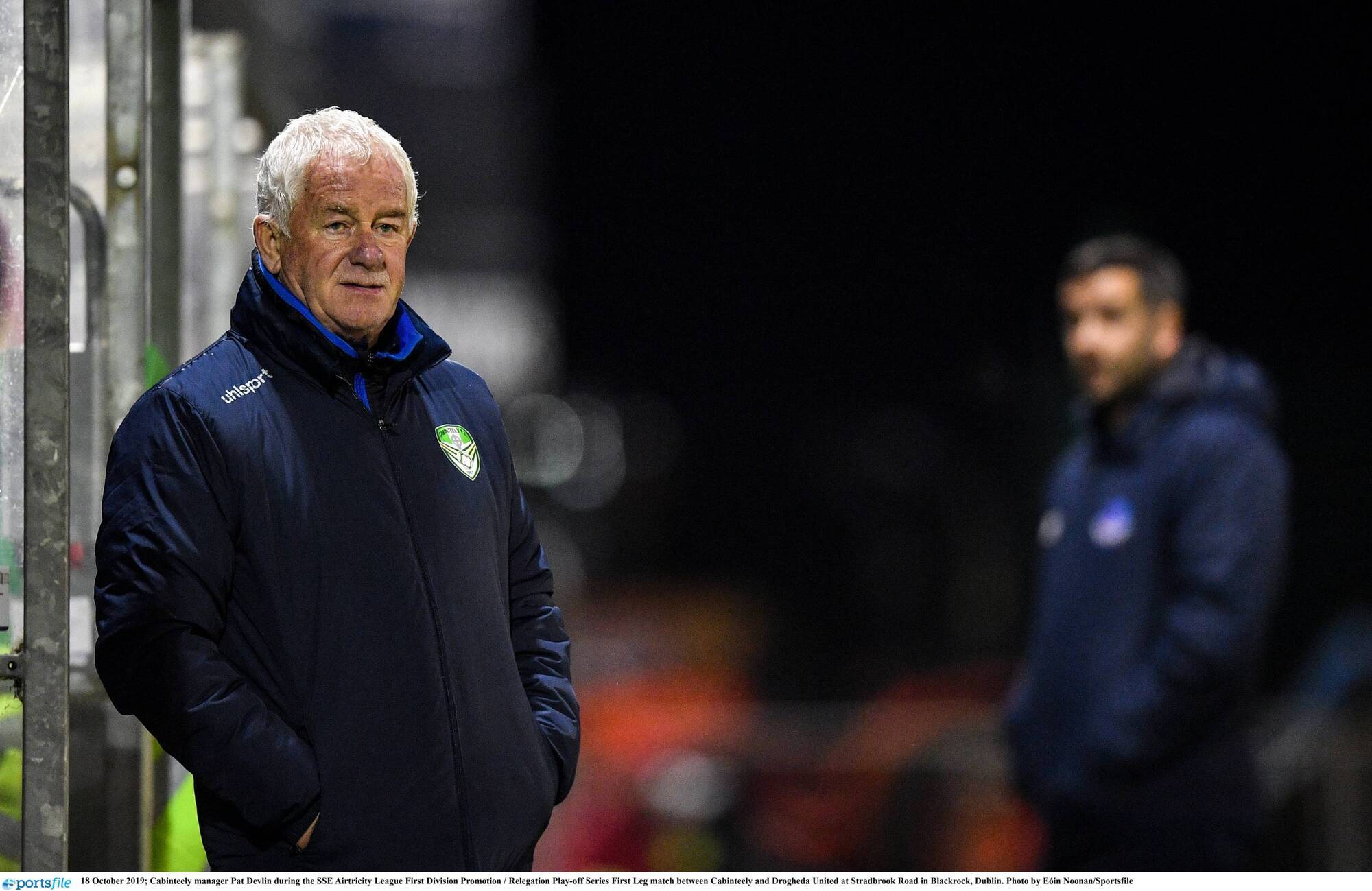
Cabinteely manager Pat Devlin during the SSE Airtricity League First Division Promotion / Relegation play-off against Drogheda United in 2019. Half a century in Irish football, Devlin is still going strong. Picture: Eóin Noonan/Sportsfile
This is a story about Ireland, or at least the League of Ireland, given he’s now in his sixth decade operating in it, but we’ll begin in Europe.
A few weeks after the whole country had gone bananas following Italia ’90, Pat Devlin and his Bray Wanderers team found themselves in the draw for the European Cup Winners’ Cup, having won the FAI Cup final in front of the biggest crowd the domestic game had known for over two decades.
They were the first name out of the hat, followed immediately by the Turkish Cup holders Trabzonspor. The winners would play Barcelona in the first-round proper.
They were heady days and innocent times, or at least for Bray they were. This was still a couple of years before Galatasaray would welcome the world and Alex Ferguson’s first Premier League-winning team to hell. Devlin and his club expected a red carpet, just like the one they had laid on for the Turks in Ireland.
“We met them at the draw,” recalls Devlin, “and said: ‘When you come to Dublin we’ll look after you and then vice-versa when we go over to Turkey.’ Our home leg was in Tolka Park because our own ground wasn’t fit to take it, so we put them up in the old Sports Hotel in Kiltiernan: it’s closed now, but it was a real fancy place. We gave them the real royal treatment. A police escort, the beautiful hotel, the lot.
“Anyway, the game finished 1-1, so the tie was very much still alive. But when we flew into Trabzon, this bus arrived and let’s just say ... it wasn’t what we expected. Then they brought us to this place that I can only describe as a hostel. For the next few days, lads were living on chip sandwiches and Coca-Cola.
“I called the Uefa observers and said: ‘Look, we’re not staying there after the match.’ So they agreed that after the match they’d fly us to Istanbul and put us up there for a few days.
“We went to the stadium. It was unbelievable. Intimidating. But our lads were fantastic. It was still 0-0 at half-time. We were a bit unlucky with some calls by the officials; they were Bulgarian, I remember. Anyway, we ended up losing 2-0 on the night, and when we got on our plane who was already sitting there drinking champagne, only the Uefa observers, the Bulgarian officials, and the owner of Trabzonspor!”
He wasn’t laughing then, but he can laugh about it now. Actually, when he looks back on all the long journeys home, it’s generally with fondness.
Derry, more often than not, would be the longest trip back of the lot, but often amongst the best.
“If you remember years ago, the beer was cheaper in the North, so coming back onto the bus, you’d think it was Christmas. And even the lads who didn’t drink would join in the craic, having only their chocolate and ice cream and crisps.
“One time we pulled up just the other side of the border. Our kitman was Locker Davis. Anyway, this particular night he said to me: ‘Do you want anything to drink?’ I said: ‘I don’t know, what about you?’ He said: ‘Well, I’m going to get a couple of flagons of cider, I feel thirsty.’ So I said: ‘Well, get me one so and we’ll see what happens.’
What happened was shortly after Locker and the rest of the gang came back onto the bus with their orders, Devlin fell asleep, oblivious to the sing-song and party going on all around him. He finally stirred as the bus stopped in Deansgrange to let Locker and some of the others out.
“‘Hey, Locker, where’s my bottle of cider?’
“Locker winked, rubbing his stomach. ‘It’s in me belly!’”
God love Locker, he passed away last year. Devlin certainly loved him, bringing him with him wherever he managed, be it Bray, Rovers, Athlone, Drogheda, right up to Cabinteely.
The bus has changed a lot through the years. Sometime a few years either side of the millennium, cans were no longer brought onto the bus. Now their presence would be unimaginable. “Preparation is totally different, in every aspect,” he says.
Locker is gone.
With Covid, there’s not even a team bus.
But one thing remains constant: Devlin. Fifty years on from when he first entered the league, he’s still there.
When Pat Devlin was growing up, Shamrock Rovers weren’t just the team, they were his team. Such was his devotion to the club when they were in the midst of winning six FAI Cups in succession, he’d religiously go watch their reserve team play every week, it being relatively straightforward to grab the 46A bus from his native Dun Laoghaire and head to Milltown.
And as for seeing the first team itself and the likes of Frank O’Neill banging them in?
“It was like going to a Premier League or Championship game in England. There’d be streams of people queuing to get in.”
Devlin played his schoolboys football with St Joseph’s until his schoolboy dream came true: Rovers asked him to join them. So he did.
And that was just with the reserves.
But after a while, that became a problem. The only game he was getting was with the reserves. So, at 21, he moved on; he was getting married to Ann and just wanted to play regular football, so he joined TEK United. At the time, with there being only one division in the League of Ireland, TEK were as good a team as there was outside it. With Devlin thumping in the goals to help them win an FAI Intermediate Cup, he was approached by St Patrick’s Athletic.
Pat’s, back then, weren’t anything like the force they’d become in the Kerr era, but even the bad days weren’t all bad. A standout memory for Devlin was their final away game of the 1973-74 season in Turner’s Cross. If Cork Celtic won, they were league champions. And they did, 3-0.
“The crowd went wild afterwards. We were all in one little shower in the dressing room, and the crowd were nearly coming in through the roof. You only need see what Turner’s Cross was like then and the improvements they’ve made to it. In those days, it was just manic.”
But as the 70s went on, the crowds drifted away; the league’s golden era had passed. By the end of the decade, even that victorious Cork Celtic team were out of the league.
“There was a lot of social change. TV, believe it or not, was not a common thing in the 60s. All of a sudden, it became massive.
In the mid-80s the crowds would come streaming back, or at least they did when Derry City came into the league and to a town near you, bringing an army of thousands along with them. To help broaden the appeal of the league, a second division was formed, featuring the Brandywell club as well as EMFA from Kilkenny, and an unlikely club from Wicklow called Bray Wanderers, with an unlikely manager called Pat Devlin.
After being unceremoniously let go by St Pat’s as a player, he went back to his roots, scoring goals for TEK and coaching kids in his alma mater St Joseph’s before Bray asked him to become their reserve team coach. Within a year he was to take over their national league side.
“I remember the day I was taking over, I was standing in the middle of the pitch in the Carlisle Grounds for a photograph and saying to myself: ‘This will never happen here’. The grass was as high as my knees. The stand was in a terrible state. But somehow the club got the place ready for the start of the season.”
They lost their opening home game, a Leinster Cup game against St Joseph’s. Then they lost their first home game in the league proper, to Longford Town. “Some fans were saying: ‘Get rid of that fella, he hasn’t a clue.’ We went unbeaten the rest of the season. Went up to Derry in our penultimate game, drew, and won the league.”
He was awake to have a cider with Locker on the bus back down that night.
By the start of the 1990s, Bray were back in the second flight, but that set them up to be part of the biggest day the league had for years. A month out from Italia 90, the FAI decided to move its Cup final out of Dalymount Park to Lansdowne Road.
It was a risky strategy, the fear being the stadium wouldn’t even be a fifth full for the meeting of First Division Bray and non-league St Francis, but the Cinderella element ended up being an attraction. About quarter of an hour before kickoff, Dr Tony O’Neill of the FAI knocked on the Bray dressing-room door. Then in an off-room, he showed Devlin TV footage of people streaming off the DART and into the stadium.
When the game finally kicked off 15 minutes behind schedule, 29,000 people were in the ground.
During the week Devlin had fought to get his players access to train in Lansdowne Road so they could get familiar with the surroundings. But they hadn’t envisaged a crowd anything as big as this.
“I went back in and said: ‘Lads, we have a little problem, but it’s not going to affect us. In fact, it’s going to be an advantage to us. It looks like there’s going to be a massive crowd. But we’re used to playing in front of crowds. They’re not.’ ”
Bray would win 3-0 and then bookend the decade by winning another cup in 1999, this time beating Finn Harps.
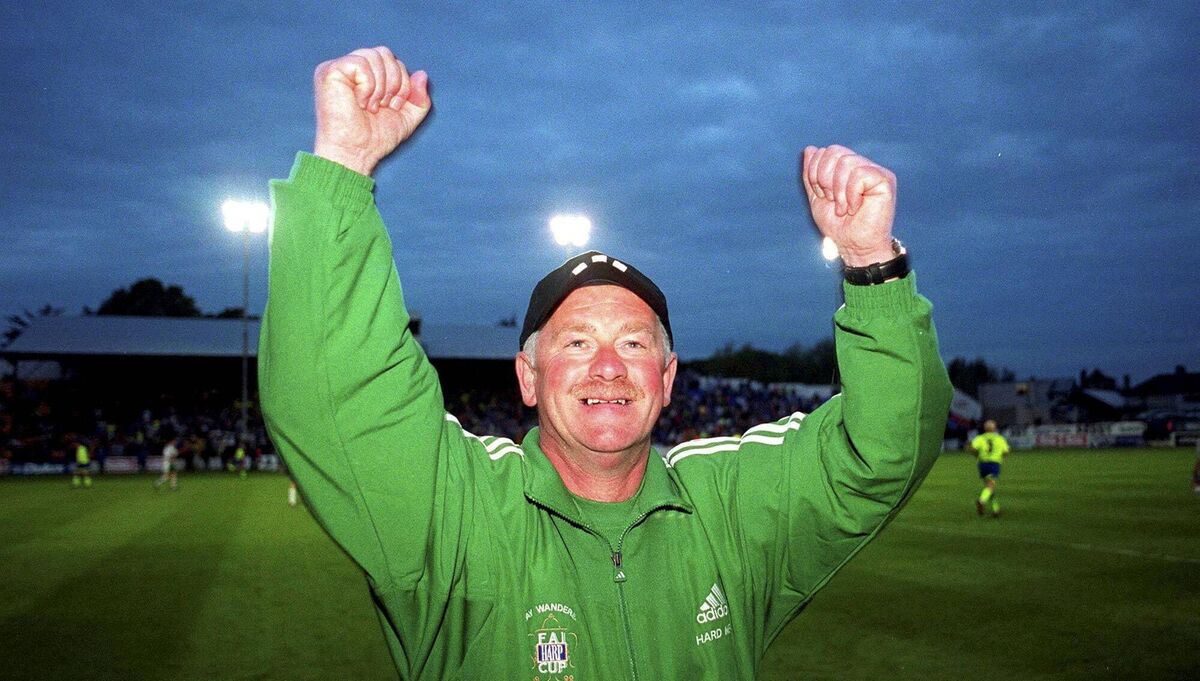
In the interim, Devlin was everywhere. Shamrock Rovers for a season, where they’d lose the Johnny Glynn Cup final. Athlone, where often the team would train in UCD. Drogheda, where they’d train on the northside of Dublin. Then back to Bray. All the while he was scouting, either finding a Damien Duff for Kenny Dalglish or trying to spot a centre-forward for his own team.
“I’d say in those years I was typically watching three games on a Saturday and three on a Sunday. I’d bring Ann and the kids along with me some of the time and they might go for a walk while I popped in to see a game.
“But there was this one weekend I couldn’t get to see a Jason Byrne lad playing for St Colmcille’s out in Tallaght. So I sent Martin Nugent who was on that 1990 Cup-winning team and whose son Darren now plays for Rovers. He went and rang me. ‘Ach, he just didn’t work hard enough.’
“‘That’s a pity,’ I said. ‘Did he show anything?’
“‘Well, he scored three goals …’
“‘That’ll do me, Martin …’”
A year later, Byrne scored two goals in the FAI Cup final for Wanderers on his way to becoming one of the two leading scorers in the league’s history.
In 2003, the same year Bray could no longer keep Byrne and he was snapped up by Shelbourne, the league moved to summer football. Good move? Bad move?
“I’m a traditionalist on that one. Personally, I preferred it the other way. To me, the summer should be for families. You miss a lot of family occasions: communions, weddings, even some funerals. But maybe I’m being old-fashioned.
Devlin’s love affair with Bray would eventually end in 2013, and while it was an acrimonious breakup, his affection for his old teams and players remains undimmed. His fondness for the league, and its for him, also remained intact — he was soon approached by UCD to become their director of football.
Again, he thoroughly enjoyed that stint, but he missed getting his hands and bib dirty. When Eddie Gormley, another former Bray player of his, asked him to get involved as manager as well as football director of Cabinteely, he couldn’t
resist.
“This is where I grew up playing, in the Dun Laoghaire area. It was traditionally a magnificent place for football, and now we have over 60 teams in the club, from under-8s up to over-35s. They’re in the league because they felt it was the best for their own players.
Already one of its graduates, Jason Knight, at 19, has been handed the captain’s armband at Derby County by Wayne Rooney. But Devlin fears a lot of fine players of a similar age could be lost to the game because there’s no domestic national league to bridge the gap from U19 to senior.
“It’s so hard to get a game now. You think of all the players coming on stream with all these underage national leagues we have now, but won’t make the first team right away. We should have an U23 league that also allows for four overage players, even if the [main] league is younger now.”
He still has his frustrations with the league. “I’d like to think it has improved, but not as much as we should have after all these years. It’s all too nice and comfortable, and the attitude seems to be if we get into Europe and get a few bob, it pays the bills.
"We need everyone in the league coming together, pulling together and singing off the same hymn sheet, like they do in other sports, in other leagues. Then we should go to Government and point out where we could be in five to 10 years’ time, attract investment.”
But, still, there’s nowhere else he’d rather be. “I never thought I’d be 68 and still managing a team. I’ve had the fortune to meet so many great people, so many great characters. I feel like I’m the luckiest man in the world.”


CONNECT WITH US TODAY



Be the first to know the latest news and updates