Hard yards ahead in Arsenal's resurrection shuffle
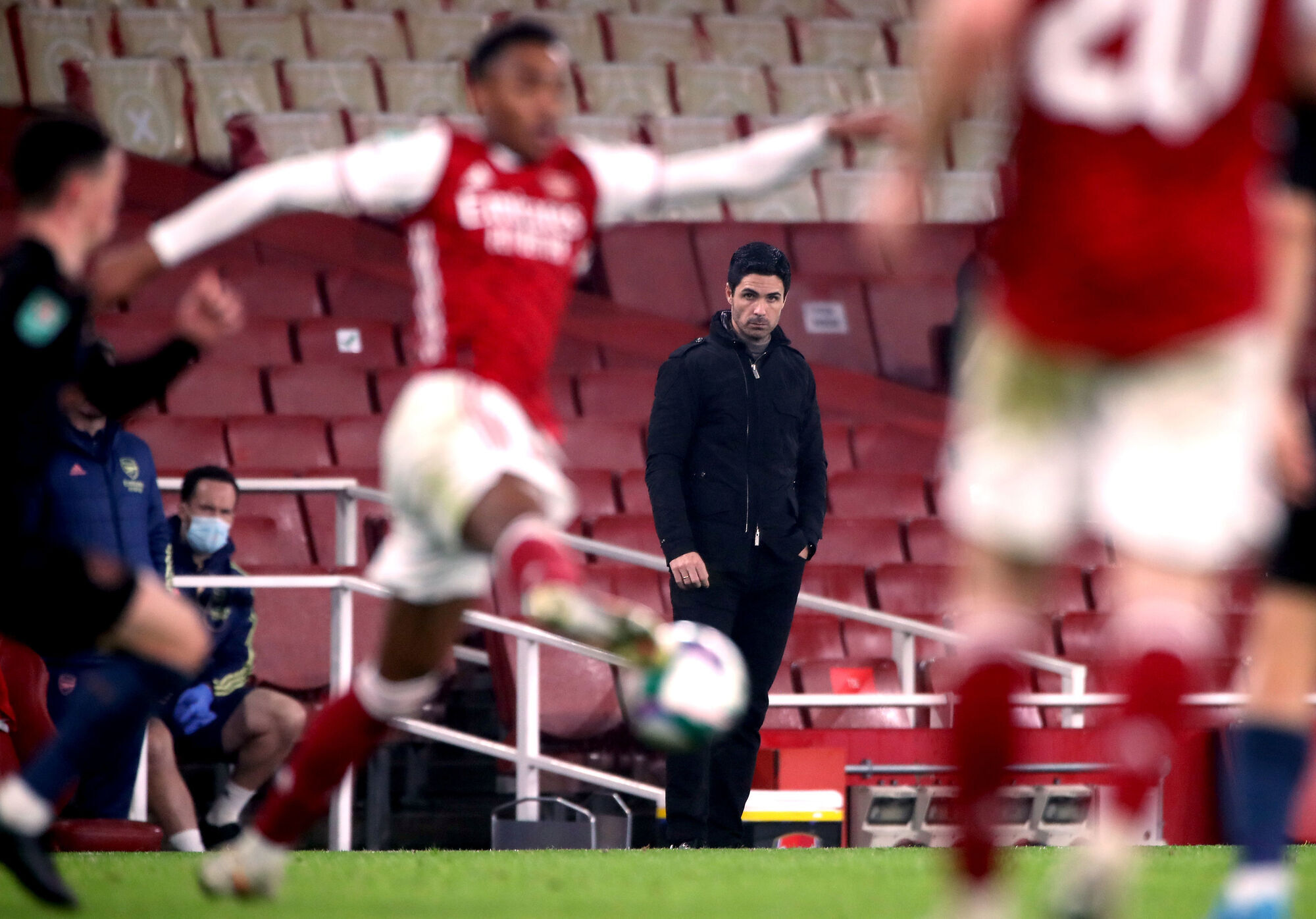
Victory over Chelsea has given under-pressure Arsenal manager Mikel Arteta some valuable breathing space after a poor run of results.
The long day’s journey into night of Arsenal Football Club may have been halted temporarily by Saturday’s inspiring win against Chelsea, but there is distance still to travel before Mikel Arteta can be regarded as a renaissance man.
Anyone with a grasp of history will know that Chelsea can be particularly obliging opposition for an ailing team in search of a morale-boosting victory. Think of Duncan Ferguson’s touchline hugathon last December as Everton climbed out of the relegation zone by thoroughly outplaying the west Londoners. Or Andriy Yarmolenko’s last-minute winner this summer which secured Premier League survival for West Ham.
In Big Soccer’s simplistic linear narrative, coaches are frequently one or two or three games (delete as appropriate) away from the sack. The mother lode of this ubiquitous football theory is the apocryphal “career-saving” FA Cup goal by Mark Robins against Nottingham Forest in 1990 which allegedly rescued Alex Ferguson from the axe.
Ferguson went on to win 37 trophies with Manchester United. He was also the subject of a protest banner (does this sound familiar Arsenal fans?) that read: “Three years of excuses and it’s still crap ... ta-ra Fergie”.
United finished that season in 13th position — five points ahead of the drop. But, unlike Arsenal, the Red Devils have experienced a relegation, falling out of the old Division One in 1974 under the stewardship of Tommy Docherty in a surreal season which saw Sammy McIlroy as their leading league scorer with six goals, George Best play his last game for the club, and Alex Stepney, their goalkeeper, step up as penalty taker.
Sometimes, the improbable happens. You know that you are in trouble when Sam Allardyce starts to play mind games (another hat-tip to Fergie) before a forthcoming fixture. Big Sam’s West Brom are set to welcome Arsenal to the Hawthorns this Saturday.
The Gunners are “absolutely” in the drop zone, says Allardyce. “They will be wondering what has hit them,” he added. “They will be wondering why they are down there. They will be wondering what it takes to get out of that position. I know what it takes. I hope to convince my players to respond to that.”
During the summer, it looked so different for the newly-appointed Arteta, who took charge of his first match one year ago this week.
A fluent semi-final display inspired by two goals from Pierre-Emerick Aubameyang saw off Manchester City and Arteta’s former boss Pep Guardiola. And then, in Wembley’s first ever behind-closed-doors final, Arteta also overcame another tyro manager, Frank Lampard, with two more goals from his Gabonese striker. This was after falling behind within five minutes. Arsenal, so some pundits maintained, were finally developing a quality they had not possessed since the era of Vieira, Petit, Pires, and Henry. They had resilience.
But this victory was misleading. It was aided by an injury which cost Chelsea the services of their most dangerous player, Pulisic, while their captain Azpilicueta was also hamstrung. Referee Anthony Taylor had a game to forget, wrongly dismissing Chelsea’s Kovacic. Pedro was carried off and Chelsea were left with nine on the pitch.
Arteta was proclaimed to the skies for landing silverware and a place in the Europa League.
Aubameyang, at that stage still involved in contract talks, was variously described as the club’s talisman, and the player that Arsenal would be built around. Christ Sutton said he would cost “zillions” to replace; Alan Shearer described him as “red hot” but, tellingly, also pointed out that the victory would give Arsenal more heft in the summer transfer market.
The passage of the intervening five months has left Arteta lamenting a lack of team bonding. His remedy is unstated. A paintball session? That old Don Revie favourite, carpet bowls? Sending the squad out into the forest with four lengths of rope and an axe and asking them to build a structure which takes all their weight? Community work? A PS5 or Xbox tournament, perhaps with as the game of choice?
So what has gone wrong at the club which has won 14 FA Cups, 13 league titles, 16 Community Shields, two league cups, and two European honours, has one of the finest grounds in Europe, and is free from debt?
They are ‘The’ Arsenal, whose motto is ‘Victoria Concordia Crescit’ — ‘Victory Through Harmony’ — a message proclaimed on advertising hoardings wedged between entreaties to ‘Visit Rwanda’, a €35m marketing message authorised by the country’s Gunners-supporting president. But harmony has not been the prevailing spirit since the move to The Emirates, and its failure is most tangibly symbolised by the melancholy exile of Mesut Özil. In a team noted for its lack of creativity, there is something head-wrecking about the highest-paid player in Arsenal’s history (until Aubameyang’s new contract) not even making their Premier League squad.
An argument which started with the unsuccessful Unai Emery has continued under Arteta, and seems incapable of resolution. An unpleasantly diverting sub-plot holds that Özil’s absence is related to his high-profile support for the oppressed Uyghurs in China and is thus in breach of club rules on political activity.
China is seen as a key expansion area for Arsenal support. Noticeable by their absence in Saturday’s victory were most members of Arsenal’s Brazilian grouping, including the controversial figures of David Luiz and Willian with unspecified illnesses.
Luiz divides opinion because of occasional errors and Willian’s move from Stamford Bridge to the Emirates on a three-year contract is not considered a success. The length of his deal, acknowledged to be generous for a 32-year-old, has puzzled supporters.
There is a strong Brazilian influence in North London where former player Edu, one of the Invincibles of 2003/04, is technical director.
He arrived in the summer of 2019 — some five months before the dismissal of Unai Emery, the man chosen to succeed Arsène Wenger, who had delivered 19 successive years in the Champions League; seven FA Cups, and three Premier League titles.
In addition to the two veteran Brazilian internationals, Arsenal also signed Gabriel, a left-sided centre back, for €30m from Lille. Gabriel missed the Chelsea game as he was self-isolating due to Covid exposure. They also have the popular young striker Gabriel Martinelli, whose pace reminds many observers of a young Nicolas Anelka. While he was a notable success against Chelsea, it will be a significant decision for Arteta if he returns Luiz, Willian, and Aubameyang to first-team action on Tuesday evening against Brighton, a team who have proved difficult for them in the past.
Although there has been pointed criticism of Arsenal’s American owner ‘Silent Stan’ Kroenke, with his multiple sports franchises, his lack of attendance at matches, and seeming absence of any stated ambitions for the team, the most frequently levelled accusation of under-investment cannot be properly levelled at him.
In recent years, in addition to the eye-watering contracts for Willian and Aubameyang (whose form has declined since he signed it) and the apparent willingness to let the hugely expensive Özil sit on the sidelines, Arsenal have spent heavily by their traditional standards.
The powerful midfielder Thomas Partey was extracted from Atlético Madrid for €50m; Nicolas Pépé is a club record signing at €72m; Switzerland’s Granit Xhaka cost €40m four years ago; goalkeeper Bernd Leno was €25m; the impressive full-back Kieran Tierney was €30m from Celtic. Defender William Saliba was priced at €30m by Saint-Étienne and has yet to kick a ball in anger for his new club. With another €250m worth of signings to choose from, it is easy to see why Arteta can say — with some justification — that he has one of the strongest squads in the Premier League.
In addition, while the days of the Irish production line which produced first-teamers such as Liam Brady, David O’Leary, Frank Stapleton, Pat Rice, and Niall Quinn are behind us, Arsenal have a burgeoning stock of young talent including Bukayo Saka, Joe Willock, Eddie Nketiah, and Emile Smith Rowe.
This won’t stop them strengthening during the January transfer window. They were repeatedly frustrated in their attempts to sign 22-year-old Lyon midfielder Houssem Aouar in the summer because of hardball tactics by the French owner Jean-Michel Aulas, while Christian Eriksen is an intriguing outside bet with a point to prove.
But perhaps what Arsenal need most is an inspirational on-field leader who is not either a red-card magnet or a man of moods.
Victory over Chelsea gave Mikel Arteta some breathing space. But for that to be effective, it must be followed by showing Brighton and West Brom the way home.
Arsenal don’t do relegations, but they experienced plenty of lean years in the ’60s, ’70s, ’80s, and ’90s before David Dein brought Wenger in from Japan to headlines of ‘Arsène Who?’. His period in charge brought beautiful football, stability, and reputational enhancement.
But it also gave Arsenal fans a sense of entitlement.
Now they need to learn patience, or they will be seeking another manager before the Covid vaccine is fully rolled out. There are others out there — Massimiliano Allegri, Thomas Tuchel, Rafael Benitez (currently in China), and Maurizio Sarri — who might all fancy the job.
Whether Gooners want to become the kind of revolving-doors club that they beat at The Emirates last Saturday night is another question entirely.


CONNECT WITH US TODAY



Be the first to know the latest news and updates