John Kirwan - The man with both an All-Ireland and FA Cup winners' medal
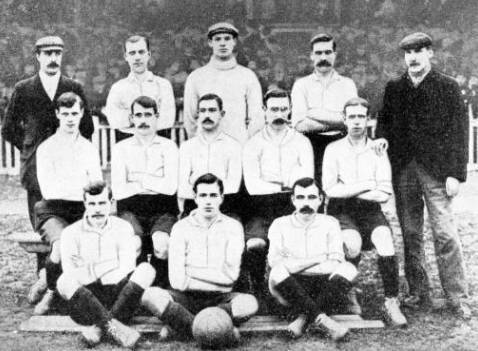
Tottenham's 1901 FA Cup team with John Kirwan on very right of second row.
Heading into the 20th century it looked as if John ‘Jack’ Kirwan would get the chance to lead a more adventurous life than most.
A thriving GAA career with Young Irelands in the 1890s provided hope, as well as an All-Ireland SFC winners’ medal. But he wasn’t prepared to settle for that.
By the time of his death in Middlesex, England in 1959 Kirwan, originally from Wicklow, hadn’t amassed the sort of wealth his career would undoubtedly provide today. But then his is a story that would unlikely happen in the modern age.
Kirwan was just 17 when Young Irelands, a team from Meath Street in Dublin’s south inner city comprising mostly of Guinness workers, made up the Dublin team which claimed the 1894 All-Ireland SFC title after the first-ever replay.
That proved to be only a small part of a dramatic episode in GAA history, with Kirwan and Co awarded the title as a result of a disciplinary hearing. Cork fans were reported to have invaded the pitch at Thurles and attacked a number of Dublin players minutes before the end of a game the Rebels were leading.
“A Dublin player struck a member of the Cork team. A bystander, a Charleville man, shouted ‘foul’. A Young Irelander ran at the spectator and struck him, but got promptly a knock down blow in return,” it was reported on the pages of the on Monday, April 22, 1895.
“The usual crowd then ran in and the match was interrupted. A few minutes later the Dublin team left the field and objected to Cork getting the match on the ground that the field was badly kept, and that one of their players had been struck.”
And yet that remains merely a footnote in Kirwan’s sporting story, one which took him to Everton, Tottenham Hotspur, Chelsea, and then to the Netherlands where he became the first recognised coach of Ajax in 1910 and led them into the top flight of Dutch football. Kirwan did take part in one more All-Ireland final before leaving these shores in 1898, when Limerick got the better of the Dubs, as he began a journey of extraordinary success, and some controversy, in Britain and further afield.
The English Football League had been established three years after Kirwan’s All-Ireland win of 1895 and it was more than just a burgeoning sport when he landed a decade later.
It was the start of a boom, and Kirwan was at the heart of it. The left winger, a waif of a player in any era at just 5ft 7in, blossomed for a few months with Southport Central in the Lancashire League.
He was at the centre of a bidding war between northern giants Blackburn Rovers and Everton, with the latter prising him away with a bid of £250, making him the first Irishman to ply his trade at Goodison Park.
Kirwan was considered one of the most technically gifted players in the country, and it was for that reason that the emerging force of Tottenham brought him to London.
With Kirwan on the wing and forward David Copeland banging in the goals, Spurs earned promotion from the Southern League Championship in 1900. It was in that year that Kirwan returned home to earn the first of his 17 international caps, in the process becoming the first Spurs player to represent Ireland.
And there was further history to be made 12 months later when, after another replayed final with Sheffield United at Bolton’s Burnden Park, Tottenham prevailed 3-1 having drawn 2-2 a week earlier in front of a world-record 110,820 fans at Crystal Palace.
“An out-and-out winger, he (Kirwan) did not appear to have the physique to overcome the often-robust challenges of the defenders of the day, but in fact had such an abundance of skill that defenders were rarely able to get close enough to tackle him,” it reads in a profile in .
Spurs had not yet been granted entry to the Football League in 1901 so they became the first non-league club to win the FA Cup. Kirwan received a £24 bonus for inspiring that triumph and found a place in the hearts of the Spurs faithful.
He stayed for six seasons, scoring 90 goals in 343 games, before a new opportunity presented itself across London.
It was a transfer not without acrimony as both Kirwan and Copeland were poached by the most expensive pub team ever assembled.
Chelsea FC was formed in an upstairs room at the Rising Sun pub just across the road from what would become known as Stamford Bridge.
Their application to the Southern League was opposed by, among others, Tottenham, yet Chelsea were able to gain admission to Division Two of the Football League. Goalkeeper Willie Foulke, all 23 stone of him, was undoubtedly the biggest signing, in every sense, but Kirwan’s defection had caused “surprise and disappointment” according to The Spurs Alphabet.
Kirwan was in the starting XI for Chelsea’s first Football League fixture against Stockport on September 2, 1905, and while they suffered a 1-0 defeat Kirwan did find the net the following season in what remains a club record 9-2 win over Glossop North End.
It was at Chelsea, however, that the 27-year-old’s playing career began to decline and after five years trawling the lower leagues the most unlikely of opportunities presented itself in the Netherlands.
“In 1910 Ajax decided to hire a trainer. The trainer would only train the players. The board of the club would, as usual, decide every week which players would be in the team. The first trainer had to be British since soccer was thought to be invented in Great Britain,” Carel Berenschot, the former Ajax Heritage Manager and co-ordinator, explained.
And yet it was Kirwan, an Irishman and All-Ireland hero, who was prepared to play the role of distinguished Englishman in order secure the job after the Ajax board raised his first week’s wages, with club members asked to contribute afterwards.
“Kirwan came and it made the difference, Ajax managed to be promoted to the highest division,” Berenschot added, explaining how their famous white-red-white jerseys were decided upon.
“Since the club Sparta from Rotterdam already used striped shirts, Ajax had to choose a new shirt. It was not Kirwan’s actual decision, but it was his success with the club that was responsible for the red stripe in the middle.” Three years later Ajax suffered relegation back to the second tier and Kirwan then returned to Britain with his wife and two daughters after the outbreak of World War One.
His nomadic sporting life brought him back to Dublin with Bohemians after a one-year spell with AS Livorno in Italy.
And while he boasted both All-Ireland and FA Cup winners’ medals, the success at Ajax seemed most special to the man himself.
“I will always remember the kindness and treatment I received from the club and supporters,” Kirwan wrote in a letter to the Ajax club magazine after they had raised 85 Guilders (roughly €320 today) for him towards the end of his life.
Legendary English coach Jack Reynolds would build on the foundations laid by Kirwan at Ajax, which was just one stop on an incredible sporting journey that began with an All-Ireland triumph.


CONNECT WITH US TODAY



Be the first to know the latest news and updates