Marching on together: How Chelsea and Leeds have remained the best of frenemies
TV’s Saturday night football special will feature a Premier League reunion with more than a hint of retro drama. But for two sets of supporters who declare undying enmity Chelsea and Leeds have much more in common than first appearances, suggests Allan Prosser
Marching on together: How Chelsea and Leeds have remained the best of frenemies

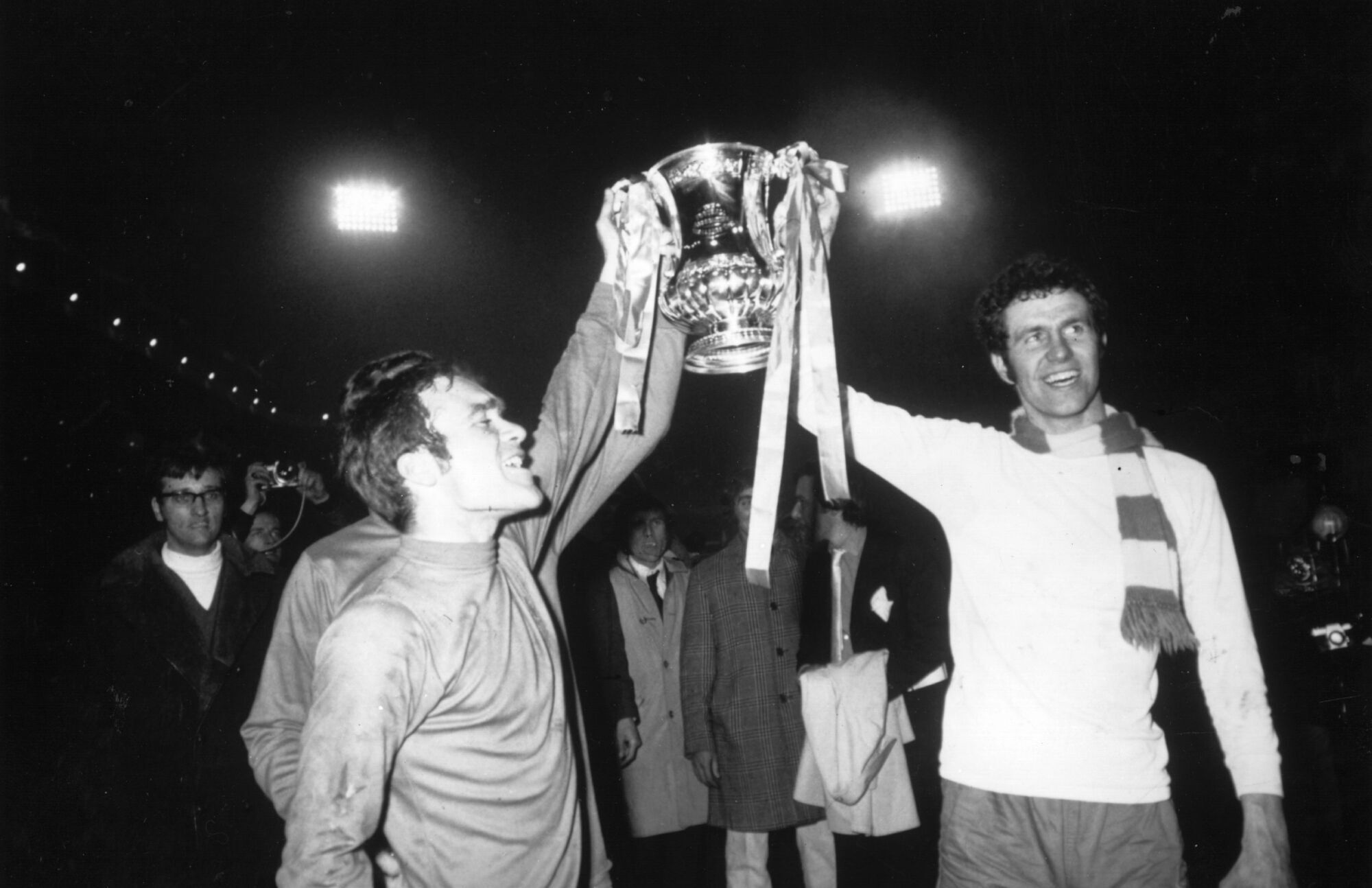
Chelsea players Peter Osgood (right) and Ron Harris lift the FA Cup trophy in celebration after beating Leeds United 2-1 after extra time in the FA Cup Final replay at Old Trafford in 1970. Picture: Getty Images

Fifty years ago in the midst of taking my A-Levels I hooked off on a 450-mile round journey for a midweek football match. I wasn’t the only one watching. 28.49 million people tuned in for the iconic cup final replay between Leeds United and Chelsea, by some distance the largest UK TV audience ever for a domestic match.

History records that Chelsea won an unlikely victory based on the quality they were supposed to lack ― resilience ― while a famously efficient Leeds United team saw the last of three trophies they had chased slip through their grasp. In that 69/70 season they finished second to Everton in Division One and lost to Celtic in the semi-final of the European Cup.


The Londoners achieved success in a match which would not have survived the modern dead hand of VAR. David Elleray, now technical director of the organisation which sets and audits the rules of soccer, once famously re-refereed the game and said he would have awarded six red cards and 20 yellows. Michael Oliver said the game merited 12 reds. This merely rubs perpetual salt into the wounds of Yorkshire.

While that Old Trafford match represented the watershed of the relationship between West London and the West Riding there have been long, and often painful, connections between the two teams which exist to this day.

Both teams emerged in the 1960s after decades of somnolence during which their joint requirement for silver polish consisted of two trophies: one Division One championship (Chelsea); one Division Two championship (Leeds).

Both teams had sold star players to Italy for world record sums: John Charles (Leeds) and Jimmy Greaves (Chelsea).

Both teams had young and unusual managers. The cerebral 33-year-old Don Revie had pioneered a role as a deep-lying centre forward (based on the successful example of the legendary Hidegkuti who led the Magical Magyar destruction of England at Wembley in 1953). Chelsea had appointed the brisk no-nonsense 32-year-old wing-half, Tommy Docherty, from Arsenal. Both placed their faith in young homegrowns. Both looked to overseas for tactical inspiration and imagination.

Revie rebadged Leeds United from their blue and gold strip into the all white of Real Madrid; he also abolished the club nickname and shirt badge believing the peacock to be an unlucky bird. Docherty introduced a stylish kit of royal blue shirts and shorts with numbers on the thigh and white socks. For that fulminating cup final Leeds changed to red socks for the game at Wembley while Chelsea changed to yellow for the Old Trafford replay.

Life was simpler then. No “ember glow” or “legend ink” or “mystery green” club colours. While Leeds were a dominant and successful team capable of stunning football they also had a mastery of the dark arts, a reputation which started to be forged during the emergence of a nails-hard midfield consisting of Billy Bremner, Johnny Giles and Bobby Collins. Add Norman “Bites Yer Legs” Hunter and Jackie Charlton into the equation and they had a formidable reputation during an era noted for the number of hard men who listed the art of the surreptitious professional foul among their life skills.

The script was written for Leeds to represent the gritty, working-class north and Chelsea to play the role of the effete, posturing, over-privileged and soft southerners.

It was a common regional view eloquently shared by Terry Collier (James Bolam) in the popular TV comedy The Likely Lads: “I hate Chelsea, they stand for everything I hate in football, with their showbiz supporters. They come out looking like The Young Generation rather than a football team.”

Reality struck when Chelsea met Leeds in an FA Cup semi-final at Villa Park in 1967. Chelsea won 1-0 through a rare Tony Hateley goal, set up by Charlie Cooke but the abiding memory is of a thunderous Peter Lorimer equaliser from a last-minute free-kick which was disallowed because the Chelsea defensive wall was not far enough back (a Terry Cooper goal had also been disallowed seven minutes from the end for a marginal offside).

Deep resentment simmered but there was some redemption for Leeds fans five months later in October when they faced a Chelsea team rocked by the resignation the day before of Tommy Docherty. Leeds won 7-0 in a game inspired by Bremner who was on the cusp of commencing a 28-day suspension for foul play. Bremner scored the seventh goal with a bicycle kick, the kind of Fancy Dan technique Leeds would normally eschew.

When the FA Cup threw the two teams together in 1970 Leeds were in their peak years and Chelsea had a team which could beat anyone on its day managed by a pragmatist, Dave Sexton, whose father had been a professional middleweight boxer. He had ensured that Chelsea had similar iron in their soul to Leeds. And in many ways Leeds respected a team that could dish it out as well as take it. “That’s just the way it was in those days” Paul Madeley said later.

Chelsea's Peter Osgood as he dives to head the equalizing goal past Leeds United goalkeeper David Harvey during the 1970 FA Cup final. Picture: PA

But it is in the fortunes of the years that followed 1970 that the two clubs who had gained promotion to Division One at the start of the 60s grew ever more to resemble each other.

Both had serious hooligan followings prone to clash on match days. On the last game of the 83/84 season Chelsea had to beat Leeds at Stamford Bridge to win the old second division and gain promotion.

They accomplished this 5-0. Leeds fans returned the favour by dismantling and burning the scoreboard in scenes which would do credit to the opening lines of the Leeds-supporting Kaiser Chiefs song I Predict a Riot: “Watching the people get lairy, It's not very pretty I tell thee.”

Both clubs wobbled on the edge of financial disaster. Chelsea because an ill-advised expansion of Stamford Bridge coupled with a reduction in the team’s fortunes led to periodic relegations (they spent seven years in Division Two between 1975 and 1985) and a protracted struggle over ground ownership.

They have been ever-presents in the top tier since 1989 and were competing for titles even before the arrival of Roman Abramovich although his investment in the ensuing 1001 games since his takeover has moved the club into becoming a major domestic and European player.

Leeds were the final champions of the old Division One when Howard Wilkinson was the last English manager to oversee a title-winning campaign. He was replaced, firstly by George Graham and then by David O’Leary who guided them to the semi-finals of both the UEFA Cup and the Champions League.

Then came the years of living dangerously when under the chairmanship of Peter Ridsdale the club board decided to “live the dream” and secured large loans and investments for player recruitment and wages against the promise of future Champions League revenues.

Jermaine Pennant of Leeds celebrates with teammates and fans after scoring during the FA Barclaycard Premiership match between Leeds United and Chelsea at Elland Road on December 6, 2003. Picture: Laurence Griffiths/Getty Images)

These failed to materialise when Leeds missed qualification to Europe in two successive seasons and a fire sale of players commenced, marked by the departure of Rio Ferdinand to Manchester United for £30m.

Like Chelsea, Leeds had over extended. The ground and training ground were sold and leased back. The club was relegated and entered the most turbulent period in its history The man who came to rescue them was Ken Bates, once cast in a similar role at Chelsea.

Early during his stewardship as owner Leeds were placed into administration and a points reduction took them out of the Championship and into League One, the third tier of English football.

If Bates appeared as an unlikely form of saviour the fact that he brought with him Dennis Wise and Gus Poyet, former Blues diehards, was difficult to swallow, giving rise to a fans song “You Chelsea bastards, get out of our club.” 

Under the guidance of Bates, Leeds returned to the Championship although he never delivered the ambition of regaining the ownership of Elland Road. That had to wait for a successor owner, the Milanese Andrea Radrizzani, who emerged after a complicated series of takeover battles, as 100% shareholder in May 2017.

After false starts with a number of managers Radrizzani secured the volatile Argentinean 65-year-old Marco Bielsa as his head coach.

This ensures even more piquancy in Saturday night’s clash with the high-flying Londoners. Bielsa was at the heart of the Spygate scandal of 2019 when a Leeds agent was discovered to be watching the closed training sessions of promotion rivals Derby County coached by Frank Lampard. Mauricio Pochettino and Pep Guardiola were quick to come to the defence of Bielsa but the FA fined Leeds £200,000 and changed its rules to prevent covert scrutiny between teams up to 72 hours before a game.

Bielsa gave a 70-minute powerpoint explanation to journalists to explain the thoroughness of his coaching and research methods but Lampard was deeply unimpressed, wryly asking his own press conference whether they were ready for him to do his presentation. “We do analysis as well” he said.

Leeds fans have their own song to mark the episode: “Don’t cry Frank Lampard, you’ll beat us one day” but the incident still rankles with the Londoner.

Lampard’s Derby went on to thwart Leeds in the play-off semi-finals by winning 4-2 at Elland Road including a clever goal by Mason Mount who will figure Saturday night in the first game at Stamford Bridge which can be attended by fans since March.

Chelsea's Frank Lampard celebrates scoring against Leeds United during the Barclaycard Premiership match at Stamford Bridge on January 28, 2003. Picture: David Davies

He also made sceptical comments when Bielsa was given a Fair Play award by FIFA last season. So far he has been silent on Bielsa’s nomination as FIFA’s Coach of the Year alongside Jurgen Klopp, Zinedine Zidane, Hansi Flick and Julen Lopetegui, but he may not stay that way forever.

The 2,000 supporters Chelsea are allowed on Saturday night because of London’s Tier 2 status will no doubt give a lusty version of their Dambusters themed anthem “We all hate Leeds and Leeds and Leeds and Leeds and Leeds and Leeds and Leeds, we all f***ing hate Leeds” but they might reflect also on the similarity between the favourite commercial songs of both clubs.

Leeds United Marching On Together:

“We've been through it all together,

And we've had our ups and downs

We're gonna stay with you forever,

At least until the world stops going round.”

Chelsea Blue Day:

“We've waited so long, but we'd wait forever

Our blood is blue and we would leave you never.”

Whatever the spice factor Saturday night, and it is likely to be high, these two sides have a shared history as attention-grabbing, crowd-pleasing, outsiders which stands for something in these troubled times.

Long may it last.

Who is left from 1970?

Leeds United

Gary Sprake: Died 2016, aged 71. Nicknamed “Careless Hands” after he threw the ball into the net at Anfield in 1967. Transferred for £100,000 in 1973 to Birmingham City; then a world record for a goalkeeper. Later accused Don Revie of matchfixing

David Harvey: Sprake’s replacement at Old Trafford. Aged 72. Lives in Dumfries, Western Scotland after working a smallholding in the Orkney Islands.

Paul Madeley: Died 2018, aged 73 with Parkinson’s Disease. Became a multi-millionaire by developing his family’s DIY business

Terry Cooper: Age 76. Lives in the Canary Islands.

Billy Bremner: Leeds United captain. Died 1997, aged 54 from a heart attack

Jackie Charlton: Died July 2020 aged 85 from lymphoma and dementia

Norman Hunter: Died April 2020 aged 76 from Covid-19

Peter Lorimer: Aged 73. Remains an ambassador for Leeds United. Writes regular column in a Leeds newspaper.

Allan Clarke: Aged 74. Lives in Lincolnshire

Mick Jones: Aged 75. Lives in Sheffield

Johnny Giles: Aged 80. Lives in Birmingham. Soccer analyst and pundit

Eddie Gray: Aged 72. Club ambassador and radio commentator

Mick Bates (substitute): Aged 73. Lives in Yorkshire

The Manager - Don Revie: Died 1989, aged 61 after suffering from motor neurone disease. A stand at Elland Road is named after him.

Chelsea

Peter Bonetti: Died April 2020, aged 78

David Webb: Aged 74 with homes in Hampshire and Portugal. Has range of property interests

John Dempsey: Aged 74. Lives in London. Worked as a care assistant in special needs after retirement from the game.

Ron Harris: Aged 76. Chelsea Captain. Lives in Somerset. In demand corporate and after-dinner speaker.

Eddie McCreadie: Aged 80. Lives in Tennessee, US.

John Hollins: Aged 74. Lives in London. Corporate hospitality and media work

Charlie Cooke: Aged 78. Lives in Cincinnati, US

Tommy Baldwin: Aged 75. Lives in Eastbourne, Sussex

Peter Osgood: Died 2006 aged 59 after suffering a heart attack

Ian Hutchinson: Died 2002 aged 54 after a long illness

Peter Houseman: Died 1977 aged 31 in a car crash near Oxford

Marvin Hinton (substitute): Aged 80. Lives in Sussex

The Manager - Dave Sexton: Died 2012 aged 82. Left club football management in 1983.

Degrees of separation

Chelsea’s Stamford Bridge ground was opened in 1905 and offered originally to Fulham FC who preferred to stay at Craven Cottage. Elland Road was the original home of another club, Leeds City, but was taken over by Leeds United upon formation in 1919.

The popular south end at Elland Road, built in the 1920s, was called The Scratching Shed. It was redeveloped in 1974 and is now known as The Norman Hunter Stand. The popular south end at Stamford Bridge was also covered by a corrugated roof erected in 1930 and became known as The Shed. It was demolished in 1994. Both locations were notorious for a certain level of partisan behaviour.

Chelsea’s last league match against Leeds was in 2004, won by a Jesper Gronkjaer goal, and notable for the departure of Claudio Ranieri following the arrival of Roman Abramovich. The man who sold Chelsea to the Russian oligarch was Ken Bates who bought a controlling share in Leeds United in January 2005. Bates sold Leeds United to Middle East equity group GFH capital in 2012.

Patrick Bamford will be leading the Leeds United attack Saturday night. Bamford was signed by Chelsea for £1.5m in 2012 after two games with Nottingham Forest before he was sent out on multiple loans, including to Derby County.

Derby County was the first club to be managed by Frank Lampard. During his tenure, there was a major row over a blackops mission on a Rams training session in a controversy that became known as “Spygate”. The person who commissioned the covert reconnaissance was Leeds manager Marco Bielsa who personally paid a £200,000 fine for a breach of the FA’s “good faith” rules. Lampard went on to question Bielsa’s FIFA Fair Play Award. His team also defeated Leeds 4-3 at Elland Road in the May 2019 play-off semi-finals. Lampard and Bielsa will meet competitively for the first time since then in Saturday night’s game.

Silverware

Leeds:

First Division/Premier League ― 3 (1968–69, 1973–74, 1991–92)

FA Cup ― 1 (1971–72)

Football League Cup ― 1 (1967-68)

Inter-Cities Fairs Cup ― 2 (1967–68, 1970–71) 

Charity/Community Shield ― 2 (1969, 1992)

Second Division/Championship ― 4 (1923–24, 1963–64, 1989–90, 2019–20)

Chelsea:

First Division/Premier League ― 6 (1954–55, 2004–05, 2005–06, 2009–10, 2014–15, 2016–17)

FA Cup ― 8 (1969–70, 1996–97, 1999–2000, 2006–07, 2008–09, 2009–10, 2011–12, 2017–18)

Football League Cup ― 5 (1964–65, 1997–98, 2004–05, 2006–07, 2014–15)

Champions League ― 1 (2011-2012)

Europa League ― 2 (2012–13, 2018–19)

European Cup Winners Cup ― 2 (1970–71, 1997–98)

Super Cup ― 1 (1998)

Charity/Community Shield ― 4 (1955, 2000, 2005, 2009)

Second Division/Championship ―2 (1983–84, 1988–89)

More in this section

Sport

Newsletter

Sign up to our daily sports bulletin, delivered straight to your inbox at 5pm. Subscribers also receive an exclusive email from our sports desk editors every Friday evening looking forward to the weekend's sporting action.

Cookie Policy Privacy Policy Brand Safety FAQ Help Contact Us Terms and Conditions

© Examiner Echo Group Limited