When Ireland went four years without a win: Paddy Mulligan recalls nightmare run
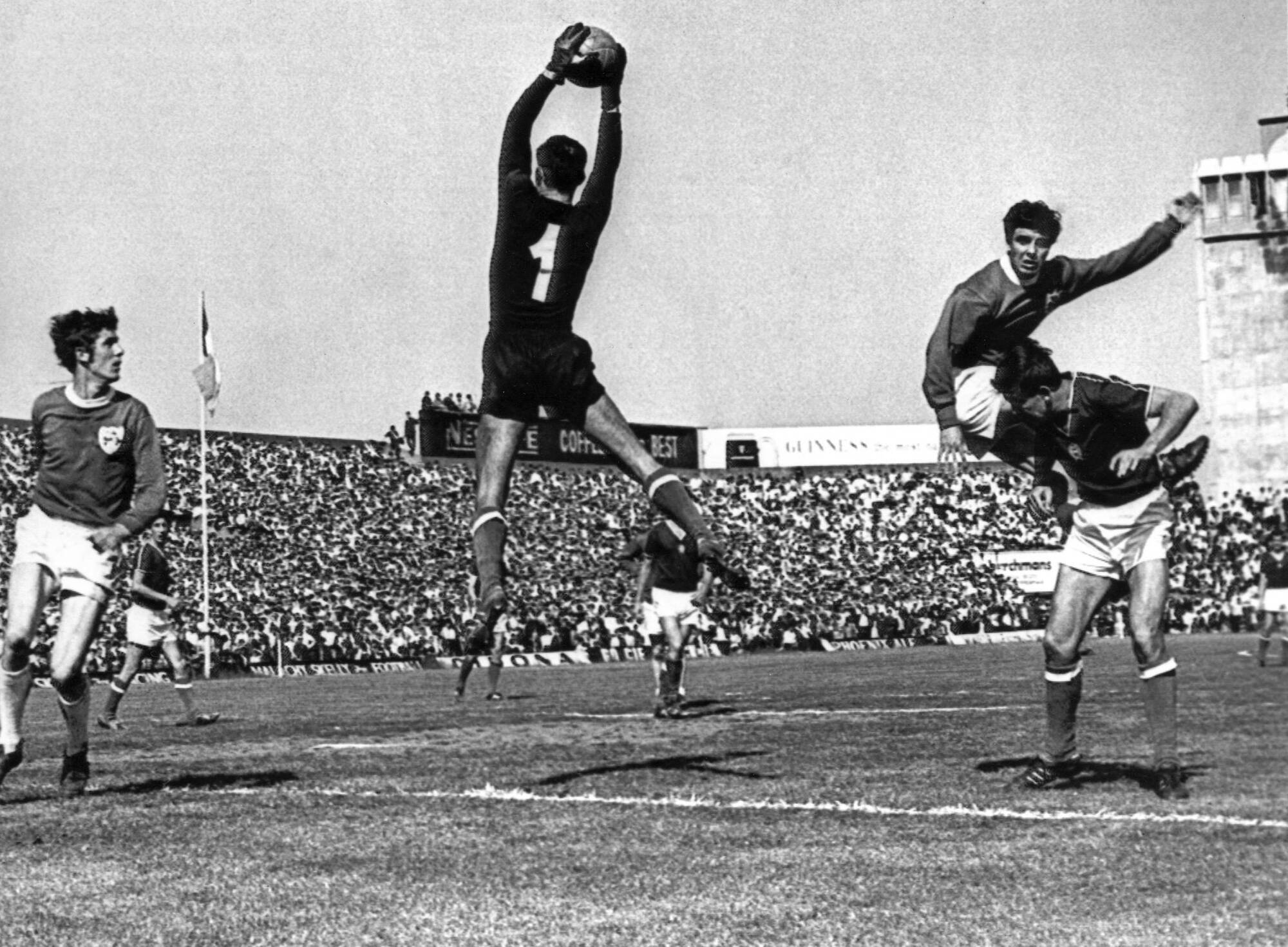
CLEAN SHEET: Hungary keeper Antal Szentmihály defies an Ireland attack in the visitors’ 2-0 win at Dalymount Park in June 1969. Picture: SSPL/Getty Images
The FAI should have created a pathway for Stephen Kenny to work with Mick McCarthy prior to succeeding him as manager of the senior national team, according to former Republic of Ireland defender Paddy Mulligan.
“I think Stephen’s in a horrendous position at present because the transition was handled badly,” says Mulligan, capped 50 times between 1969 and 1979.
“Once the FAI decided that Stephen would replace Mick they should have provided for a gradual hand-over, with Stephen learning the ropes by being part of Mick’s set-up — observing, listening and learning — although not as assistant manager.
“There’s a huge difference between managing Dundalk and taking charge of the national team. It’s a completely different kettle of fish.
“Stephen has been very unfortunate with the Covid situation and injuries. Overall, he’s having to learn a lot of things very quickly.”
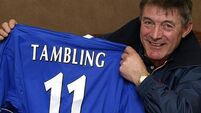
Mulligan, who won a European Cup Winners’ Cup medal with Chelsea in 1971, is well placed to talk about Ireland’s current dismal run (no win in the last nine fixtures, and no competitive victory from the last 11 attempts).
After all, he experienced an even worse level of under-achievement in the green jersey five decades ago during a 19-match winless spell stretching from early 1968 to mid-1972.
“That was nightmare stuff,” Mulligan recalls. “It was always one step forward, then two or three backwards because of injuries and clubs in England refusing to release players for international duty.
"At that time, we had a core squad of about 15 or 16, with four or five outstanding players. If any of these were injured we struggled.
“When I started playing for Ireland, the team was picked by a Selection Committee.
“For one match they dropped Johnny Giles in favour of Billy Newman, a decent League of Ireland player [with Shelbourne]. His reaction was ‘What am I doing here?’ I told him, ‘This is your chance, make the most of it’”.
Giles and Shamrock Rovers winger Frank O’Neill were among the players who persuaded the Selection Committee to install a manager with full responsibility for team matters, resulting in Mick Meagan’s appointment in 1969.
Even then, things got worse before they improved. Ireland nosedived to a 6-0 drubbing by Austria at Linz in a Euro qualifier in October 1971 — the national team’s second-heaviest competitive defeat — in Liam Tuohy’s first match in charge.
“I was the only England-based player released for the match, so the other 10 came from League of Ireland clubs,” says Mulligan. That number included seven débutants.
His next cap was a happier one, skippering Ireland to a 2-1 win against Iran at Recife in June 1972 during the Brazil Independence Cup, a tournament to mark the 150th anniversary of the Brazilian Declaration of Independence.
In Mulligan’s playing days, expectations around the national team were much lower than today. But the memory of a play-off defeat by Spain for a place at the 1966 World Cup finals still annoys him, “because the FAI agreed to play in Paris for financial reasons rather than hold out for a venue in England where Irish support would have been a huge boost”.
Pondering Ireland’s prospects for 2021 and beyond, Mulligan finds it hard to be optimistic. “I saw Belgium outclass England the other night, after England had beaten us 3-0 at Wembley,” he points out. “So that puts our situation in perspective.
“I don’t think David McGoldrick will be a particularly big loss, because we needed him to play in a more forward position. Away to Gibraltar he spent too much time dropping deep, almost in front of our back four on occasions.
“Stephen Kenny’s tactics should be tailored to suit the players he’s got. I’m inclined to favour 4-4-2, where the central striker has support alongside him. Maybe Adam Idah will solve the scoring problem.
“There’s a lot of media hype about Aaron Connolly, but since scoring those two goals for Brighton against Spurs, what has he done?
“Above all, I’d like to see more football intelligence on the field from Ireland’s players. Everyone should know exactly what their role is. It looks at times as if the players are getting so much information they find it hard to think for themselves and are afraid of making mistakes.
“I know, in comparison to the great squads Jack Charlton could choose from, the current squad has nowhere near the same quality.
“But some basic things can always be done. A pass from back to front is the most progressive ball in the game, but if you put too much emphasis on possession the opposition will be happy to let you have lots of the ball as long as you’re not threatening them."
CONNECT WITH US TODAY



Be the first to know the latest news and updates