Timeline of Ireland’s Covid-19 woes after a week of off-field drama
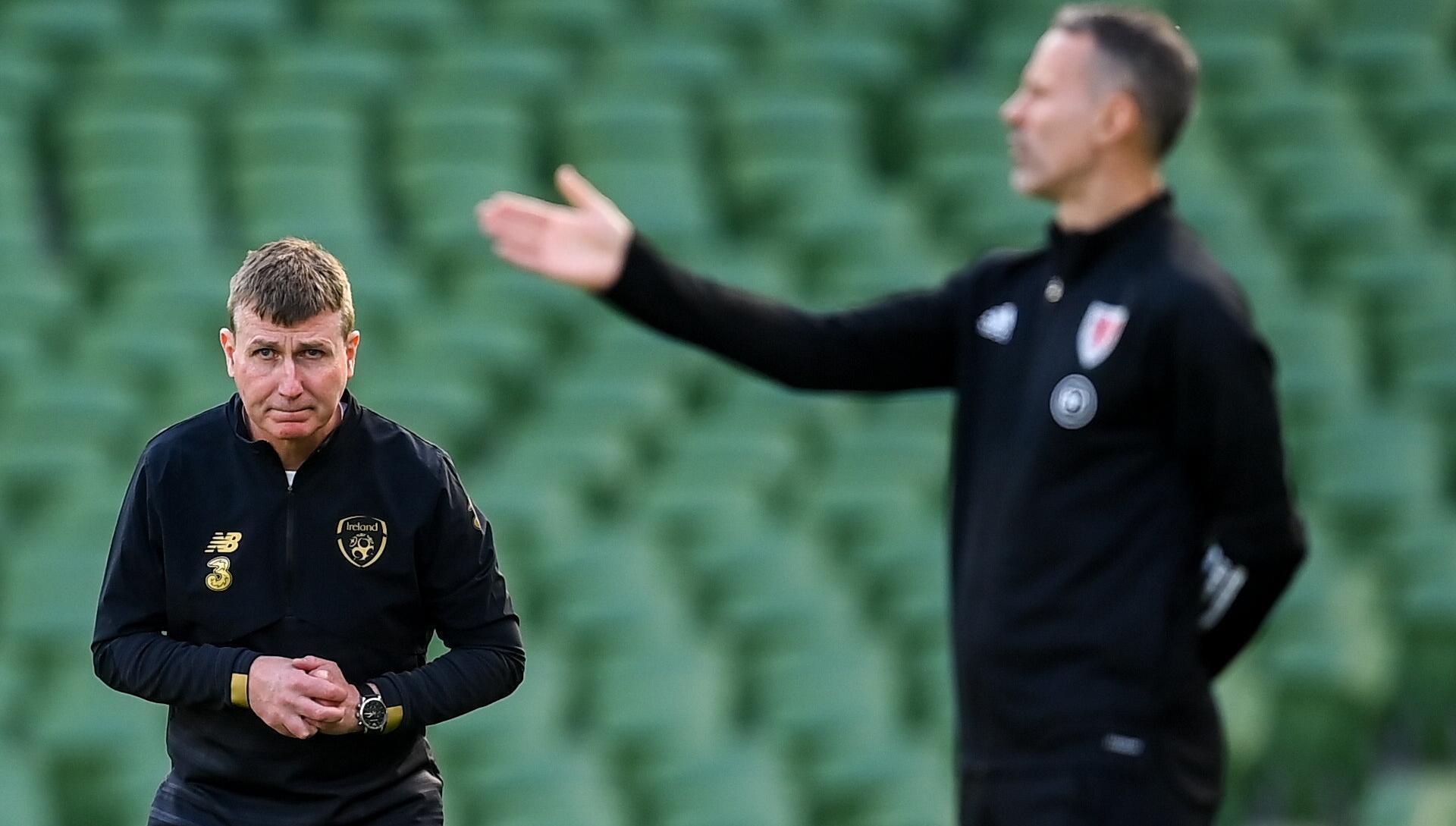
Republic of Ireland manager Stephen Kenny and Wales manager Ryan Giggs at the Aviva Stadium. Photo by Stephen McCarthy/Sportsfile
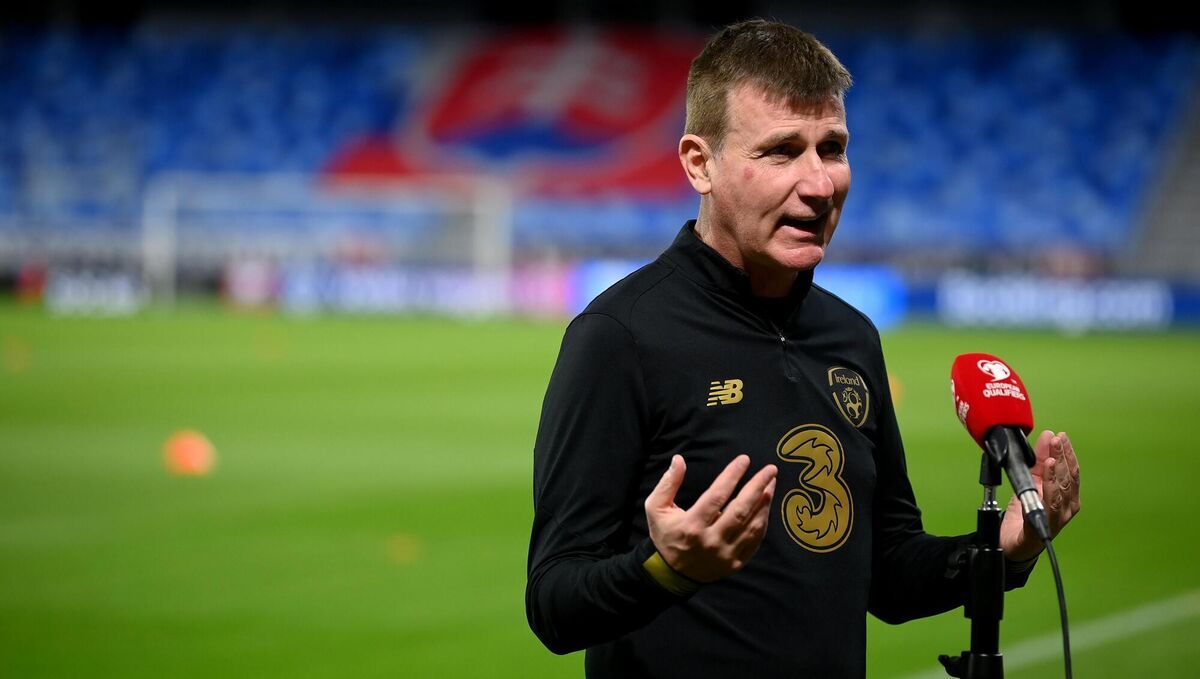
Stephen Kenny has referred to this week’s events as a saga and that was before two of the three games in this international window kicked off.
The FAI had only in late August retained a specialist company – One-Team Risk Management Solutions – to carry out risk assessments arising from the pandemic.
The company, run by ex-Garda assistant commissioner Pat Leahy and another retired senior member of the force, Stephen Ward’s father Sean, took over the security and health role for the first games of Kenny’s tenure in September.
An FAI spokesperson said at the time: “In light of the Covid-19 pandemic, the FAI is adopting a new approach to risk management and security around all our international teams.
“International football has been impacted at all levels by the pandemic and in response to this need, we have recruited One-Team Risk Management Solutions and their highly experienced security experts to work with us from the start of this Uefa Nations League campaign.”
The events of the last week have seen the virus rip up Kenny’s preparations.
Here we chronicle the chain of events:
The reports that one member of Kenny’s backroom team had tested positive for Covid-19. His test was carried out on Sunday as the squad and staff assembled in their Castleknock Hotel base in Dublin.
A contact tracing exercise resulted in two additional backroom staff members being stood down for the three games. All three couldn’t travel to Slovakia with the party by charter plane later that day.
Several other personnel, including those in the media, are deemed as casual contacts. That extended to manager Stephen Kenny, despite the manager sitting beside the victim in a room for at least 45 minutes on Sunday, with neither wearing protective masks.
The charter flight leaves Dublin Airport with a colleague replacing the Covid victim for handling media duties. He had been tested negative that morning before joining the senior ‘bubble’.
The other newcomer, who replaces the kitman deemed a close contact, travels to Bratislava independently by scheduled flights.
In total, 53 passengers board the sanitised plane into allocated seats. There is distance between each traveller but not the two metres stipulated by the Health and Safety Executive.
Repeat tests of players and staff return one positive result. The new victim happened to be a communications executive who joined the bubble. He is asymptomatic and begins the process of compiling his list of close contacts from the previous four days.
Uefa and the Irish statutory body, the Health and Safety Executive (HSE), are notified.
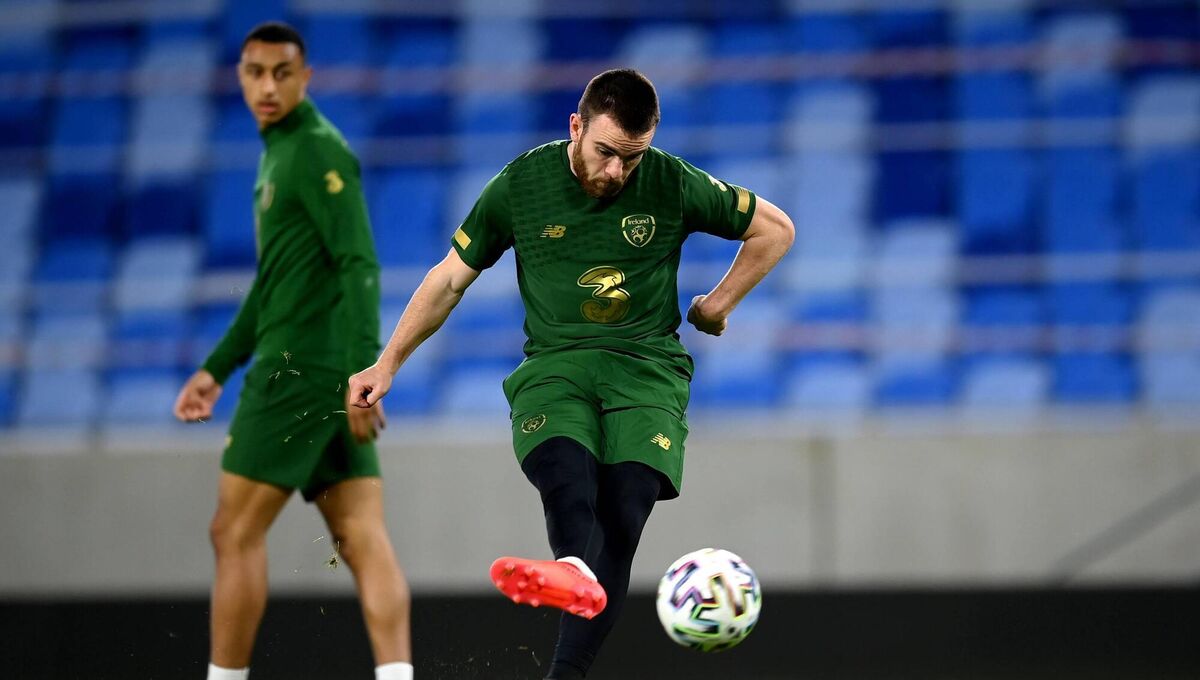
From discussions, four members of the travelling party are considered close contacts. Adam Idah and Aaron Connolly, who moved from their allocated seats further down the rows nearer the confirmed case, are two, along with one of the physiotherapy support staff and an international administrator.
CCTV footage is studied to measure the distance, with Idah found to have been 1.7m away from the victim. Connolly, at 1.9m, was even further away.
An appeal for an exemption to the HSE is rejected, forcing Kenny to replace Connolly in his starting team with James McClean just hours before kick-off.
The names of Connolly and Idah appear on Uefa’s teamsheet but they stay back at the team hotel, along with three other affected personnel.
Ireland’s dream of a third successive European Championship finals appearance is shattered by a penalty shootout defeat. Kenny afterwards expresses his disappointment at losing his two players: “We have different rules in Ireland than in the UK; they’re much more stringent and would be deemed close contacts to one of our non-footballing staff,” he told Sky Sports.
“It’s very, very harsh to rule them out as they were perfectly fine.”
The Ireland squad return to Dublin overnight and are retested as per Uefa’s protocols. The five people related to the Covid case remain in Bratislava and are flown home later in the day by private jet, the players returning to England as their time in camp appears to be over.
Kenny is quizzed for the first time by Irish media about events in Bratislava. On a Zoom call, he outlines his annoyance at developments.
“Realistically, the person... it was a non-essential football member in terms of a crisis situation that travelled,” he said.
“That is something that we have to live with. To find out on match day, and then a bit of a saga because the possibility existed of an appeal and so forth... it wasn't good preparation on match day because we were having discussions about it and the impact of it rather than the match, but there is nothing we can do about it.”
His take on the situation is not received well inside the corridors of power at Abbotstown. Hearing the term ‘non-essential’ assigned to certain staff rips asunder any notion of a unified vibe within the Ireland delegation.
The results of the latest tests are returned, with mixed outcomes.
On the plus side, the press officer diagnosed with Covid in Bratislava tests negative. The quartet of affected people no longer have to restrict their movements.
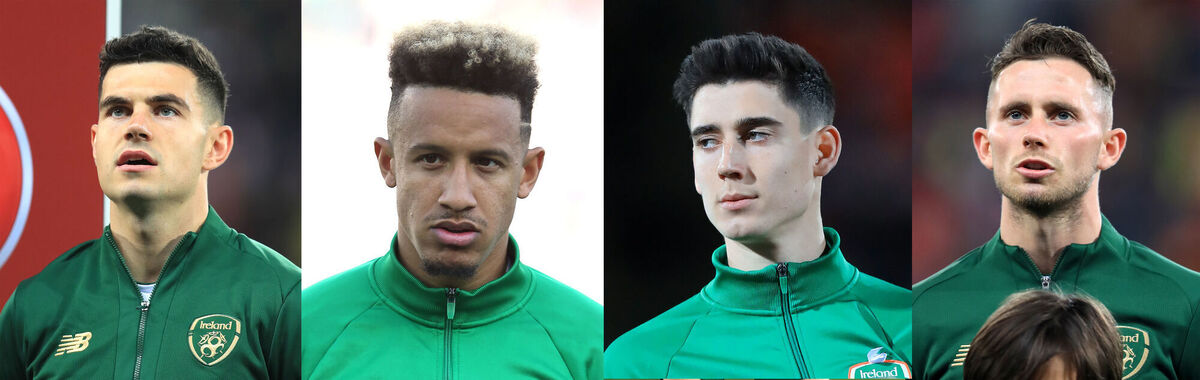
Unfortunately, one player is positive for the virus. Overnight contact tracing identifies four players he sat near on the return flight from Bratislava as close contacts. Those players – Alan Browne, John Egan, Callum Robinson, and Callum O’Dowda – were due to start on Sunday against Wales but are ruled out.
The breaks news of the latest Covid episode, which is followed by an FAI statement.
Despite the withdrawals of five further players, the game versus Wales must proceed as the squad still has the 13 minimum members, including a goalkeeper, under their latest protocols.
“In light of these developments, the FAI wishes to make it clear that it complied with all Uefa and HSE Covid-19 guidelines concerning the availability of players and the well-being of staff around the Slovakia v Republic of Ireland fixture in Bratislava on Thursday night,” the FAI pointedly added, indicating a different interpretation to that of Kenny.
Read More
The FAI’s interim chief executive Gary Owens gives an interview to , addressing various queries on the topic.
The outgoing supremo said: “Everyone who was on the plane over has a clear role. Nobody travelled on the plane that didn’t need to be there.
“The person was required to travel under Uefa protocols so I would disagree with Stephen there. We brought the right people to support the team. The assumption is that everyone who gets on the plane is negative from all the testing.
“Where people sat on the plane is a red herring. HSE guidelines don’t dictate where people sit on the plane. Even if the players had sat in the right seats, they wouldn’t have been 2 metres apart.
“We had 53 people on the flight. To social distance, we would have needed four planes. That would be a huge financial burden on associations. Wales are using the same plane for this match.
“We will review all matters with the HSE and Uefa.”
Owens added that the FAI are still holding out hope of having Idah and Connolly return to the squad for Wednesday’s Uefa Nations League game in Finland. Kenny said much the same in his pre-match interview in a rare glimpse of unity.

CONNECT WITH US TODAY



Be the first to know the latest news and updates