Time to hear England's side of the Stuttgart story
Time to hear England’s side of Stuttgart story, writes Brendan O'Brien.

Time to hear England's side of the Stuttgart story

The sporting calendar has been all but scrubbed. Fields, gyms, and halls lie empty. Football boots and racquets have been consigned to the darkness under the stairs. Sport has never stood so insignificant in our eyes and yet we’ve never needed its distraction more than now.

Into the void this Monday evening will land the second-half of the Loosehorse team’s Boys In Green documentary and, while it will have to detail the fall and decline of the Jack Charlton era, then the opening episode last Monday was a love letter to the best of those times.

The story of Euro ‘88, how Ireland got there and what they achieved when they arrived in Germany, has been told time and again in newspapers and books and on radio, TV and online.

Christy Moore wrote a song so evocative that Joxer is still a part of us all.

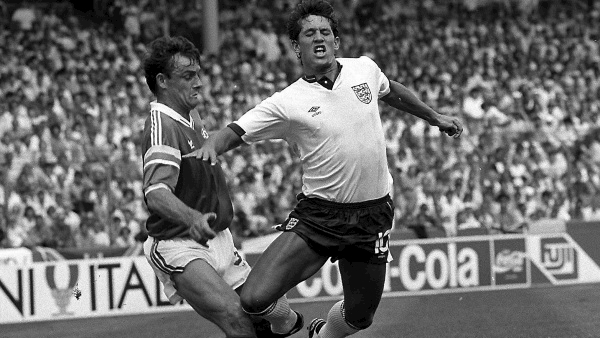
To watch the programme five days ago was to marvel at how much even those of us who were lucky enough to be there at the time didn’t know. Or forgot. Every old clip was a joy and among the contributors was Gary Lineker who, forgive the pun, played such a central role in Stuttgart.

Seeing Lineker got us thinking. How many times have we seen the clip of the physio Mick Byrne walking in to the ground and declaring that ‘we’ll do them for yis today’? There were two teams that day but we only ever look at the game through green-tinted glasses.

What about England’s side of the story?

Take Ray Houghton’s header. The most famous goal in Irish history was an English disaster. Kevin Moran’s free kick arrived from another postcode, a good 30 yards inside the Irish half.

England had all the time in the world to man the walls but all they did was hand over the keys.

It started with Mark Wright and Gary Stevens challengIng Frank Stapleton for the same ball in the air. Tony Galvin, left utterly unmarked by Neil Webb, hooked it over. Kenny Sansom fly-kicked it skywards and then John Aldridge outjumped Tony Adams who stood a good four inches taller.

Houghton, meanwhile, was haring in towards the back stick. His marker, Liverpool clubmate John Barnes, can be seen dawdling miles away in the footage.

The rest, as they say, is history and so was England’s high hopes of a first European title when they lost 3-1 to the Netherlands days later.

The third defeat, to the USSR in Frankfurt, was academic for them and yet, at the same time, something of a nadir with Robson making a number of changes to a team that played like dead men walking anyway.

This was not how anyone thought it would end.

******

England’s flight to Germany was an hour late leaving Luton Airport the previous week but everything else had gone smoothly. Edged out of a World Cup quarter-final by the deception and the genius of Diego Maradona in 1986, they sailed through qualifying unbeaten.

Nineteen goals in six games spoke emphatically for a team that was among the favourites that summer in 1988. Their official song, ‘All The Way’, reflected that, although the video ended somewhat presciently with Tony Cottee driving a vintage Formula 1 car into a tree.

Bryan Robson said outright that they could win it. Bobby Robson declared it the best squad he had assembled in his six years in charge and Peter Shilton reckoned it was on a par with any England party he had been with, including the 1970 version replete with World Cup winners.

Brian Clough spoke respectfully of Ireland on ITV’s match day coverage but he countered that by announcing in his own inimitable way that he couldn’t see them causing England any problems.

It was a confidence reflected in the squad that day in Stuttgart.

Among the treasures on YouTube is a clip of ITV’s Jim Rosenthal on the England team bus as it made its way to the Neckarstadion for the game.

It was the first time a TV crew had been afforded such access but it didn’t bother the England players one bit.

Mark Wright dismissed any talk of a lingering injury from earlier in the week, Chris Waddle told a joke about Jack Charlton’s love of fishing and Sansom did impressions of everyone from Norman Wisdom to Ronald Reagan. The entire bus was in stitches.

Ireland? They were listening to rebel songs.

******

The mood among England’s supporters was edgier. Forty had been arrested the night before and 44 more would join them in the clink that night.

England’s clubs had already been turfed out of Europe and Minister for Sport Colin Moynihan was talking openly that very week about the possibility of banning the national team from international football.

“Let’s hope we can look back in the events with pride and not shame,” said ITV host Nick Owen shortly before crossing over to his comms team in Germany. It’s a line that still strikes a sobering note today.

The only other concern, if not one shared by all, was the centre of the English defence. Terry Butcher was out with a broken leg and there were misgivings over a 21-year old Tony Adams — who admitted later to missing the Rangers veteran beside him — and Wright.

Clough was blasé about all that and preferred to talk down Mick McCarthy who had passed a medical that morning.

“I’m glad from England’s point of view that the Irish centre-half is fit ... because I don’t think he is international class for starters and I’d have thought that [Peter] Beardsley and [Gary] Lineker would be rubbing their hands.

“In fact,” said the Nottingham Forest manager from the comfort of his studio armchair, “if they could have got him a few Deutschmarks to get him even fitter still so there would have been no doubt then I think they would have slipped him a few.”

What Clough and everybody else didn’t know at the time was that Egland’s greatest concern was at the other end.

Lineker was suffering from hepatitis B and spoke later of the lethargy he felt at the time, not least that first day against Ireland when four good chances passed him by.

Liam Brady was bullish at half-time when interviewed but he spoke fearfully of the threat that Glenn Hoddle would bring if brought on. He was. And Hoddle very nearly unpicked the Irish defence. Bobby Robson counted a dozen chances created by his team.

All to no avail.

Republic of Ireland Manager Jack Charlton, right, and Assistant Manager Maurice Setters celebrate after the game. European Championship Finals 1988, Group B, Republic of Ireland v England, Neckarstadion, Stuttgart, Germany. Picture credit: Ray McManus / SPORTSFILE

******

“We think it’s recoverable,” said Bobby Robson. Comparisons were made with Mexico ‘86 when England lost their first game but rebounded to reach the last eight and, while their record of three defeats that summer make for grim reading, they don’t tell the full story.

Their meeting with Holland, the eventual champions, in Dusseldorf three days later has been all but forgotten but it was, and remains, a classic. Lineker and Hoddle both hit the same post in the first half before Marco van Basten scored the first of his three on the day.

The AC Milan striker ran Adams, who had been depicted as a donkey by one tabloid earlier that year, ragged.

A second loss meant England were out with a game still to play and the downturn in fortunes and mood was captured one night in the team hotel when Bryan Robson, the captain who scored a brilliant equaliser against the Dutch, chinned Shilton.

The pair, both of them experienced pros at that point, had never had any particular beef before but Shilton, according to Robson, turned on him, taunting the Manchester United man about his ‘Captain Marvel’ nickname and declaring himself to be the ‘number one’.

“I kept my temper for about half, three-quarters of an hour,” said Robson in his autobiography, which was published 18 years after the event. “Then he said I was a ‘bottler’ and that was when I snapped.

“He was sitting at the bar so I told him, ‘Get up and I’ll show you who’s a bottler’. He wouldn’t get up, but I was so angry I punched him. He just sat there and went quiet. I was fuming, but as soon as I went for him I knew I shouldn’t have.”

Assistant manager Don Howe suffered a suspect heart attack days after the team’s return home but the red tops didn’t back off the boss man whose offer to resign was rejected by FA chairman Bert Millichip.

In Ireland the party was only getting started.

x

More in this section

Sport

Newsletter

Latest news from the world of sport, along with the best in opinion from our outstanding team of sports writers. and reporters

Cookie Policy Privacy Policy Brand Safety FAQ Help Contact Us Terms and Conditions

© Examiner Echo Group Limited