The big interview: Lisa Fallon wants to be judged on her own merits
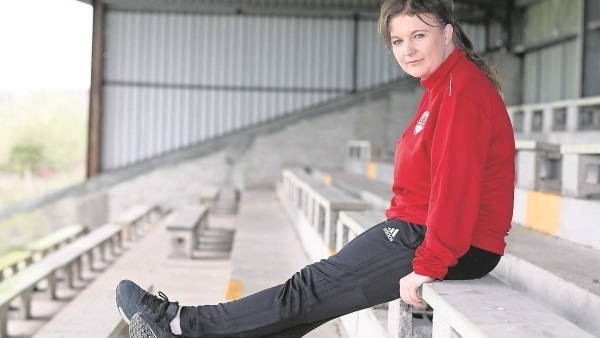
Many will applaud her breakthrough achievements as a woman in a man’s world but Cork City’s Lisa Fallon really wants to be celebrated for her abilities as a coach. “Football is a tough environment for everybody, not just for me."
Many will applaud her breakthrough achievements as a woman in a man’s world but Cork City’s Lisa Fallon really wants to be celebrated for her abilities as a coach. ‘Football is a tough environment for everybody, not just for me.’
For even the most avid devotee of 1980s television nostalgia, The Manageress might not ring too many bells. Starring Cherie Lunghi in the title role, the Channel 4 drama charted the trials, tribulations, and hard-won triumphs of Gabriella Benson, a woman managing a men’s team in English professional football.
But though it ran for only two seasons, from 1989 to 1990, The Manageress made a lasting and, it might be no exaggeration to say, even life-changing impression on one football-obsessed young girl watching enthralled from her home in Dublin.
“I just thought it was amazing,” says Lisa Fallon. “At the time all I knew is that I loved football, just loved it, and I wanted to be involved in the game. But, as a girl, I couldn’t see how because it was all for boys back then.
“They say that ‘if you can’t see it, you can’t be it’. And that programme let me see it. It let me see that the concept of a woman working in football could be achieved. And I really don’t know if I would be where I am now if I hadn’t seen it when I was 12.”
Where Lisa Fallon is now — in fact not fiction — is operating at the highest level of the game in Ireland, as a coach with Cork City in the League of Ireland Premier Division, the only woman to hold such a position in the professional game here.
A holder of football’s highest coaching qualification, the Uefa Pro Licence, her impressive CV also includes working as an opposition analyst with Michael O’Neill’s Northern Ireland when they qualified for Euro 2016, a role she initially carried out for John Caulfield at Cork City before more recently taking on expanded duties as part of the manager’s coaching staff.
Last year, she also got back in touch with her GAA side — having once won Dublin Senior B Camogie Championship honours as a player with Round Towers — when Dubs manager Jim Gavin added her to his backroom team.
But football was her first love and remains her main sporting passion. The 42-year-old was immersed in the game from an early age, thanks to strong family connections with Palmerstown Rangers, a side managed by her grandfather and for whom two of her uncles played.
She played with a boys team up until the age of 10 before graduating to her girls school team at Lucan Community College and, as a midfielder, turning out for clubs like Lucan United and Leixlip United. But, from the very outset, when she wasn’t actually playing the game she was studying it with a precocious attention to detail.
“When I was a kid I used to watch games all the time,” she says. “I still have about 1,500 VHS tapes of matches from the ’80s and ’90s. And I used to watch them over and over again. I just loved how it worked, how units connected on the pitch, how different players could impact on different things. I can’t remember ever not looking at football in that way.”
Happily, her childhood coincided with a time when, internationally, Irish football’s stock was at an unprecedented high, Fallon part of that lucky young generation weaned on the exploits of Jack Charlton’s teams at Euro ’88 and Italia ’90. And because her mother worked in Finnstown House, then the Irish team hotel, Lisa and her sister often found themselves mingling with some of the biggest stars of the day.
It was hilarious,” she recalls. “Niall Quinn and other lads used to get us to run into the kitchen and rob cakes for them. I always remember being in awe of them. In May 1989, the squad was in for World Cup qualifiers against Malta and Hungary and it was that famous night that Liverpool were playing Arsenal for the title, and it was live on television. Frank Stapleton said, ‘we’re going to watch the match so you can watch it with us’.
“I remember going into the room and Tony Cascarino taking off his flip-flops and he had the stinkiest feet ever (laughs). I remember (physio) Mick Byrne coming in with bags of Scots Clan sweets for the lads and the lads going, ‘what about a bag for the kids?’. And all I was thinking was, ‘I didn’t know Scots Clan existed in May, I thought they were just for Christmas’. So there was I was eating my Scots Clan and watching this unbelievable game with the Irish team.”
1989 was also the year in which Fallon made her first foray into sports reporting. On the 2FM show The Breakfast Club, there was a competition for young listeners to submit either a match report or a book review. Or, to be more accurate, a match report if you were a boy and book review if you were a girl. Naturally, Lisa Fallon was having none of that.
“So I rang in and asked if I could do the match report and they were, like, ‘well, yeah, OK, no problem’. So they gave me Ireland v West Germany that September — the game where Jack Charlton substituted Liam Brady before half-time. They also said to me that the game would be on TV but I was, like, ‘no way, I’m going to it’. Because I used to go to all the games with my uncle or my granddad.
“Actually, I remember we’d won the tickets for that game in the Palmerstown Rangers draw and I was devastated because they were for the West Stand. And that’s where all the boring people were. I used to love going to the South Terrace. And because I was small, my uncle Anthony used to buy two cans of Fanta and I’d stand on them so I could see. Anyway, I did the match report for radio and it went really well.”
Little could she know then, of course, that she was laying the early groundwork for a later career move which would, in turn, lead to working full-time in the game to which she remained devoted from childhood into her teens and beyond.
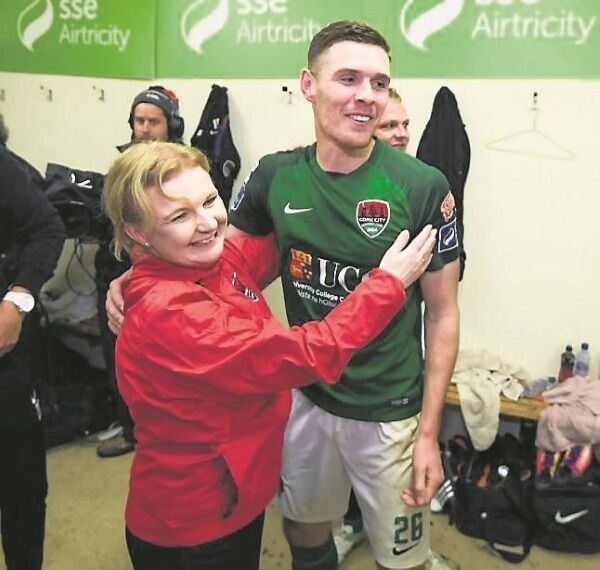
After studying sports science at Canterbury University in England while continuing her playing career with clubs like Sittingbourne, Gillingham, and Southampton — “I was OK but I knew I wasn’t the best player,” she says, “I wasn’t going to take on five or six people and stick one in the top corner” — she returned to Ireland and was working in newspaper advertising when she was recommended to the sports department at 98FM.
The late and legendary Johnny Lyons was running the show back then and, not surprisingly, Lisa will never forget her first close encounter with a force of nature whose twin passions were heavy metal and total football.
“I went to meet him and there he was in the great big leather coat, the big black boots and the Iron Maiden t-shirt,” she grins. “When you hear someone on air, you have this perception of what they look like and Johnny was just a million miles from that. I remember sitting on a chair in the office and I felt like I was on Mastermind — he was just firing questions at me. And then he said: ‘You need to brush up on the Eircom League but, yeah, I think you’re alright’.”
She was told to come in the following Saturday “to be shown the ropes”. But on the appointed day, with the clock ticking towards air time, there was still no sign of Johnny.
“I was ringing him and texting him frantically,” she recalls, “and then, about 10 minutes before the bulletin, I get a phone call from him and he just goes, ‘Sink or swim, baby’. (Laughs) And that was my introduction to radio.”
Fallon makes no secret of the fact that she regarded sports reporting as a fallback career for the one she really wanted to pursue.
I am living my dream as a kid, now,” she reflects. “But for a long time I actually changed my dream because I didn’t think societal norms would accommodate my dream. That was why I became a radio reporter because I couldn’t see any other way to work in football.
In fact, it would be as a result of searching questions she asked about tactics in an interview with Michael O’Neill that the manager would invite her on board at Shamrock Rovers and, later, appoint her as opposition analyst with Northern Ireland. Similarly impressed with her insights, John Caulfield would follow suit at Cork City.
Reflecting on how you get the best out of footballers, she observes: “It’s all about potential. I think great managers and great coaches see potential, not end product. They see not just what’s there, but what you can work with and what you can develop. And, for me, in a funny way, I am where I am today because managers saw potential in me.”
Having long been involved in coaching at grassroots level, in 2013 she became the first woman to manage a senior men’s team in Ireland when taking over at Leinster Senior League side Lakelands FC. Did that feel like she was crossing the Rubicon?
“It didn’t for me, I think it did for other people,” she says. “We had our first game and I remember there was a request in to do interviews before the match. And I was like, ‘when was the last time a Lakelands manager was asked to do interviews before a game?’ And they were, like, ‘never’. And I was, ‘so why now? And the answer was, ‘because you’re a woman’. ‘No chance, forget it’. I just wanted to concentrate on preparing the team. And we won that game. Then, the following week, ‘Herald Striker’ came out to cover our game, which I’m not sure they would have done otherwise. We won the game 2-0 and, in fairness, the article was all about the game. They respected the fact that I was just there as a coach and a manager.”
And that is still the only barometer by which she wants to be judged.
“You get to a point where you’re in the game long enough and people will judge you on your work,” she says. “If you pass your courses, you’ll get your qualifications. At the end of the day, you get to a point where you are where you are because you did your job well.”
But, of course, she is not blind to the reality that some of the issues she encounters in the men’s game are not ones with which her male counterparts have to contend. Hence, holding up a mirror to the whole process, she chose as the subject for her Pro Licence thesis the journey of a female coach doing the pro licence in men’s football.
“Because there was so much I encountered that wasn’t in the manual,” she says. “I used to email Corrine Diacre (now the manager of the French women’s team, in 2014, she became the first woman to coach a men’s professional football team, Clermont Foot, in France) because there weren’t really any women you could think of to chat to about things and say, what would you do in this scenario? And I think it was helpful for both of us. I mean, I have no French and she didn’t have great English but we still managed because football is a universal language, isn’t it?
“You would come up against challenges that the other lads wouldn’t come up against. Some of the stuff you encounter is not acceptable, not a way to be treated. Banter is subjective. What I could find funny mightn’t be funny to someone else. You also have things like stereotypes, unconscious bias, where people don’t know their comments are unacceptable because they might have grown up in a culture where that was normal. At the professional level, it tends to be OK, to be fair. And it’s not that I experienced a whole lot of it, it was isolated stuff here and there. It’s not that it would be the norm. It genuinely isn’t. Generally, if you give a guideline, people will respect it.”
Then there are the practical hurdles to be considered and overcome.
There are no women’s toilets in League of Ireland dressing rooms,” she offers as one example, “so you’d either have to go out and use the fans’ toilets or the lads’ one. Or, if you’ve been out and about during the day, at a meeting maybe, you have to make sure you have no perfume on. Why? Because you just wouldn’t wear perfume in a dressing room. Lads wouldn’t wear aftershave in there. They’re little things but you have to respect the environment you’re in.
“Football is a tough environment, for everybody, not just for me. It’s tough for players, for staff, for everybody. It’s a tough, competitive environment and you have to be resilient. Because, at the end of the day, the dressing room environment is about producing a winning performance. Nothing else matters when you’re in there. It’s about winning your football match.”
Having just begun her sixth season with Cork City, Lisa Fallon’s role at the club — which began as an opposition analyst — continues to evolve, as she works with assistant manager John Cotter and her fellow coach Liam Kearney to provide crucial back-up for manager John Caulfield.
“To be fair to John, he would always have taken my ideas on board and we would always have talked about stuff,” she says. “That would be normal. He kind of gave me my first bit of coaching responsibility in 2016 and gradually that has evolved so you’re doing bits and pieces all the time. I would have done presentations at team meetings and stuff like that.
“This year, am I doing a little bit more on the pitch? I probably am. This year I’m getting to vocalise a little bit more of my stuff whereas in other years I might have given that stuff to John and he would do it.”
The great reward, she says, is seeing something that has been worked on in training paying dividends on the pitch.
“Oh yeah, they’re gold. They’re the moments. But the best feeling really is just seeing the lads win matches. At the same time, when you work in football, you can’t get too high when it’s good and you can’t get too low when it isn’t.
You have to be able to operate in both scenarios, you can’t let either cloud your professionalism. It’s about balance, it’s about being able to enjoy the good days and understand the bad ones. And manage both.
“Listen, when things are good, you can’t beat that feeling. But it’s the pursuit of that feeling that pulls you through the bad days. That’s what you’re constantly striving for. And, as a fan, that’s probably what drove you into the industry in the first place. You don’t become a robot. You couldn’t be in this job unless you genuinely loved it. You feel it every single day, all of it. But, ultimately, it’s really all about the players and the hard work they put in. We’re just there to facilitate them and help them to become better and reach their potential.”
Applying the same sense of rigorous improvement to herself, she is currently close to completing an LMA Diploma In Football Management for which she has been regularly commuting to the English FA’s National Football Centre at St George’s Park.
“It’s quite similar to the Pro Licence in some ways but there are different slants, different perspectives,” she explains. “The lecturers would be experienced managers, people who are currently working in the English game.
“So, for example, instead of talking about how, in football, you have to learn to be prepared for when you get the sack, you’ve actually got people telling you: this is what happened to me. It’s real life.”
Can we take it from all this then, that management is indeed her long-term goal?
“It’s really hard to say,” she replies. “I didn’t really think I’d ever get to where I am now and the reason I am where I am now is because of the opportunities that managers have given me. You’re nothing without an opportunity. I never thought I’d be doing what I’m doing so from that perspective I feel that I’m already in bonus territory. But I do want to know what the extent of my potential is because I don’t think I’ve reached it yet. My personal goal is to try to be better every single day. I owe that to myself but also to the people who’ve given me the chance. I don’t want to get stale.”
Does she feel she has to try harder in part because she is, as the phrase has it, ‘a woman in a man’s game’?
“I don’t look at it like that,” she insists. “My biggest competition is with myself and I want to make sure that tomorrow I’m better and that I can continue to bring new ideas and continue to add value.
And as long as I do that, it should keep me in a job. Because football’s a weird industry. It’s not like you’re working to get a job: you’re working to stay in a job.
“One thing is no-one will ever beat me on work-rate. It’s important not just that I do my job as well as I can but that I get better every single day, that I’ve learned something new that I didn’t know yesterday.
“So, I don’t know where I will go with this but I know what I will be ready for. And that’s whatever comes up. I genuinely love the job I’m doing right now with Cork City. I absolutely love it. Getting up at five o’clock on a Monday morning and putting a tracksuit on to go to work in football — it’s amazing and I really value that. It’s been a long road to get here so it’s not a case that I’m wishing it away for something else because I’m not.
“Some people would see me as being a little bit unique in my field. But when everybody is in it together, you’re all going after the same thing. I fully buy into what John is trying to do here. And it’s something we all love doing.”


CONNECT WITH US TODAY



Be the first to know the latest news and updates