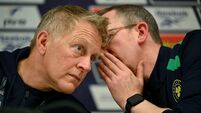
Did O'Leary lose the dressing room?
Less than nine months into his reign at Leeds United David O’Leary had made mentor George Graham look foolish.
Graham had claimed he had taken the team as far as he could after Leeds finished sixth at the end of the 1997-98 season, so when the bright lights of London tugged at his heartstrings, he answered Tottenham’s call.
O’Leary, who had leaned the managerial ropes initially as a player under Graham at Arsenal and then as the Scots’ assistant at Elland Road, was not chairman Peter Ridsdale’s first choice as replacement.
Martin O’Neill with Leicester at the time, was seen as the ideal candidate but contractual problems meant Ridsdale was forced to turn to O’Leary.
At first O’Leary seemed to possess a natural aptitude for life as a high-profile Premiership manager. He had the courage of his convictions and was not afraid to make tough choices when needed.
During Graham’s time in charge, he had resisted blooding a number of the club’s rising young stars like Jonathan Woodgate and Stephen McPhail, but O’Leary threw them in at the deep end and they repaid his faith.
O’Leary, though, wanted his team, not the one Graham had built and although he took his time in doing it, he systematically sold virtually all the players whom his predecessor had brought in.
By the end of that first season in charge, after taking up the reigns following a short spell as caretaker, O’Leary had lifted Leeds to fifth in the Premier League and all the signs appeared optimistic.
The Irishman was slowly but surely changing the profile of a club whose previous image, both on and off the field, had long been tarnished by the reputation they had sullied themselves with in the late 1970s and early 1980s.
But as the personnel changed and O’Leary began to mould the team into what he desired, the players stepped into the spotlight as they played vibrant, exciting, passionate football which was full of flair and vigour.
It was the kind of football which had not been seen at Elland Road since the halcyon days of the early 1970s when Leeds, under the guidance of the legendary Don Revie, ruled the British game.
When they clinched a Champions League place by the summer of 2000 the sky appeared the limit.
O’Leary’s star, and that of his team, was on the rise, in particular across Europe as they confounded their critics - and their big name opponents - with dashing performances which belied their lack of continental experience.
At the same time, Ridsdale was bankrolling O’Leary’s transfer market spending spree which reached its zenith towards the end of 2000 as Leeds shattered the world record for a defender by paying £18m (€28m) to West Ham for Rio Ferdinand.
That was followed soon after with the £13m (€20m) capture of Robbie Keane, albeit with a fee paid in instalments to Inter Milan, but with O’Leary determined to show he was a big spender able to match Alex Ferguson’s Manchester United, Arsenal’s Arsene Wenger and close friend Gerard Houllier at Liverpool.
Leeds continued to march on across Europe, remarkably with Lee Bowyer and Woodgate in the dock at Hull Crown Court as they answered charges of grievous bodily harm with intent and affray.
While Woodgate was unable to handle the effects of the case, Bowyer proved to be the driving force behind Leeds’ run to the semi-finals where they eventually met their match in Spanish side Valencia.
It perhaps signalled the beginning of the end for O’Leary who, in having lavished millions on new players, ultimately failed at the end of the 2000-01 season to again qualify Leeds for the much-needed riches of the Champions League.
The glint in the Irish eyes of O’Leary was now beginning to loose its lustre, and while injuries and the Bowyer-Woodgate retrial undoubtedly took its toll last season, the 43-year-old appeared to be losing his grip.
Players no longer seemed to respond to his commands and rumours began to surface that O’Leary had lost the respect of the dressing room.
Certainly Leeds looked like a spent force as they toiled through what proved to be a torrid campaign, with the fire which had previously burned so brightly now barely a flickering flame both in domestic competition and abroad.
They limped home in fifth place, again outside the coveted Champions League places which would have brought desperately-required funds to help ease a now substantial debt.
Ridsdale, who had for so long adamantly stood beside O’Leary, watching him spend almost £100m (€154m) in the process, must now search for a successor.
Whoever gets the job faces the challenge of restoring the impetus that was lost towards the end of O’Leary’s reign.
CONNECT WITH US TODAY



Be the first to know the latest news and updates