John Delaney ‘absolutely thrilled’ about new Uefa role
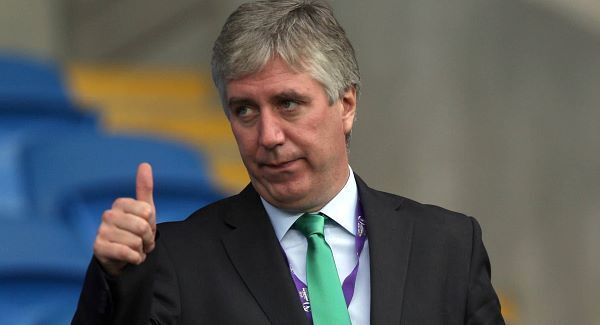
Delaney received the second highest number of votes with 48, two fewer than Sweden’s Karl-Erik Nilsson, as 11 contenders stood for election to fill eight vacancies on European football’s supreme executive body.
The six other successful candidates were former Juventus and Poland star Zbigniew Boniek, former Manchester United chief executive Daivd Gill, German FA president Reinhard Grindel, Italian FA director Michele Uva, Dutch FA president Michael van Praag, and Turkey’s Servet Yardimci.

While the controversy engulfing the FAI over the Irish women’s senior football team continued at home, politicians, sports administrators, and the board of the FAI extended congratulations to the association’s chief executive on his election at Uefa’s Congress in Helsinki where, it also emerged, the FAI — in common with all other national associations in Europe — are set to receive a bonus ‘solidarity payment’ of €1m.
Sports minister Shane Ross, described Delaney’s election as “a hugely positive development for Irish sport and for football, which will now have a significant voice at the decision-making end of the European game”.
Delaney said: “To represent your country in Europe at the highest level in Uefa is something I’m very proud of. I’m very proud to represent Irish football and the grassroots. It’s all really about getting 28 votes. That was the objective because 28 gets you elected. I think when your name is called out second then you’re absolutely thrilled.
“While Ireland may be regarded as one of the smaller footballing nations, we are known for punching above our weight and I look forward to bringing our voice and our views and experiences to the table in Uefa.”
Under limits ratified at yesterday’s Congress, executive committee members can now serve for a maximum of three four-year terms with, as a general rule, the committee meeting once every two months.
Uefa points out that a member of the committee can play no part in deliberations on any matter involving their own member association and/or a club affiliated to their member association or “in any case in which a conflict of interest exists”.
It has been widely reported that Delaney, who commands a salary of €360,000 as FAI chief executive, could earn an additional €100,000 a year in his new role at Uefa, as well as €300 in expenses for days worked — the latter, ironically, the figure which Ireland’s senior international women footballers have been seeking in match fees.
In Helsinki, European football’s assembled chiefs also heard about Uefa’s record turnover of almost €4.6bn in 2015/16 and were told that their federations would be receiving an extra €1m as a one-off “solidarity payment”.
“That’s something that everybody was thrilled about,” Delaney told RTÉ. “When you get an extra €1m of a bonus for each national association, it’s something that everybody in the room you could see was thrilled about.”
In a wide-ranging speech Uefa president Aleksander Ceferin, who was elected last September, restated his intentions to defend the interest of smaller countries and leagues and step up efforts on child protection.