Does Zlatan have too much power?
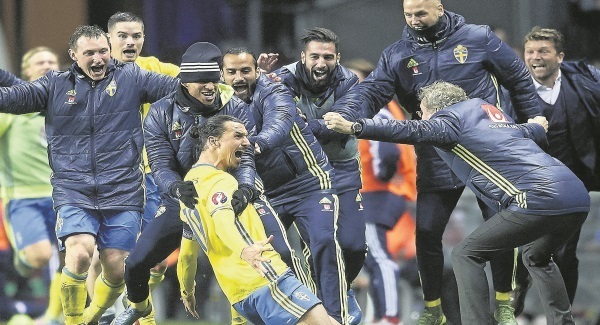
As it happened, Ibrahimovic scored twice in a 2-2 draw, the second a swerving free-kick that Kasper Schmeichel could do nothing about, that sealed their place in France and then said: “They said they were going to send me to retirement. I sent their whole nation into retirement.”
It was typical Ibrahimovic; his goal was a moment of individual brilliance, and his response was funny and egotistical.
This is the man who six weeks ago said he would only stay at Paris Saint-Germain “if they replace the Eiffel Tower with a statue of me”.
Behind the bluster and the moments of brilliance — last week he scored twice for PSG and managed to miss a one-on-one with the Rennes goalkeeper Benoit Costil, because he looked the other way as he struck the ball — remains some serious questions about his influence on the Sweden team that faces Ireland in Paris on June 13.
Although he might play for the Olympic team in Rio this summer, if this is his last major international tournament, how will Sweden cope without him in the future, and what can he consider his legacy after 15 years in the national side?
Legacy first. According to sports writer Arvid Nikka, more players from second-generation immigrant families have broken into the team; the likes of Erkan Zengin and Jimmy Durmaz even grew up in Ibrahimovic’s home town of Malmo.
“Zlatan was criticised at the beginning of his career for his ‘egotistic’ style and lack of humility,” said Nikka.
“Today I would say that young players with a similar attitude and style of play face a much more forgiving reception and are encouraged in this new way to ‘dare’.”
Football commentator Gunnar Persson, who has been covering the game for over 35 years in Sweden, agreed with Nikka but added the caveat that it was not a good thing.
“The rule with Ibrahimovic has always been: ‘What does Zlatan want?’ rather than, ‘How can we use him best?’” said Persson.
“The current coach Erik Hamren brings out the worst in the situation. He has no assistant coach and does not like to argue about or even discuss his team selections.
So Hamren turned to Ibrahimovic for advice. The consequence of this is that the squad has seen very few changes, and rarely for the right reasons. Instead, weak links are picked again and again.”
The idea that Ibrahimovic is a de facto assistant coach is not the only issue that has upset Persson, who is one of the most respected voices on the game in Sweden.
It’s that Ibrahimovic makes up his tactics as he goes along and has encouraged an obsession with individualism among his team-mates.
“Ibrahimovic will be 35 this year but still has not developed a tactical understanding of the game,” Persson said.
“One of the problems with him playing for Sweden is that nobody ever knows how he will play.
“Sometimes he is a big target player, sometimes he drops back to collect the ball and then, a couple of moves later, he realises he has nobody to pass the ball to but himself.
“His dominance on football in Sweden has had an interesting impact on the next generation of players and coaches,” he continued.
“There is now an unfortunate emphasis on individual skills while positional sense, covering for teammates is a lost art.
“Senior team coaches now deal with a supply of young players who are basically ball-jugglers, narcissistic in their approach to the game and alien to basic concepts of teamwork.
“Like Ibrahimovic, Zengin and Durmaz … regard the ball as a private possession… and traditional strengths like defensive teamwork and organisation have suffered.” There is talent coming through the Swedish ranks.
The U21s won the European Championships last summer while the U17s came third in the 2013 World Cup.
It will be up to Hamren’s successor Jan Andersson, who was the coach of surprise league champions IFK Norrkoping last year, to build a team combining these new generations of players.
One thing he has promised to do is appoint an assistant coach, which is surely a step in the right direction.
Whatever happens in France, and wherever Ibrahimovic ends up once he leaves Paris this summer, there will be an inevitable clamour for him to stay with the national team. But Persson has some advice for the new man in charge.
“If he wants to create a clean slate, then he must do so without Ibrahimovic in the squad,” he said. “That will lead to a healthier mental climate in the group.”
CONNECT WITH US TODAY



Be the first to know the latest news and updates